


If you want to get good at bidding on construction jobs, you have to nail one thing above all else: your prep work. Seriously, what you do before you even start thinking about numbers is what will make or break your bid. It’s a common misconception that winning is all about being the cheapest. The best, most objective way to win comes from submitting the smartest, most buttoned-down bid that shows the client you've covered all the angles and minimized risk—for both of you.
Building the Foundation for a Winning Bid
Before you even open a spreadsheet, the real work begins. The most successful contractors I know, especially in competitive markets like Toronto and the GTA, get their edge during this initial diligence phase. Cutting corners here is a surefire way to land a low-profit nightmare or, just as bad, get your proposal tossed in the bin. This isn't about ticking boxes; it's about gathering strategic intelligence.
This first stage truly sets the tone for the entire project. You have to look past the blueprints and understand the real-world context of the job. For anyone just starting out, getting this right is non-negotiable. In fact, these same habits of meticulous planning are just as critical when you're figuring out https://socaservicespainting.com/how-to-start-painting-business/ and want to build a solid reputation from your very first project.
Dissecting the Bid Documents
Your first job is to become an absolute expert on every piece of paper you’ve been given. Don’t just skim the plans and specs—take them apart, piece by piece. Your goal is to sniff out potential risks, hidden costs, and unique opportunities that your less thorough competitors are going to miss completely. This objective, structured approach is your best first step.
Keep an eye out for things like:
- Vague or Conflicting Information: If the scope of work feels ambiguous, that's a massive red flag.
- Specialized Material Requirements: Make a note of any non-standard materials or items with long lead times. These can wreck your schedule and budget if you're not prepared.
- Subcontractor Dependencies: Pinpoint exactly which parts of the job will need specialized trades. Do you have reliable partners ready to go?
A deep dive into the documents allows you to ask sharp, intelligent questions later. It’s one of the first ways you can show a potential client that you’re a true professional who's already thinking three steps ahead.
The Critical On-Site Assessment
I’ll say this plainly: never, ever bid on a job without putting your boots on the ground. This is especially true in dense urban areas like Mississauga or downtown Toronto. A site visit tells you a story that no document ever can. You’re there to assess the real-world logistics—things like site access, where you can (or can't) store materials, and how your work might disrupt the neighbours. All of these carry very real costs for any contractor near me.
Before submitting any bid, a thorough review of the job's specifics is essential. This checklist helps ensure you've covered the crucial initial details, particularly for projects within the Greater Toronto Area where site conditions can vary dramatically.
Initial Bid Review Checklist
| Checklist Item | Key Considerations for GTA Projects | Status (Complete/In Progress) |
|---|---|---|
| Full Document Review | Have all architectural, structural, and MEP drawings been cross-referenced? Any discrepancies noted? | |
| Site Access & Logistics | How will crews and materials get in/out? Is there laneway access? Any road closure permits needed from the City of Toronto? | |
| Material Staging Area | Is there a secure, designated space on-site? Or will off-site storage be required? | |
| Neighbourhood Impact | Are there noise by-laws or specific work-hour restrictions (e.g., in a residential condo)? | |
| Parking & Traffic | What's the parking situation for your crew and subs? Will local traffic patterns affect deliveries? | |
| Site-Specific Hazards | Any visible signs of environmental issues, overhead wires, or unstable adjacent structures? |
Running through a list like this turns assumptions into facts, which is the bedrock of a confident and competitive bid.
A winning bid is built on certainty. The more unknowns you can eliminate through careful site visits and document analysis, the more accurate and competitive your pricing will be. It’s about replacing assumptions with facts.
During your visit, you're looking for those practical challenges. Think about parking availability, local traffic snarls, and any municipal quirks that could mess with your schedule. For instance, a renovation in a busy commercial district might have ridiculously strict limits on work hours, which will absolutely affect your labour costs.
This on-the-ground knowledge is what separates a decent bid from a winning one. To really level up, it's worth exploring broader strategies for winning more contracts that build on this foundational research.
Mastering Accurate Cost Estimation and Takeoffs
Once you've done your homework on the project, it's time to get down to the brass tacks: building a rock-solid cost estimate. This is where the job is truly won or lost. Come in too high, and you're out of the running. Too low, and you're working for free or, worse, losing money. It’s a delicate balance, and getting it right comes down to meticulous detail.
Think of your estimate as the project's financial blueprint. Every single number needs to be defensible, backed by thorough material takeoffs, realistic labour projections, and solid quotes from your trades.
Nailing Your Material Takeoffs
Your direct costs all start with a detailed material takeoff. I’m not just talking about counting the big-ticket items. You have to account for everything, right down to the last box of screws, tube of caulking, and roll of tape. A small oversight on a large job can easily balloon into thousands of dollars of unbudgeted expenses.
This means poring over the plans and specs, creating a comprehensive list of every single material required. For a specialized trade like painting, this goes far beyond just the cans of paint. You can see just how detailed it gets by looking at the true cost to paint a room, which accounts for things like surface prep materials, primers, and various paint finishes that clients often overlook.
Estimating Labour in a Competitive Market
Labour is almost always the biggest and most volatile line item on any bid, especially in a high-demand market like the Greater Toronto Area (GTA). You can't just multiply hours by a wage rate and call it a day. A truly accurate labour estimate has to factor in the realities of the job site.
You need to consider:
- Productivity Rates: How long does it actually take your crew to frame a wall or hang a door? This knowledge comes from experience and tracking data from past jobs, not guesswork.
- Skill Levels: A master carpenter costs more than a green apprentice for a reason. You need to assign the right skill level—and cost—to each task to be both competitive and realistic.
- Site Conditions: Working on a tight, cluttered site in downtown Toronto is a world away from an open, new-build site in Mississauga. Access, logistics, and other trades getting in the way all impact your team's efficiency and need to be built into your numbers.
Your labour estimate is a direct reflection of how well you understand the project and your crew's capabilities. It's the single biggest place to gain an edge or make a catastrophic financial mistake.
This infographic breaks down the essential first steps for gathering the data you need to build that precise estimate.
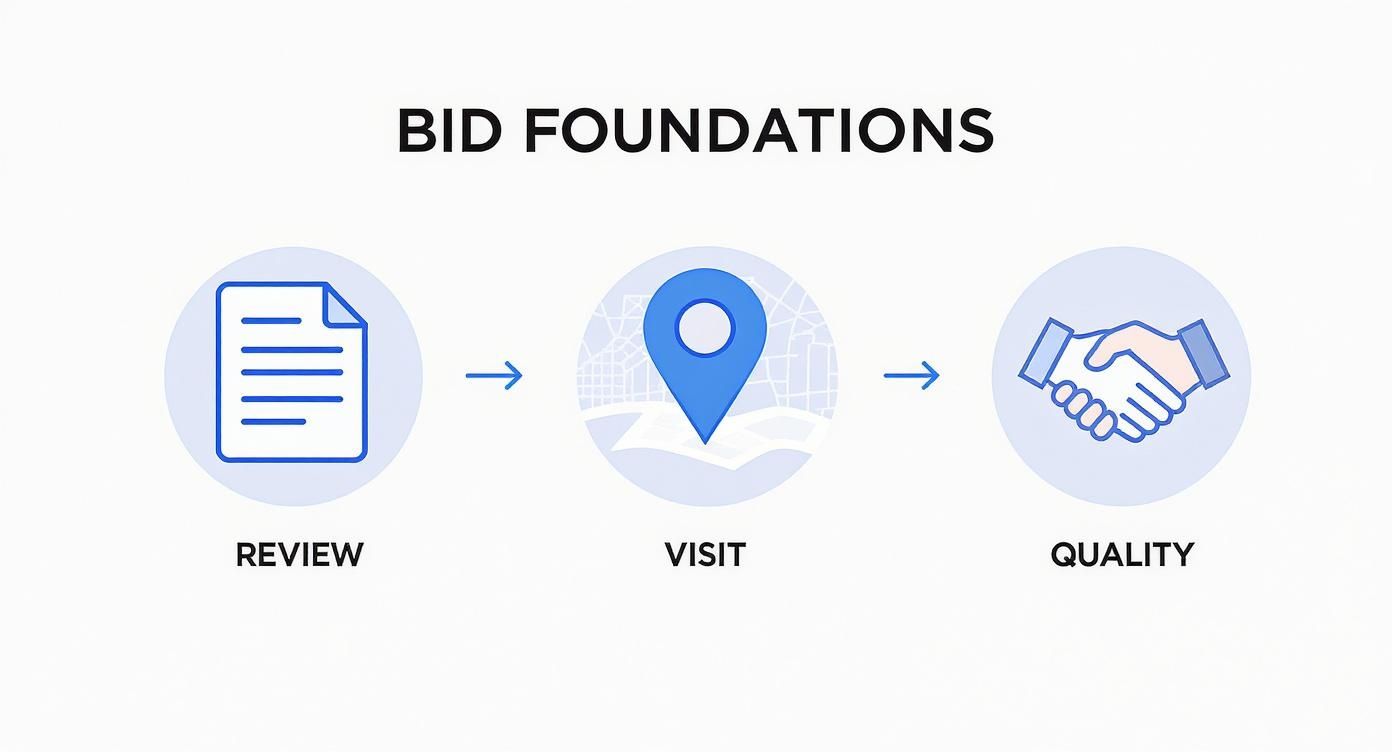
This simple workflow—Review, Visit, Qualify—is your foundation. It ensures every estimate is built on verified information, not just assumptions from behind a desk.
Securing Reliable Subcontractor and Supplier Quotes
Unless you're a one-person show, your bid will lean heavily on quotes from your subs and suppliers. Honestly, building strong relationships with reliable partners is one of the best things you can do in this business. It’s how you get competitive and timely pricing when you need it. Just be sure to give them the exact same detailed info you're working from so there are no surprises later.
As a rule of thumb, always try to get at least three quotes for any major trade or material supply. This lets you benchmark the cost and easily spot an outlier that’s way too high or suspiciously low.
It’s also crucial to know the rules of the game you're playing. Bidding regulations can have a huge impact on your costs and process. For example, in California public works, K-12 school projects have a formal bid threshold of $15,000, while a different act sets an informal limit near $220,000. You can read more about these public bidding regulations on content.acsa.org. Knowing these numbers is essential for staying compliant and competitive.
By carefully assembling all these precise costs, you create a transparent and accurate foundation for a bid that not only wins the job but also makes you money.
Getting Your Head Around Overhead and Profit
Once you have a firm grip on your direct costs—the materials, labour, and sub-trades—it’s time to look at the bigger picture. A successful bid does more than just pay for the job at hand; it needs to fuel your entire business. This is where your overhead and profit margin come in, and getting them right is crucial for survival and growth.
Too many contractors, especially when they're starting out, just guess at these numbers. They'll throw a flat percentage on top of every estimate and hope for the best. That's a risky game. You can easily underbid a complex project and lose money, or overbid a simple one and lose the job. You have to know your numbers, plain and simple.
Factoring in Your Overhead Costs
Overhead costs are all the things you pay for just to keep the lights on, whether your crews are working or not. Think of them as the cost of doing business. These indirect costs have to be covered by the jobs you win.
This includes expenses like:
- Rent for your office or shop.
- Insurance and WSIB premiums.
- Salaries for your office staff—the people who aren't on the tools.
- Utilities, phone bills, and subscriptions to software.
- Vehicle costs, from fuel and insurance to maintenance.
To figure out how to apply this to an estimate, you first need to know your total annual overhead. Add it all up. Then, divide that number by your total projected sales for the year.
For example, if your annual overhead comes to $100,000 and you plan to do $1,000,000 in sales, your overhead percentage is 10%. You have to add that 10% to the direct cost of every single job just to break even.
Setting a Smart Profit Margin
Profit isn't the money that's left over by luck; it's a critical part of your business plan. It’s what allows you to buy new equipment, hire more people, and build a cash reserve for the slow times. While slapping a standard 15% on everything might seem easy, the most successful contractors are much more strategic.
Your profit margin should be flexible, adjusted based on a few key factors:
- Risk and Complexity: A straightforward job doesn't carry the same risk as a complex, custom renovation in downtown Toronto with logistical nightmares. Your margin should reflect that. Higher risk demands a higher reward.
- How Busy You Are: If your schedule is packed for the next six months, you can afford to bid with a healthier margin. If you’re trying to fill a gap and keep your team busy, you might tighten that margin to be more competitive.
- The Client: For a new client, you might stick to your standard margin. But for a great repeat customer, you might offer slightly better pricing to show you value the long-term relationship.
Profit is your reward for taking the risk. It’s not an afterthought. You need to strategically decide on a margin that fits the project’s specific challenges and aligns with your company’s goals.
Different types of work call for different pricing strategies. For instance, putting together residential house painting quotes in Toronto involves a different markup approach than a large commercial contract. The goal is always to find that sweet spot—staying competitive in the GTA market while making sure every job is truly profitable.
Crafting a Professional Bid That Actually Wins Jobs
Let's be blunt: your numbers can be spot-on, but if you present them in a sloppy, confusing document, you're not getting the job. Your bid proposal is so much more than a price tag. Think of it as your first handshake, your main sales pitch, and your best chance to prove you’re the right person for the work. It has to be clear, thorough, and ultimately, persuasive enough to convince the client you’re their best and safest choice.
This document is where you show you’ve actually listened. It's your opportunity to demonstrate that you understand the client's vision and have a rock-solid, structured plan to bring it to life. Every single element, from the cover letter to the cost breakdown, needs to work together to build trust and show why you're a better choice than the other guys who just scribbled a number on a piece of paper.

What Every Winning Bid Package Must Include
A truly professional bid is a well-organized package that anticipates and answers every question a client could possibly have. If you leave out key information, you're forcing the client to make assumptions—and that’s a risk most aren’t willing to take. This clear structure is key.
Your bid package should always contain:
- A Compelling Cover Letter: This is where you connect personally. Show the client you get what they need and briefly explain what makes you the perfect fit.
- A Detailed Scope of Work: Clearly outline what’s included in your price. Just as importantly, spell out what isn't included. This simple step can save you from massive headaches and scope creep down the road.
- A Transparent Cost Breakdown: Don't just give a total. Break down the costs into logical groups like materials, labour, subcontractors, and your overhead and profit. This level of transparency is a huge trust-builder.
- Project Schedule & Key Milestones: Lay out a realistic timeline. It shows the client you’ve actually thought through the project's flow from day one to final walkthrough.
- Proof of Insurance and Licensing: Always include current copies of your WSIB clearance certificate and liability insurance. This is a non-negotiable sign of a professional operation.
This comprehensive approach is crucial, especially as project values climb in competitive markets. For instance, an analysis of the San Diego market revealed that construction contract values shot up by 157.9% between 2017 and 2025. This shows how in any major city, a thorough, professional proposal is non-negotiable for landing those high-value contracts. You can dig into these construction bid environment findings on sandiego.gov to see the data for yourself.
Writing a Cover Letter That Gets You Noticed
Your cover letter is your opening move. Don't waste it by just restating the project name and your bid total. This is your chance to tell a quick story and connect directly with what the client cares about most, whether that’s hitting a tight deadline, staying on budget, or achieving a certain level of quality.
Your cover letter shouldn’t just state your price. It should sell your value. Pinpoint the client’s biggest concerns and explain exactly how your company is the ideal solution.
Show them you’ve done your homework. Did you notice a specific challenge during the site visit? Mention it, and briefly explain how you'd tackle it. That personal touch proves you’re genuinely engaged and have the expertise to back it up.
This level of detail is a valuable skill, whether you're bidding on large-scale builds or looking into specialized painting jobs in Toronto, Ontario. When you put together a polished, detailed, and persuasive proposal, you make it incredibly easy for the client to say "yes."
Submitting Your Bid and Managing Follow-Up
You've poured hours into getting the estimate right and polishing your proposal. Now comes the moment of truth: submitting the bid and following up. It’s tempting to rush this final step, but a simple mistake here can undo all that hard work. A missed signature or a clerical error could get your bid tossed out before it's even read.
Before you hit 'send' or drop that envelope in the mail, take a breath. This is your last chance for a final check. Better yet, have a fresh pair of eyes look over everything. Did you include all the requested addenda? Is every form signed? Do the final numbers on the proposal match your detailed estimate? It’s these small details that show you’re a pro.

The Art of Professional Follow-Up
Once your bid is submitted, the waiting game begins—but that doesn't mean you should sit on your hands. This is where you shift from estimating to engaging, a critical part of applying strategies to convert leads into customers effectively. The goal is to stay on their radar without becoming a nuisance.
A few days after the submission deadline, a quick, polite email to confirm they received your package is a smart move. It’s a simple touch that keeps your name fresh in their minds and opens the door for any questions they might have right away.
"Just wanted to confirm you received our proposal for the [Project Name]. We're excited about the opportunity and confident we can deliver outstanding results. Please don't hesitate to reach out if you need any clarification. We look forward to hearing from you."
This kind of brief, professional note shows you're organized and eager, not desperate. If a week or two goes by without a word, a polite phone call to check in on their review timeline is perfectly acceptable. You're positioning yourself as a helpful resource, not a high-pressure salesperson.
Learning from Every Bid, Win or Lose
No matter the outcome, every bid you submit is a learning opportunity. If you land the job, great—now the real work begins. But if you don't, your work isn't done yet.
Don't be afraid to politely ask for feedback. Was your price out of line with the competition? Was a part of your proposal not as strong as the winning bidder's? This information is gold for refining your approach on the next job, whether it's in Mississauga, downtown Toronto, or anywhere else in the GTA.
Understanding the market is key, especially when major investments heat up the competition. Think about it: California’s construction industry is projected to grow by 6.5% in 2025, driven by over $53 billion in federal infrastructure funding. That kind of money brings a flood of opportunity, but also a surge in competition. This cycle of bidding, learning, and refining is what separates the top contractors from everyone else.
Common Questions About Bidding on Construction Jobs
Even the most seasoned contractors run into questions when bidding on construction jobs. The industry has its own rhythm and unspoken rules, and figuring them out can be a challenge, especially in a competitive market like Toronto or Mississauga.
Let's dive into a few of the questions I hear most often from other contractors.
One of the first puzzles is just figuring out where the good jobs are hiding. It used to be all about who you knew. Now, specialized bid sites are where a lot of the action is, but that doesn't mean you should go after every project you see.
The biggest mistake I see is contractors trying to bid on everything. The best in the business are picky. They zero in on projects that are a perfect fit for their crew, their schedule, and where they want their company to be in five years. Winning isn't about volume; it's about winning the right jobs.
This selective approach means you’re investing your bidding efforts where they’ll actually pay off, keeping your team profitable, not just busy.
Should I Bid on Jobs I Might Not Win?
It’s easy to fall into the trap of only bidding on what feels like a sure thing. But sometimes, there's real value in throwing your hat in the ring for a long shot. I call it "bidding for practice." It keeps your estimating skills from getting rusty and, just as importantly, it gets your company's name on the radar of new clients and general contractors.
Think about it from a few angles:
- You're gathering intel. When you submit a bid, you have a legitimate reason to follow up and ask for feedback. You might find out your price was just a hair off or that the winner offered an alternative you hadn't even thought of. That’s valuable market research.
- You're building relationships. A sharp, professional bid makes a good impression, even if you don't land the project. That good impression can turn into an invitation to bid on the next job.
- You're sharpening your own process. Every bid you put together makes the next one a little easier, a little faster, and a whole lot more accurate. You're constantly fine-tuning your own system.
What Is a Bid Bond and When Do I Need One?
A bid bond is basically an insurance policy for the project owner. It’s your guarantee that if you’re the winning bidder, you’ll actually sign the contract and secure the necessary performance bonds to get the work done. For an owner, it's a way to filter out contractors who aren't serious or don't have the financial footing for a big project.
You'll run into bid bond requirements most often on large public works jobs or major commercial projects across the GTA. The bid documents will always spell it out clearly if a bond is needed, typically for 5-10% of your total bid amount. If you miss this, your bid is dead on arrival—no exceptions.
This is where a deep understanding of your costs becomes critical. For instance, knowing how much painting costs per square foot can help you quickly decide if a large, bonded project is even worth pursuing for your team.
Ready to transform your property with a flawless finish? The expert team at Soca Services Painting delivers exceptional quality and professional service for every project in the Toronto area. Visit us to get your free estimate today at https://www.socaservicespainting.com.




One Comment