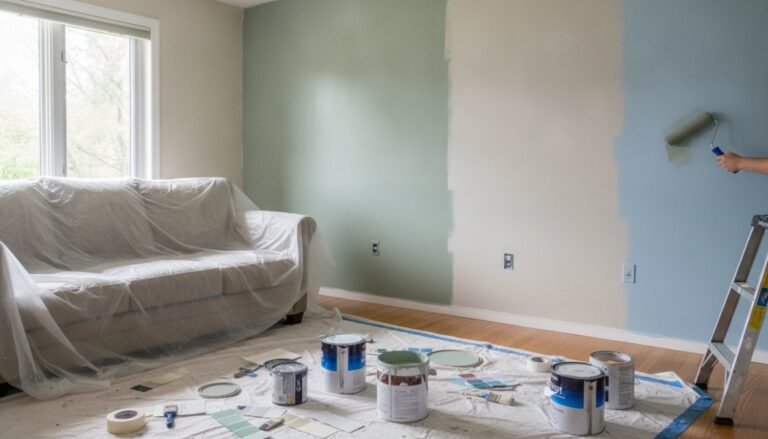
A full-home interior repaint in the Toronto area typically costs between $3,000 and $15,000+ CAD plus HST, depending on your home’s square footage, the scope of work, and the condition of your walls. That’s a wide range — so this guide breaks it down the way a contractor would: by house size, by what’s actually being painted, and by the factors that move the number up or down.
If you’re planning a room-by-room refresh rather than a full repaint, our guide to how much interior painting costs in Toronto covers per-room pricing in more detail. This post is specifically for homeowners tackling the whole home at once — the most efficient and cost-effective way to do it.
Cost to Paint a Whole House Interior by Size (Toronto)
The most reliable starting point for any painting budget is square footage. In the GTA, interior painting costs typically land between $2.00 and $3.00 CAD per square foot for walls only, jumping to roughly $4.70 per square foot or higher when you include ceilings, trim, and doors. Labour makes up the lion’s share — usually 70–80% of your total bill, with materials covering the rest.
Here’s how that translates across the three most common Toronto home types. All prices are before 13% HST and assume two coats of quality paint on move-in-ready walls.
| Home Type | Floor Area | Walls Only | Walls + Trim + Ceilings | Typical # of Rooms |
|---|---|---|---|---|
| Downtown condo / apartment | ~1,000 sq ft | $2,500 – $4,000 | $4,500 – $7,000 | 4–6 rooms |
| Semi-detached (2 storeys) | ~1,500 sq ft | $3,750 – $5,500 | $7,000 – $10,000 | 6–9 rooms |
| Detached house (2 storeys) | ~2,500 sq ft | $6,000 – $9,000 | $11,000 – $15,000+ | 9–14 rooms |
Note: “Rooms” includes bedrooms, living/dining, kitchen, bathrooms, hallways, and closets. Prices are in CAD before HST. Older homes, high ceilings, or significant wall repairs will push toward or beyond the upper range.
A few things worth noting about each home type in the Toronto market:
1,000 sq ft Condo
Condos look simple on paper but often come with hidden complexity. Ceilings are frequently 9 feet or higher. Many downtown buildings have strict elevator booking windows and noise bylaws that limit the crew’s working hours, which drives labour time up. Budget closer to the top of the “walls + trim + ceilings” range if your condo has smooth ceilings and a lot of built-in cabinetry or millwork to cut around.
1,500 sq ft Semi-Detached
This is the most common Toronto home type — a two-storey semi with a narrow staircase, a combined living/dining area, and three to four bedrooms upstairs. Stairwells add meaningful cost because they require ladders or scaffolding and careful cutting in across multiple angles. If your semi was built before 1980, expect plaster walls, which may need more prep than standard drywall.
2,500 sq ft Detached House
Larger detached homes in areas like North York, Etobicoke, or Scarborough often have high-volume main floors with open-concept layouts, two-storey foyers, and more trim detail throughout. A large two-storey foyer alone can cost $3,000–$4,000 CAD to paint properly. A full repaint with all trim and ceilings can “easily top $15,000 CAD plus HST” once all surfaces are included. Get a line-item quote, not just a lump sum.
What’s Included: Walls, Trim, Ceilings, and Prep
The single biggest pricing variable in a whole-home repaint is scope — specifically, whether you’re painting walls only or the full interior envelope. The difference between these two scopes can nearly double your quote.
Walls Only
Painting walls only means rolling out the four walls of each room, cutting in at the ceiling and baseboard lines, and skipping the trim entirely. It’s the most affordable scope and works well for a quick refresh where the trim is already in good condition. Per-square-foot pricing for walls only typically runs $2.50–$3.50 CAD plus HST in the GTA.
Adding Trim and Doors
Trim work — baseboards, door casings, window frames, and doors themselves — is labour-intensive brushwork. A painter can roll a wall quickly; cutting a clean line along a baseboard takes significantly more time per linear foot. For a standard Toronto home, painting all interior trim and doors typically adds $700–$1,200 CAD plus HST. Ornate Victorian crown moulding or wide baseboard profiles common in older Annex or Rosedale homes can push that number considerably higher.
Adding Ceilings
Ceiling painting for a typical 1,500 sq ft Toronto home adds roughly $1,000–$1,200 CAD plus HST. Popcorn ceilings add another $300–$400 on top of that — they absorb more paint and require a slower application to avoid pulling texture. Smooth ceilings that have been skim-coated are actually faster and cheaper to paint than textured ones.
Closets
Standard closets add $75–$125 each. Walk-in closets with shelving systems run $200–$500 depending on their configuration. Most painters will include closets in a full-home quote automatically — just make sure they’re called out on the estimate so there’s no confusion.
What’s Always Included in a Proper Quote
A professional quote should include surface preparation as a line item, not as an afterthought. This means filling nail holes and drywall dents, sanding smooth, spot-priming repairs, caulking gaps around trim, and masking floors, fixtures, and hardware. Prep isn’t an add-on — it’s what separates a paint job that looks great for a decade from one that starts peeling in two years.
Factors That Drive Your Interior Painting Cost Higher
The price ranges in the table above assume reasonably good wall conditions, standard 8-foot ceilings, and a single-colour scheme. Here’s what pushes the actual quote above those numbers.
Ceiling Height
Standard 8-foot ceilings are the pricing baseline. Nine-foot ceilings are common in newer Toronto builds and add a moderate amount of wall area. Vaulted ceilings, two-storey great rooms, or foyers with 16-foot ceilings require taller ladders, scaffolding, and more careful safety staging. High ceiling work can increase labour costs by 20–40% or more for those specific areas.
Wall Condition and Prep Needs
Walls with significant damage — large cracks, water stains, holes from removed fixtures, or layers of old gloss paint — require more prep time before a brush touches them. If your walls need extensive repairs, such as plaster patching or drywall skim-coating, this can add 20–30% to your total project cost. Many older Toronto homes built before the 1970s have plaster walls rather than drywall, which are more brittle and require specialist patching techniques.
Colour Changes
Going from a dark colour to white, or painting a bold accent wall, typically requires a third coat to achieve even coverage. Dramatic colour changes like dark navy or deep red can need three to four coats. Each additional coat adds both material and time. If you’re repainting from a builder beige to a consistent neutral throughout the whole home, you’re usually looking at two coats — the efficient scenario painters prefer.
Number of Colours
A single-colour whole-home repaint is the most efficient job to schedule and execute. Every time the colour changes — between rooms, or for an accent wall — the crew has to mask, clean equipment, and carefully cut new lines. Multiple colours can add $50–$100 per additional colour to the overall quote and slow the project down.
Furniture and Occupancy
An empty home (post-move or pre-occupancy) is the fastest and cleanest painting scenario. When the home is fully furnished, painters work around furniture, cover it with plastic sheeting, and need to move items from room to room as they progress. This adds hours over the course of a whole-home project. If possible, clearing the room completely before painters arrive gives the cleanest access and the best results.
Older Homes with Complex Trim
Toronto’s older housing stock — Victorian semis in the Annex, wartime bungalows in Etobicoke, or century homes in the Beach — often has ornate crown moulding, wide multi-profile baseboards, and detailed door casings. This kind of detailed trim work can double the labour cost for a given room compared to a newer home with simple square-edge profiles.
For a deeper look at what drives per-square-foot pricing across different GTA neighborhoods, see our guide to painting cost per square foot in Canada.
How Long Does a Full-Home Interior Paint Job Take?
For a typical detached Toronto home around 2,000 sq ft, a professional crew painting walls, ceilings, and trim will take approximately 3–5 days. Larger or more complex projects — heavy prep, multiple colours, detailed moulding — can run 5–10 days or more.
Here’s a realistic timeline breakdown by home size, based on a standard two-person crew:
| Home Type | Walls Only | Walls + Trim + Ceilings | Notes |
|---|---|---|---|
| 1,000 sq ft condo | 1–2 days | 2–4 days | Building elevator access can add time |
| 1,500 sq ft semi-detached | 2–3 days | 4–6 days | Stairwells add significant time |
| 2,500 sq ft detached | 3–5 days | 6–10 days | High ceilings or plaster walls add days |
A few things that affect these timelines:
Crew size matters. A solo painter might take a full week to do what a skilled two- or three-person crew finishes in two days. Ask your painter how many people will be on site.
Drying time between coats. Latex paint typically needs 2–4 hours between coats. Experienced crews sequence rooms so one area dries while another gets first-coated — but you can’t rush chemistry. Add 1–2 extra days if your home needs heavy prep like plaster repair or skim-coating.
Winter is actually a great time to repaint. January through March is peak season for interior painting in Toronto — exterior work is on hold, crews are available, and indoor humidity is low, which means paint dries faster and more evenly. Book 2–4 weeks ahead during these months.
Choosing Paint Quality: Where to Spend and Where to Save
Paint materials typically account for just 10–20% of a professional painting quote — the bulk of your budget goes to labour. That said, the paint grade you choose affects both how the job looks and how long it lasts. Here’s how to think about it room by room.
Spend More On: High-Traffic and High-Moisture Areas
Hallways, kids’ bedrooms, and mudrooms are scrubbed regularly. Premium paints like Benjamin Moore Regal Select or Sherwin-Williams Emerald hold up to washing far better than budget lines, and they touch up cleanly — meaning you don’t need to repaint an entire wall to fix a scuff. Bathrooms and kitchens need moisture-resistant formulations; Benjamin Moore Aura Bath & Spa or equivalent mould-resistant products are worth the upgrade in these rooms.
Save On: Low-Traffic Bedrooms and Guest Rooms
A spare bedroom or home office that gets minimal use is a reasonable place to use a mid-grade paint. Benjamin Moore’s Ben line or Sherwin-Williams SuperPaint delivers solid coverage at a lower price point than their premium tiers. The finish quality will be good; it just won’t handle repeated scrubbing as well.
Don’t Skimp On: Trim and Doors
Trim takes the most physical contact in a home — fingers on door frames, shoes on baseboards, furniture brushing against casings. Use a hard-curing waterborne enamel on all trim and doors. This finish is tougher than standard wall paint, resists dents and chips, and can be wiped down without dulling. It costs a bit more per litre but the durability difference over five years is significant.
Finish Guide by Room
| Room / Surface | Recommended Finish | Why |
|---|---|---|
| Living room, bedroom walls | Eggshell or matte | Hides imperfections, low glare |
| Kitchen & bathroom walls | Satin or semi-gloss | Moisture-resistant, washable |
| All trim & doors | Semi-gloss or waterborne enamel | Hard-wearing, easy to clean |
| Ceilings | Flat / ceiling-specific paint | No glare, hides brush lines |
| Hallways & kids’ rooms | Satin or scuff-resistant | Stands up to daily cleaning |
If you’re comparing paint brands for your GTA project, our Benjamin Moore vs. Sherwin-Williams breakdown covers the key differences in quality, coverage, and price so you can make an informed choice before your quote conversation.
Getting Quotes: What Toronto Painters Will Ask You
When you call a painter for a whole-home quote, you’ll get a more accurate number — faster — if you can answer these questions upfront. Painters aren’t trying to trip you up; these details genuinely change the scope of the work.
What’s the square footage of your home?
Floor square footage is the starting point. You don’t need to calculate wall area — your painter will do that on a walkthrough. But knowing your home is roughly 1,400 sq ft or 2,200 sq ft helps them show up with the right expectation. Check your property listing or MPAC assessment if you’re not sure.
What scope of work are you considering?
Walls only, or the full envelope? Are ceilings being repainted? Are you including all interior doors? Clarifying this before the walkthrough helps the painter provide a quote with proper line items — not a single number that leaves you guessing what’s covered.
What’s the current condition of the walls?
Be honest about holes, cracks, water stains, or existing texture. If your walls need significant repair, it’s better to know upfront than to discover it as a surprise add-on once the job has started. A painter doing a proper walkthrough will identify these anyway — telling them in advance builds trust and speeds up the quote.
What colours are you considering?
A full-home repaint going from one neutral to another neutral is the most straightforward and cost-effective scenario. If you’re switching from dark to light colours, planning multiple accent walls, or haven’t chosen colours yet, mention that — it affects the number of coats and the quote.
Is the home occupied or empty?
Painting an empty home (between possession and move-in, for example) is faster and cheaper than working around furniture and a family’s daily schedule. If it’s occupied, painters need to sequence rooms around your life, which extends the timeline and may affect the price.
For a room-by-room look at what individual spaces cost — useful if you’re phasing your repaint over time — see our guide to the real cost to paint a room in Toronto.
Get a Free In-Home Estimate
At Soca Services Painting, we’ve been helping Toronto and GTA homeowners plan whole-home repaints for over 10 years. We know that a ballpark number only gets you so far — the real confidence comes from a detailed, line-item quote after someone has actually walked through your space.
We serve homeowners across Toronto, Mississauga, Etobicoke, North York, Scarborough, and the surrounding GTA. Our estimates are free, transparent, and broken down by scope so you know exactly what you’re paying for — walls, ceilings, trim, prep, and paint brand all called out separately.
Ready to get a real number for your home? Contact Soca Services Painting to schedule a free in-home estimate. No pressure, no vague guesses — just a clear plan and an honest price for the project you’re actually planning.
Frequently Asked Questions
How much does it cost to paint a whole house interior in Toronto?
A whole-home interior repaint in Toronto typically costs between $3,000 and $15,000+ CAD plus HST, depending on the size of your home, the scope of work (walls only vs. walls plus trim and ceilings), and the condition of your walls. A 1,000 sq ft condo might run $4,500–$7,000 for a full repaint, while a 2,500 sq ft detached home can range from $11,000–$15,000+ for a complete job including all trim and ceilings.
What is the cost per square foot to paint interior walls in Toronto?
In the GTA, interior painting costs typically fall between $2.00 and $3.00 CAD per square foot for walls only, and can climb to $4.70 per square foot or more when you include ceilings, trim, and doors. All prices are before 13% HST.
How long does it take to paint a whole house interior?
For a typical 2,000 sq ft Toronto home, a two-person professional crew will take approximately 3–5 days to paint walls only, and 6–10 days for a full repaint including trim and ceilings. Larger homes, significant prep work, or complex trim detail can extend this timeline.
Does painting trim and ceilings significantly increase the cost?
Yes. Adding trim and doors to a walls-only quote typically adds $700–$1,200 CAD plus HST for a standard Toronto home. Ceilings add another $1,000–$1,200 plus HST. Bundling all three into a whole-home project is more cost-effective than pricing them separately.
What factors increase the cost of a whole-home interior paint job?
The main cost drivers beyond square footage are ceiling height (vaulted or two-storey spaces add 20–40% to labour), wall condition (significant repairs can add 20–30% overall), dramatic colour changes requiring extra coats, ornate trim detail in older Toronto homes, and painting around a fully furnished and occupied home.