
Your kitchen can start to feel tired long before the cabinets fail. The finish looks dull, the colour feels dated, and every scratch around the handles seems more obvious in the morning light. If you're in Toronto, Vaughan, North York, or King City and you've been searching for cabinet refinishing near me, you're probably trying to figure out whether a refresh can save the kitchen you already have, without the mess and cost of a full remodel.
That's where professional refinishing earns its place. It keeps the cabinet layout that works, updates the look, and gives homeowners, landlords, and property managers a practical way to improve the room people notice first. For anyone comparing options, a useful background read is this guide on kitchen cabinet refinishing near me, because the decision is rarely just about colour. It's about condition, durability, indoor air quality, and whether the cabinets are worth refinishing in the first place.
At Soca Services, cabinet work sits alongside home painting, interior painting, and other finishes where prep and product choice matter just as much as the final colour. If you want a clear, local answer instead of guesswork, the first step is simple, review the cabinets thoroughly, then ask for a quote that spells out the process. You can also read more about the value of professional cabinet work on why hire professional painters for cabinets.
Why Toronto Homeowners Search for Cabinet Refinishing Near Me
A lot of searches start the same way. The kitchen is still functional, but the cabinets look worn enough that the whole room feels older than it should. In a Toronto semi, a Vaughan family home, a North York condo kitchen, or a King City property getting ready for market, that tired finish can make the entire space feel less cared for than it really is.
The appeal of refinishing is simple. You keep the cabinet boxes and doors that already fit the room, then renew the surface so the kitchen looks cleaner, brighter, and more current. For many homeowners, that's a smarter move than replacement because the goal is usually not a full layout change, it's a better-looking kitchen with less disruption.
The value is in avoiding replacement
In broader home-improvement market terms, cabinet refinishing demand has grown with the “refresh rather than replace” mindset, especially when materials and supply chains have made replacement less appealing. The strongest market signal comes from the housing and remodeling environment itself, not from a standalone cabinet census. California, for example, had about 14.9 million housing units in the 2020 Census, with a large share of owner-occupied single-family homes that commonly take on kitchen upgrades and refinishing work, a useful reminder that this service grows where homeowners want to preserve a solid kitchen and improve its appearance rather than rebuild it from scratch (market overview).
Toronto homeowners think about the same trade-off, even if the local housing stock is different. Cabinets that are structurally sound, but visually dated, are often strong candidates for refinishing. That's especially true when the plan is to sell, rent, or improve the kitchen without taking on a full renovation.
Practical rule: If the cabinet boxes are solid and the doors still line up properly, refinishing is often the first option worth pricing.
For landlords and property managers, the appeal is even more obvious. A cleaner kitchen can help a unit show better and feel better cared for, without the downtime of a full tear-out. For homeowners, it's often about getting a fresh result that fits the home's value and timeline.
Local expertise matters more than most people think
Toronto, Vaughan, North York, and King City all have different housing styles, but the common thread is that cabinet projects have to fit real life. The contractor has to work around tight spaces, existing hardware, ventilation limits, and the way people use their kitchens. That's why local experience matters. A painter who understands cabinet prep, indoor protection, and clean finish work can give you a much more reliable result than a general handyman trying to learn on your kitchen.
If you're just starting to compare quotes, get a free estimate from a contractor who explains the condition of your cabinets before talking colour. That one conversation usually tells you more than any sales pitch.
What Cabinet Refinishing Really Means for Your Kitchen
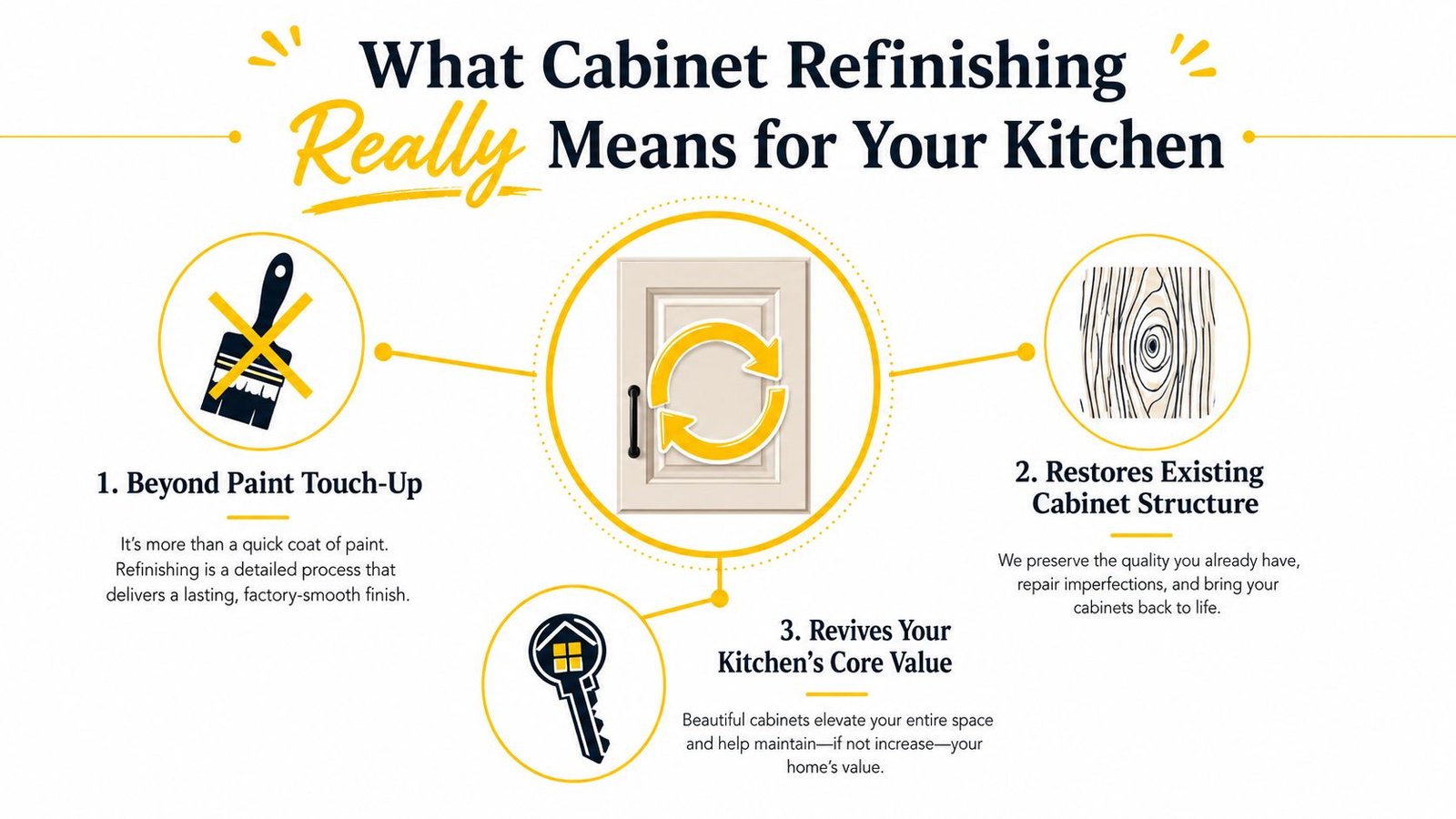
A kitchen can look tired even when the cabinets still have good bones. Cabinet refinishing works with those existing doors, drawer fronts, and visible cabinet faces by cleaning, preparing, priming, and recoating the surface so it can handle daily use.
A worn table is easier to understand than a cabinet on first glance. If the structure still holds up, the finish can be renewed instead of discarded. The old grime comes off, the surface gets proper prep, and the coating system is built to bond to the material already there.
Repainting, refinishing, and refacing are not the same
Homeowners and even some contractors use these terms loosely, but they describe distinct processes with different outcomes. Repainting usually means changing the colour of the visible surface. Refinishing goes further, with prep and coating steps that help the surface stand up to long-term wear. Refacing changes the outer skin or doors, while the cabinet box stays in place.
That difference matters because the substrate, the material under the finish, decides how well the project can hold up. Solid wood cabinets, sound MDF, and well-bonded previously finished surfaces can often be refinished successfully. Cabinets with peeling laminate, moisture damage, or failing thermofoil are a different conversation. If the base material is compromised, no finish system can fully correct that.
For a Toronto homeowner, the first decision is condition, not colour. Before you call for quotes, check whether doors are stable, hinges are secure, and cabinet boxes are dry and intact. If those basics are off, refinishing may not be the right investment.
Quality refinishing starts with the cabinet's condition, not the paint chip.
The practical side matters too. A refinished cabinet should look smooth, feel consistent to the touch, and clean up easily. If a contractor skips prep, the result may look fine for a short time, then chip, peel, or show old damage through the new finish later.
What quality work is trying to achieve
The goal is a durable, renewed surface that still feels like part of the original kitchen. Toronto homeowners often ask how a finish will perform in high-use spaces, not just how it will look in the first week. Kitchens get steam, grease, fingerprints, and repeated contact, so the cabinet coating has to be chosen and applied for real use.
Finish choice also affects indoor air quality and everyday comfort in a busy kitchen. A contractor should be able to explain which products are being used, how they cure, and what kind of ventilation the job needs. If you want a clearer sense of how a finish behaves on stained surfaces, painting over stained wood is a useful related read because the same surface-prep questions often come up there too.
A helpful visual for this is below, because it shows how refinishing is really about renewal, not a quick cosmetic touch-up.
For homeowners comparing options, the right contractor earns trust. If they can explain the process clearly, show you how they assess cabinets, and tell you when a project is a poor fit, you're dealing with someone who understands refinishing as a craft, not just a paint job.
Refinishing Compared to Replacing and Refacing
Toronto homeowners often compare these three choices after the kitchen starts looking tired, but each one answers a different problem. Refinishing renews the surface while keeping the cabinet structure in place. Refacing changes the visible parts, such as doors and front panels. Replacement starts over with new cabinets.
The first check is usually the same. Are the cabinet boxes sound, do the doors still hang properly, and is moisture damage limited to small areas? If the answer is yes, refinishing often gives the best balance of appearance, durability, and less disruption. If the structure is soft, warped, or failing around sinks or dishwashers, replacement starts to make more sense.
A simple way to compare the options
| Option | Typical Cost Range | Timeline | Best For |
|---|---|---|---|
| Refinishing | Lower than the other two options, with professional work often falling in the range described in this cabinet painting vs replacing cost comparison | Usually shorter than replacement | Sound cabinet boxes, limited moisture damage, a faster kitchen refresh |
| Replacing | Higher than refinishing | Longer, with more disruption | Cabinets that are structurally damaged or badly laid out |
| Refacing | Middle ground between the two | Moderate | Cabinets with sound boxes but a need for new doors or outer surfaces |
That table gives a useful starting point, but an in-person look still matters. A contractor has to check the substrate, hinge alignment, wear around sinks and dishwashers, and whether the current cabinet style still suits the home. Those details often decide whether a finish job will hold up or start failing early.
For a wider comparison of the trade-offs, Soca Services also has a guide on cabinet painting vs replacing cost comparison. Homeowners who are still weighing broader cabinet paths can also review kitchen cabinet options Southwest Michigan to see how refacing and replacement are framed in another market.
When refinishing is the smarter move
Refinishing makes the most sense when the kitchen already works and the goal is a cleaner, fresher look without ripping out a usable room. That fits resale prep, rental refreshes, and homes where the budget needs to stay focused on the most visible improvement. It also suits cabinetry with solid construction that still has years of service left.
Replacement is the better choice when hidden repairs would wipe out the savings, or when the cabinets themselves have failed. Refacing sits between the two, but it still depends on the cabinet box being worth keeping. The right call usually comes down to the cabinets already in the house, not the newest option on paper.
Inside a Professional Cabinet Refinishing Process
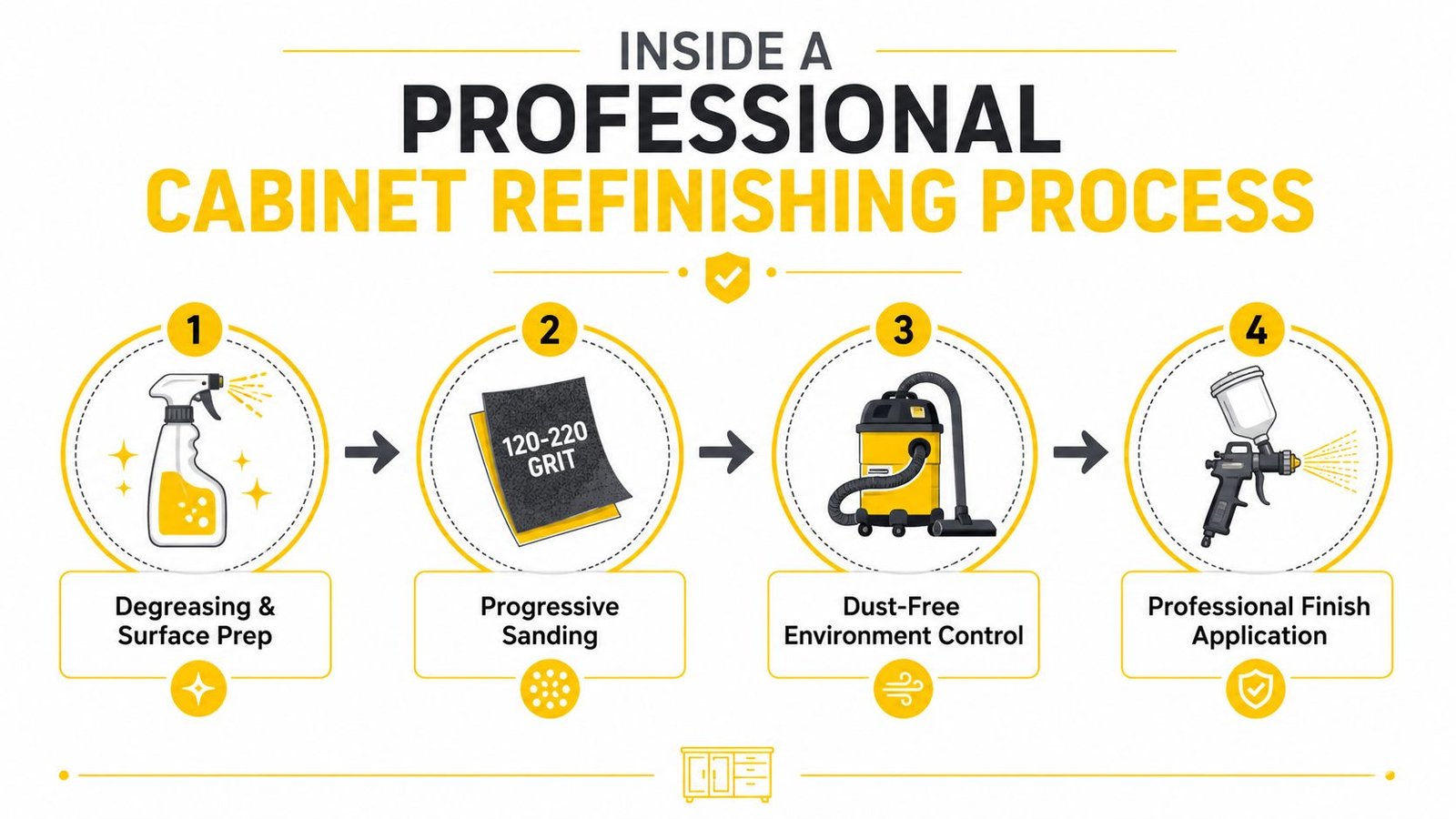
A durable cabinet finish needs careful work before the colour goes on. Good crews spend most of their time on prep, containment, and the steps between coats, because cabinets get touched constantly and shortcuts show up fast. A smooth-looking finish is the result of thorough prep work done before any colour is applied.
The prep work is where the result is won
Professional guides consistently call for degreasing first, then sanding in the 120 to 220 grit range, with 220-grit commonly used as a final scuff before primer or between coats (Benjamin Moore kitchen cabinet guidance). That grit progression matters because it gives the new coating enough tooth to bond without cutting through the existing finish or leaving ugly scratch marks.
After cleaning and sanding, dust control becomes the next job. Doors, drawers, and cabinet boxes need masking and protection, because any debris trapped in the finish will show up later as roughness or defects. Kitchens are high-contact spaces, so a clean work area is not a luxury, it is a basic requirement.
Practical rule: If a contractor talks mostly about paint colour and barely mentions cleaning, sanding, masking, and cure time, keep shopping.
Once the surface is ready, primer goes on, then thin, even coats of the finish. In a cabinet job, that means controlled application, not heavy one-pass coverage. Thin coats reduce sagging and help the coating cure more evenly on edges, rails, and raised details.
A cabinet pro should also be able to explain why spray setup matters in a Toronto home. The difference between a tidy finish and a cloudy one often comes down to how the shop handles airflow, overspray, and dust, which is why spraying kitchen cabinets deserves careful planning before any colour is mixed.
Why the cure matters as much as the coat
The finish still has to harden properly before the doors and drawers go back into service. That means respecting the manufacturer's dry and cure intervals, not rushing reassembly because the colour looks dry on the outside. Cabinets are touched with wet hands, slammed, wiped down, and opened dozens of times a day, so a weak cure shows up quickly as chipping or wear.
If you want a deeper look at spray technique and cabinet finish control, this spray painting kitchen cabinets guide 2026 is a useful reference point. The practical lesson is simple. Ask how the crew will degrease, sand, mask, and protect the kitchen, then ask when the cabinets can be used normally again. That answer tells you a lot about the quality of the job.
Costs Timelines Materials and Finishes in Toronto
The first question people ask is, “What's this going to cost, and how long will my kitchen be out of commission?” Those are fair questions, and the answer depends on cabinet count, condition, finish choice, and how much repair work is needed before coating starts. A small kitchen with straightforward prep is a very different job from a larger kitchen with worn doors, hardware changes, and edge repairs.
What affects the price and schedule
The biggest cost drivers are the ones you can see before work begins. More doors and drawer fronts mean more labour. A kitchen that needs extra repair time or deeper cleaning will take longer. Finish quality also matters, because the materials used for cabinet work have to handle heavy contact, not just look good in a sample can.
For planning purposes, the timeline is usually tied to prep, coating, and cure rather than just the spraying day. That's why a project can't be judged only by how quickly a contractor says they can “paint the cabinets.” The drying and reassembly window matters just as much as the visible application.

Finish choice affects durability and indoor air quality
Industry guidance recommends thin, even coats with intercoat sanding, plus strong dust control and masking, because cabinet doors and drawers get frequent contact and wear (cabinet finishing guidance). That approach helps prevent lap marks, sagging, and premature chipping, especially on edges and handles where cabinets get touched the most.
Finish choice also matters in Toronto homes where indoor air quality is part of the decision. Low-VOC and zero-VOC products are often discussed because homeowners want fewer fumes and less disruption in the house. The trade-off is that the wrong product in the wrong conditions can still underperform, so the question is not just “low VOC or not,” but whether the coating system suits the cabinet surface and the home's ventilation.
Sherwin-Williams and Benjamin Moore both offer product lines that contractors commonly use for cabinetry, and sheen choice also changes the result. Satin gives a softer look, semi-gloss is easier to wipe down, and higher sheen will show more surface flaws if the prep isn't excellent. In a busy kitchen, durability and cleanability usually matter more than chasing the glossiest look.
Soca Services also has a local pricing guide on cost of painting kitchen cabinets Toronto 2024 pricing guide, which is helpful if you want to compare quotes with a Toronto lens.
Why homeowners should ask for a detailed estimate
A good estimate should separate prep, coating, hardware handling, and any repairs. It should also explain the finish system, not just say “paint cabinets.” If you're comparing quotes in Toronto, Vaughan, North York, or King City, ask how the contractor controls dust, what product line they use, and when the doors can safely go back up.
If you want a quote for your space, Contact Soca Services and ask for a free estimate that reflects your cabinet condition, not a generic kitchen average.
How to Choose a Trusted Cabinet Refinishing Contractor Near You
A good cabinet job is easy to admire after the fact, but the true test is how the contractor plans the work before they start. The best ones don't hide the prep, they explain it. They don't rush the estimate, they walk you through what your cabinets need and what they don't.
Questions worth asking before you sign
Look for direct answers to the basics. Who will do the work, how will they protect the room, and how do they handle dust and curing? If the answers stay vague, that's usually a sign the process is too.
- Verify Licensing and Insurance Credentials. Ask for proof, don't assume it's in place.
- Review Portfolio of Local Toronto Projects. You want to see work that looks like your home, not just generic photos.
- Ask for and Contact Provided References. Recent, local references tell you far more than a polished sales pitch.
- Get a Detailed, Written Project Estimate. The estimate should show scope, materials, and any likely add-ons.
A contractor should also be able to tell you whether your cabinets are a candidate for refinishing at all. That's a major trust signal. If they push every job forward without inspecting condition, they're not really advising you, they're just selling.
A trustworthy cabinet painter makes it easier to say no to the wrong project.
Red flags that usually show up early
Watch for weak prep descriptions, no mention of dust control, and a quote that only lists one number with no breakdown. Those are the easiest signs that the job may be handled too casually. In a high-use kitchen, casual work usually becomes expensive work later.
The local market is active enough that you do have choices. In the Toronto, ON market, the Better Business Bureau lists 70 results for cabinet refinishing businesses, which shows this is a large, active service category rather than a niche search term (BBB Toronto cabinet refinishing listings).
That level of competition helps homeowners, but only if they compare contractors carefully. Toronto, Vaughan, North York, and King City all have enough demand that you can choose based on process and professionalism, not just price. Soca Services fits into that conversation as a local option for cabinet work, home painting, and interior finishes where clear communication and durable results matter.
If you're still comparing providers, Learn more on our website and ask the questions that separate a polished pitch from a real cabinet process.
Real Transformations and Your Next Steps With Soca Services
A successful cabinet refinishing project usually does not make a kitchen look showroom-new. It makes the room look cared for, brighter, and better matched to the rest of the home. That is the transformation many Toronto homeowners want, especially when the cabinet boxes are still solid but the finish has faded, chipped, or yellowed over time.
The strongest projects usually follow the same pattern. The cabinets are good candidates for refinishing, the prep work is thorough, the finish system fits the kitchen's daily use, and the contractor explains the process before work begins. When those pieces line up, the result feels like a kitchen reset without the disruption of a full renovation.
Soca Services approaches cabinet work the same way it approaches painting more broadly, with prep, product choice, and finish quality doing most of the heavy lifting. If you are also planning wall colours, interior painting, or a broader home refresh, it makes sense to coordinate those decisions so the kitchen does not feel disconnected from the rest of the house. For Toronto homes, that kind of planning also matters for indoor air quality, because the finish products chosen for a busy kitchen can affect how the space smells and how quickly it is ready for everyday use.
One simple way to judge whether refinishing is a good fit is to look at the cabinet structure before you look at the colour. If the doors are sound, the frames are stable, and the surface can be properly prepared, refinishing may be the right path. If the wood is damaged, the cabinets are warped, or the layout no longer works, replacement may be the better call. A good contractor should explain that difference clearly, so you are deciding based on condition rather than hope.
If you are reviewing project photos, look for signs of careful work, smooth edges, even sheen, clean lines at the hinges and trim, and a finish that looks consistent in natural light. Those details matter more than a dramatic before-and-after image. A cabinet job that holds up in a high-use Toronto kitchen needs to be chosen, prepared, and finished with that day-to-day wear in mind.
If your kitchen still has solid cabinets, do not guess at the outcome. Get a proper assessment, ask how the finish will hold up, and make the decision based on condition, not just the urge to replace everything. Get a free estimate if you want a local opinion on whether refinishing is the right move for your Toronto home, rental, or property turnover.
Soca Services Painting handles cabinet refinishing, interior painting, and other home finishes for Toronto and the GTA with a focus on clean prep and durable results. If your cabinets are tired but structurally sound, they can help you judge whether refinishing makes sense and give you a clear, written estimate. Visit Soca Services Painting to contact the team and book your free estimate today.