
Table of Contents
- Is Professional Spray Painting Worth the Cost? The Real Trade-Offs
- Spray Painting vs. Brush Painting Durability: Which Finish Lasts Longer?
- Professional Spray Painting Cost Estimator: What to Expect in Toronto
- Is Spray Painting Kitchen Cabinets Worth It, and How to Prepare Surfaces for Professional Spray Painting
Last Updated: June 18, 2026
Is Professional Spray Painting Worth the Cost? The Real Trade-Offs
Asking whether professional spray painting is worth the cost is the right question before any project. The answer depends on project scale, surface type, and finish quality needed. At Soca Services Painting, we’ve worked on hundreds of projects across Toronto, Vaughan, North York, and King City, and the pattern is consistent: professional spray painting delivers results that brushes and rollers cannot replicate on certain surfaces. This isn’t a budget question, it’s a value question.

Professional spray painting applies paint through a pressurized spray gun to achieve a smooth, factory-like finish. The two dominant technologies are airless sprayers (high pressure, fast on large surfaces) and HVLP sprayers (High Volume Low Pressure), which offer finer control and less overspray.
| Factor | Airless Sprayer | HVLP Sprayer | Brush/Roller |
|---|---|---|---|
| Finish quality | Excellent on large surfaces | Excellent for detail work | Good, visible texture |
| Overspray risk | High | Low-moderate | None |
| Speed on large areas | Very fast | Moderate | Slow |
| Skill required | High | High | Low-moderate |
| Cleanup time | 30-60 min | 20-40 min | 10-15 min |
| Best for | Walls, exteriors, ceilings | Cabinets, furniture, trim | Accent walls, small rooms |
A professional crew brings contractor-grade equipment, handles masking, manages paint viscosity and tip selection, and controls overspray. A DIY attempt with a rented sprayer often produces uneven coverage, wasted paint, and surfaces needing recoating.
Skipping proper masking and surface preparation is the single most common DIY mistake. Overspray travels further than most people expect, and inadequately protected surfaces can require costly remediation.
According to guidance from the Painting and Decorating Contractors of America, proper surface preparation accounts for the majority of a paint job’s long-term durability, regardless of application method.
Spray Painting vs. Brush Painting Durability: Which Finish Lasts Longer?
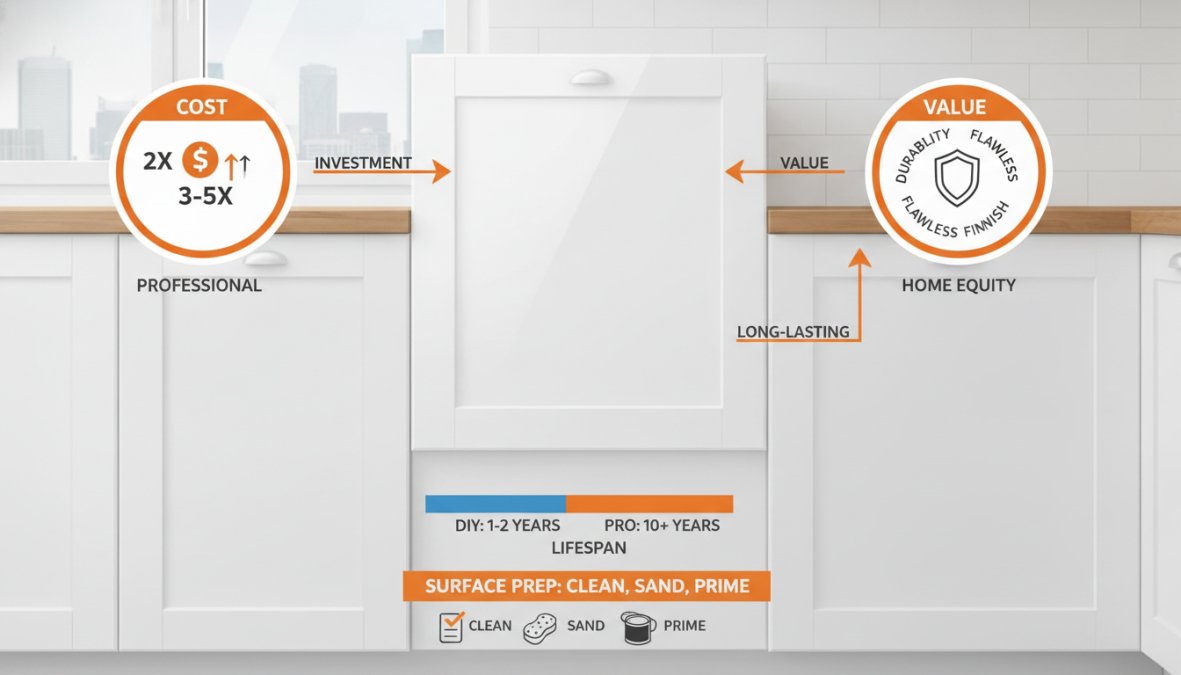
The spray painting vs brush painting durability debate has a clearer answer than most expect. A properly applied spray finish produces a thinner, more uniform film per coat that adheres more evenly to the substrate, reducing micro-texture variations that cause premature wear. Brushed finishes deposit more paint per pass, but thickness without uniformity creates stress points where coatings crack or peel, especially in Toronto’s extreme seasonal temperature swings.
Spray application wins on:
- Even coverage across complex surfaces (crown molding, cabinet doors, recessed panels)
- Adhesion on smooth substrates like MDF, metal, and previously painted surfaces
- Professional finish with no brush marks or roller stipple texture
For walls and ceilings, the durability difference between spray and brush is minimal when both are done correctly. For cabinetry, trim, and doors, spray painting produces a measurably superior finish that holds up better to daily contact and cleaning. Brush and roller holds its own for textured surfaces, small touch-ups, and projects where masking setup would take longer than the job itself.
Check cabinet door edges under raking light after a spray job. A professional finish shows no runs, no sags, and consistent sheen across the entire panel. Any variation signals an issue with tip size, pressure, or paint thinning.
As noted in the Sherwin-Williams professional painting resource center, paint viscosity and proper thinning are critical variables in spray application, paint that is too thick clogs the tip and produces an uneven fan pattern.
Professional Spray Painting Cost Estimator: What to Expect in Toronto
Professional spray painting costs in Toronto vary based on surface area, surface condition, paint selection, and masking complexity. Here is a practical framework for estimating your project.
The four variables that drive cost:
- Surface area: Larger rooms benefit most from spray application as setup costs are amortized across more square footage.
- Prep work required: Damaged or high-porosity surfaces need more preparation before spraying can begin.
- Paint grade: Contractor-grade paints from Sherwin-Williams or Benjamin Moore cost more per litre but cover better, require fewer coats, and last longer.
- Masking complexity: Rooms with furniture, built-ins, and detailed trim require more taping time, adding to labour cost.
Rental vs. hiring: the real calculation
| Cost Category | DIY Rental | Professional Service |
|---|---|---|
| Equipment | Rental fee | Included |
| Paint waste (overspray) | High | Managed by pro |
| Masking materials | You supply | Included |
| Cleanup time | 1-2 hours | Handled by crew |
| Risk of rework | Moderate-high | Low |
Paint waste is a factor most DIY guides ignore. Inexperienced operators lose significantly more paint to overspray than professionals who manage tip size, fan pattern, and distance. Over a large project, that waste can close much of the gap between DIY rental and professional pricing.
According to the Canadian Painting and Decorating Association’s homeowner guidance, getting at least two itemized quotes and confirming surface preparation is included is the best way to compare contractors accurately.
The true cost of professional spray painting includes equipment, prep, masking, paint, labour, and cleanup. When you account for all of these, the gap between DIY and professional narrows considerably, especially for complex surfaces like cabinetry and trim.
Is Spray Painting Kitchen Cabinets Worth It, and How to Prepare Surfaces for Professional Spray Painting
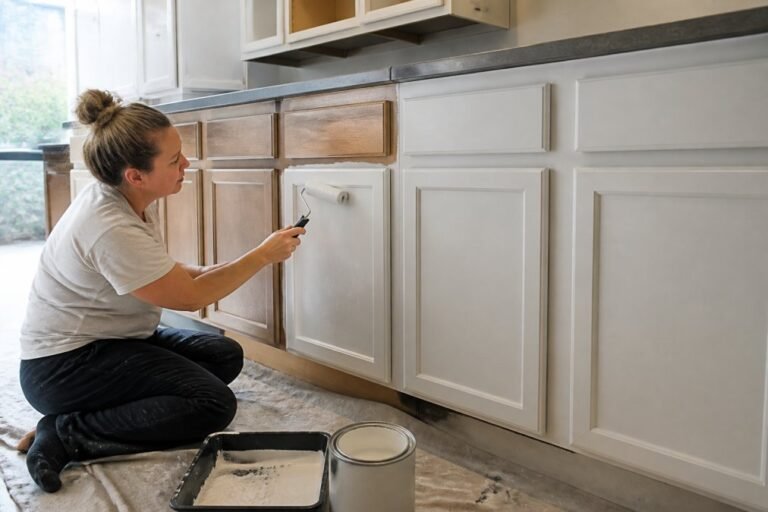
Is spray painting kitchen cabinets worth it? Yes, without qualification. Kitchen cabinets are the highest-traffic painted surface in any home, taking daily contact, cleaning, grease, and humidity. A spray-applied enamel or lacquer finish produces a harder, smoother surface that resists chipping and cleans more easily than a brushed finish.
Surface preparation is where professional results separate from disappointing ones. Here is how to prepare surfaces for professional spray painting on kitchen cabinets:
Step 1: Remove cabinet doors and hardware
Label all doors and drawer fronts. Spraying flat eliminates runs and sags.
Step 2: Clean all surfaces thoroughly
Degrease before sanding, grease prevents paint adhesion.
Step 3: Sand to scuff the existing finish
Fine-grit sanding creates a mechanical bond. Skip this and the finish will peel within months.
Step 4: Fill and repair surface defects
Fill dents and grain raise in MDF doors before priming.
Step 5: Apply a bonding primer
A quality bonding primer is especially critical on previously painted or laminate surfaces.
Step 6: Apply topcoat in controlled conditions
Control temperature, humidity, and dust. Don’t rush dry time between coats, trapped solvents cause adhesion failure and bubbling over time.
Cabinet refinishing with spray application extends cabinet life by years, costs a fraction of full replacement, and produces a finish rivaling new factory-painted cabinetry. For Toronto homeowners weighing renovation against a professional respray, the value proposition is clear.
As documented in Benjamin Moore’s professional application guidelines, proper surface preparation and primer selection are the most critical factors in achieving a durable finish on kitchen cabinetry.
Choosing the right painting contractor in Toronto is harder than it looks. Soca Services Painting brings over a decade of experience in residential and commercial spray painting across Toronto, Vaughan, North York, and King City, with a simple 4-step process, detailed project proposals, and a 5.0 rating from clients who’ve seen the difference a professional finish makes. Get Your Free Estimate Today and find out exactly what your project requires before committing to anything.
Frequently Asked Questions
How much does professional spray painting cost compared to traditional painting in Toronto?
Professional spray painting in Toronto generally costs more upfront than brush or roller painting due to equipment, prep work, and masking time. However, the superior surface finish, faster application on large surfaces, and longer-lasting results often make it more cost-effective over time. For an accurate estimate tailored to your project, whether interior walls, cabinets, or exterior surfaces, contact Soca Services for a free, detailed project proposal.
Does spray painting last longer than brush and roller painting?
When applied correctly by a professional, spray painting can deliver equal or better durability than brush painting. Airless sprayers and HVLP spray guns apply paint at a consistent viscosity and flow rate, creating an even, thin coat that bonds tightly to the surface. Using contractor-grade paints like Sherwin-Williams or Benjamin Moore further improves longevity. The key factor is proper surface preparation, without it, even the best spray finish won't hold.
Is spray painting kitchen cabinets worth it, or should I just replace them?
Spray painting kitchen cabinets is almost always more cost-effective than full replacement. A professional spray finish on cabinets delivers a factory-smooth result that brushes simply can't replicate, eliminating brush marks and lap lines. It also extends cabinet life significantly. In Toronto, professionally spray-painted cabinets can transform a dated kitchen at a fraction of the cost of new cabinetry, making it one of the highest-value home improvement investments available.
What prep work is needed before professional spray painting?
Surface preparation is the most critical step for a lasting spray paint finish. Professionals typically sand surfaces to remove imperfections, clean away grease and dust, apply primer where needed, and carefully mask and tape all adjacent surfaces to prevent overspray. For kitchen cabinets, doors are often removed and sprayed flat. Skipping any of these steps leads to poor adhesion, uneven coverage, and premature peeling, which is why hiring an experienced professional like Soca Services makes a measurable difference.
Can I rent a paint sprayer and get professional results myself?
Renting an airless sprayer or HVLP spray gun is possible, but achieving a professional finish requires practice, the right tip size, correct pressure adjustment, and proper paint thinning. Most DIYers underestimate cleanup time, paint waste from overspray, and the learning curve involved. For small furniture refinishing projects, renting may be worthwhile. For larger interior or cabinet projects in Toronto, hiring a professional typically saves time, reduces paint waste, and delivers a noticeably better result.
This article was written using GrandRanker