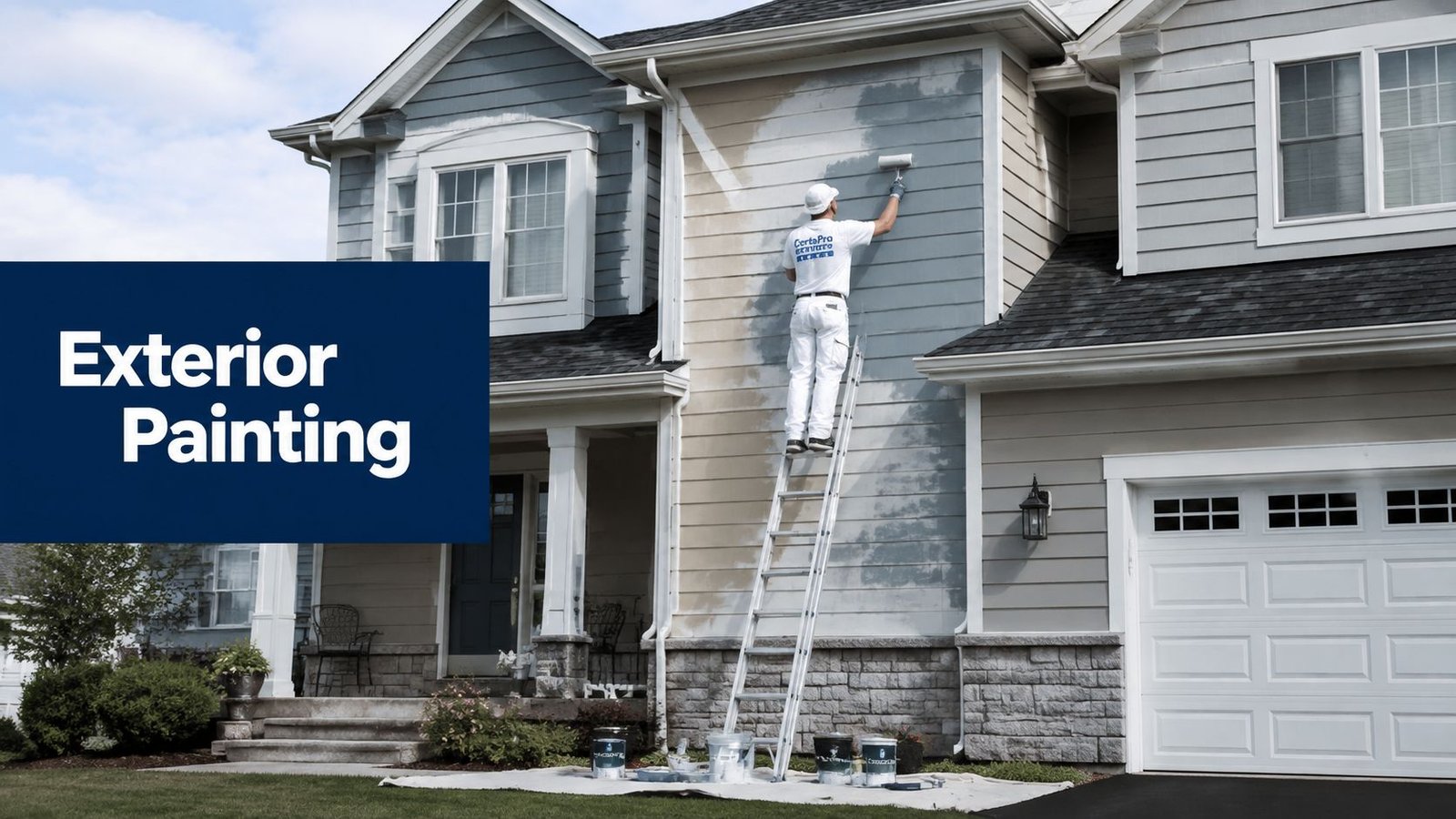
You're looking at the front of your Richmond Hill home after another wet spring. The trim looks tired, a few caulk joints have opened, and the south-facing siding has lost its colour. Perhaps you're planning to sell, preparing a custom home for summer entertaining, or managing several units where a small exterior defect can become a larger repair.
Exterior painting in Richmond Hill isn't just a colour update. The coating protects wood, siding, stucco, trim, soffits, fascia, doors, and other exposed surfaces from moisture, sunlight, and seasonal movement. The right result depends on local weather, substrate condition, preparation, product selection, and timing.
Why Exterior Painting Matters for Richmond Hill Homes
A homeowner in Oak Ridges with a two-storey house from the 1990s may begin with a simple plan: patch the stucco, change the colour, and prepare the property for a spring listing. The inspection often broadens the scope. Window caulking may have separated, lower trim may carry moisture stains, and older coatings may be peeling wherever water reaches the surface repeatedly.
The finish must look well maintained beside neighbouring homes, support a York Region sale, and protect the exterior through the next maintenance cycle. Colour can improve curb appeal, but paint performs only as well as the surface beneath it. Covering failed joints or damp material saves time briefly and usually creates a larger repair later.
Richmond Hill's housing stock produces different repainting requirements. The city's 2021 Census profile records 44.4% of housing units as built since 2001, with 18% built between 2011 and 2021 (Richmond Hill housing profile). Newer homes may be reaching first-cycle maintenance, colour changes, or caulking renewal. Older properties commonly require more scraping, substrate repair, and primers selected for adhesion.
Paint is part of the building envelope
An exterior coating reduces direct exposure to rain and humidity. It cannot correct failed joints, damaged flashing, leaking gutters, or deteriorated wood. If water continues entering through one of those defects, the new finish may hide the problem briefly before failing in the same area.
Freeze-thaw movement makes the repair decision important. Water enters a crack or open joint, temperatures fall, and the affected material expands and contracts through seasonal changes. UV exposure adds wear, especially on raised and south-facing surfaces where fading and chalking are easier to see.
Practical rule: Treat peeling paint as evidence to investigate, not as a surface problem to cover quickly.
A Richmond Hill exterior assessment should identify the substrate, map failed areas, check moisture, and separate cosmetic work from repairs. A newer vinyl-sided home may need cleaning, bonding primer, and colour-safe topcoats. An older stucco or wood-clad property may also require crack repair, failed caulk removal, spot priming, and tighter moisture control.
York Region's housing mix supports both scopes. Single-detached houses represented 61.9% of occupied private dwellings in York Region in 2021, while Richmond Hill had one of the region's higher apartment shares at 21% (York Region dwelling profile). Homeowners, townhouse communities, condominium boards, and property managers therefore face different access, repair, and coating decisions.
Before selecting a colour or comparing quotes, establish whether the exterior needs repair, moisture control, or a fresh finish.
Richmond Hill Climate and the Best Season to Paint
A Richmond Hill wall can feel dry at noon and still be too damp to coat by late afternoon. The area's humid continental climate makes moisture control part of the painting plan. Average annual relative humidity is around 75%, winter humidity often reaches 83% to 90%, and cold-season lows can approach -20°C. These conditions affect cleaning, drying, adhesion, and curing.
Air temperature gives only part of the answer. A cool wall may sit close to its dew point even when the afternoon forecast seems suitable. Condensation can form before the coating develops a stable film, leaving soft spots, blistering, premature peeling, or uneven sheen.
Ontario-focused project specifications advise against painting when relative humidity exceeds 85% or when the gap between air temperature and surface temperature is below 3°C. They also call for protection from rain and snow during application and final curing, plus moisture testing on the substrate. Those checks matter more than a calendar date.
The practical painting window
For most Richmond Hill homes, late May through early October offers the most workable scheduling period, provided the day's readings support application. Exterior coatings generally need temperatures above about 10°C to cure properly, but that threshold does not replace checks for dew point, overnight cooling, surface moisture, or incoming rain (Richmond Hill exterior painting guidance).
| Month | Average high | Average relative humidity | Painting decision |
|---|---|---|---|
| May | About 19°C | About 62% | Use stable dry periods, after morning dew has cleared |
| June | About 24°C | About 63% | Generally favourable, with surface-moisture checks |
| July | About 26°C | About 64% | Suitable when direct sun, shade, and rain are managed |
| August | About 25°C | About 67% | Usually workable, with a clear rain buffer |
| September | About 20°C | About 70% | Often good, but finish earlier before evening cooling |
| October | About 13°C | About 75% | Selective scheduling, with frost and dew-point checks |
Monthly averages help with planning, not approval. Before coating, record air temperature, surface temperature, relative humidity, dew point, and substrate moisture. A wall that feels dry by hand can still fail a moisture-meter reading.
Why shoulder seasons need discipline
Spring and fall can provide excellent painting days, but morning dew, overnight lows, rain fronts, and rapid evening cooling reduce the effective work period. A schedule packed too tightly may push application into late afternoon, when the wall is approaching condensation conditions.
Summer also requires judgment. Direct sun can heat a wall enough to make paint flash or dry too quickly, while a shaded north-facing surface may retain moisture. Crews should schedule by exposure, shade, wind, and forecast changes rather than treating the entire house as one surface.
Homeowners comparing schedules can review this guide to planning exterior painting in the GTA around weather delays, which focuses on measurable site conditions instead of promising a fixed calendar window.
Best Exterior Paint Systems and Materials for Local Weather
Richmond Hill homes need different coating systems. Vinyl siding, oxidised aluminum, wood, stucco, brick, and fiber cement each handle adhesion, heat, and moisture differently. Start by identifying the substrate and its condition, then choose the colour and product system.
| Substrate | Recommended Primer | Recommended Topcoat | Climate Caution |
|---|---|---|---|
| Vinyl siding | Vinyl-safe bonding primer where required, such as for dark colour changes, previously painted surfaces, or manufacturer specifications | Flexible exterior acrylic formulated for vinyl | Avoid dark colours that may increase heat stress unless the siding and product system allow them |
| Aluminum siding | Acrylic bonding primer after oxidation removal | Premium exterior acrylic | Chalk and oxidation must be removed or the new coating may not bond |
| Wood clapboard and trim | Exterior alkyd or stain-blocking primer on bare or stained areas | High-build acrylic or solid exterior stain | Moisture must be controlled, and exposed end grain needs careful sealing |
| Stucco and EIFS | Compatible masonry or elastomeric primer | Breathable elastomeric or masonry coating | Do not seal in moisture or bridge active cracks without repairing them |
| Brick | Masonry-compatible primer where specified | Breathable masonry coating | Sound older brick may be better left unpainted because paint can complicate moisture release |
| Fiber cement | Manufacturer-compatible acrylic primer | Exterior acrylic designed for fiber cement | Pay attention to cut edges, joints, and factory finish condition |
Substrate moisture must be within the coating manufacturer's limits before application. For masonry, concrete, and wood, that means checking with a moisture meter rather than relying on how the surface feels. Excess moisture can interfere with adhesion, slow curing, and leave Richmond Hill's freeze-thaw exposure working against the coating.
Product choice and VOC compliance
Canada regulates 53 architectural-coating categories, with limits ranging from 100 g/L to 800 g/L, depending on the product type (Canada's architectural-coatings VOC regulations). VOC content is measured on a “less water and exempt compounds” basis at the time of application. Choose by substrate, exposure, primer compatibility, and the applicable category, rather than relying on a low-odour label.
The federal rules prohibit manufacturing or importing a coating above its category limit unless it is diluted according to the manufacturer's written instructions or covered by a permit (federal architectural-coatings regulation). Homeowners should ask for the exact product name, technical data sheet, and intended use before work begins.
Low-VOC acrylic latex can reduce odour while providing colour retention and flexibility. It still needs a dry, sound, properly prepared surface. A compliant product applied over damp, chalky, or poorly repaired material can fail sooner than a correctly prepared system.
For a broader comparison, this overview of exterior paint for Toronto weather can help homeowners compare exterior systems before requesting a quote. Sherwin-Williams and Benjamin Moore both offer exterior product families, but the brand matters less than matching the coating to the surface and following its written application limits.
How a Proper Exterior Paint Job Is Done Step by Step
A Richmond Hill repaint can appear finished quickly while failing within a season if moisture, chalk, or loose coating remains underneath. A durable job follows a deliberate sequence, and each stage affects the next.
Start with cleaning and assessment
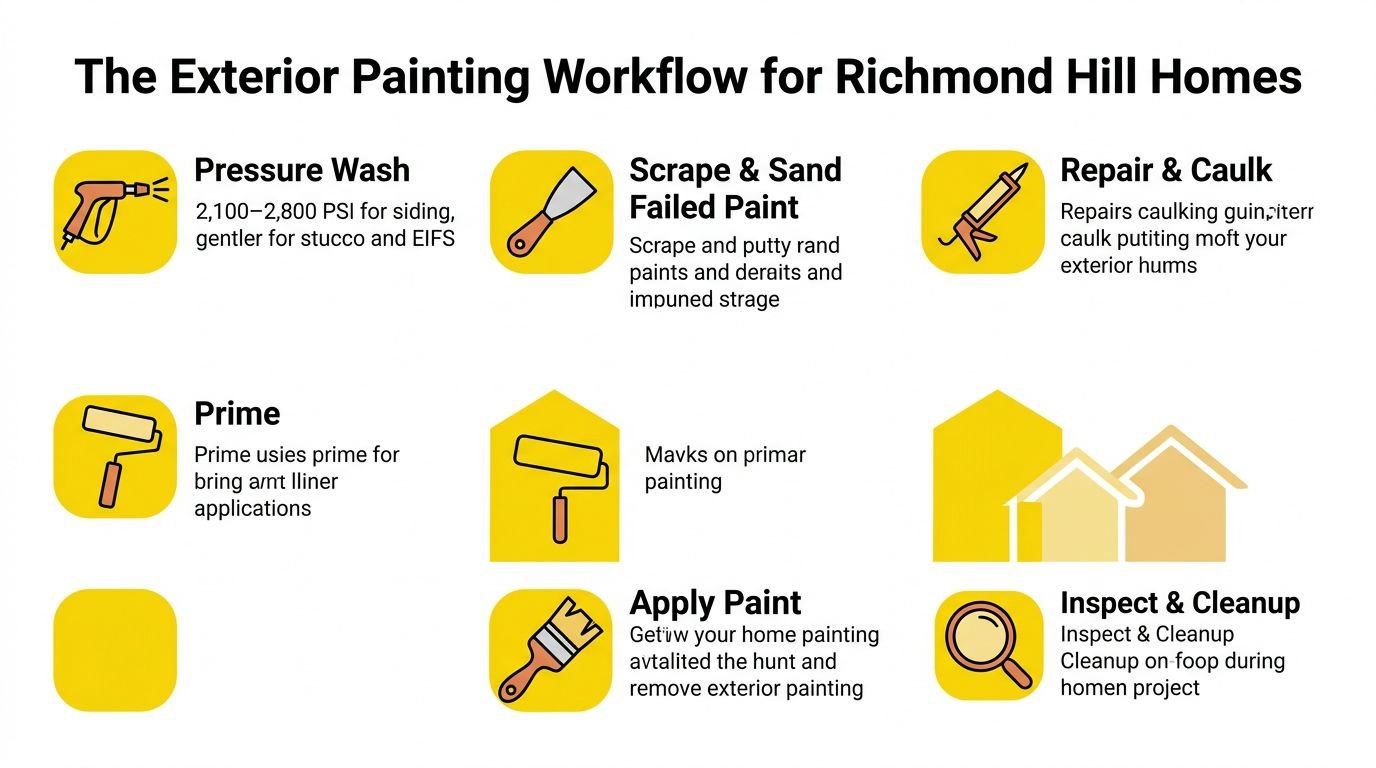
Wash the exterior. Siding can often be pressure washed at 2,100 to 2,800 PSI. Stucco and EIFS need gentler treatment to prevent surface damage. The purpose is to remove dirt, pollen, loose contamination, and chalk without forcing water behind the cladding.
Allow proper drying. A crew should check the surface with a moisture meter rather than relying on touch. For latex application, the substrate should read below 15% moisture, while masonry and concrete commonly require below 12% under coating specifications. If readings remain high, postpone priming instead of trapping moisture beneath the film.
Scrape and sand failed coatings. Remove peeling material to a sound edge, feather the transition, and sand glossy areas so the new coating can bond. Extensive scraping may expose rot, cracked stucco, rust, or failed sealant that must be addressed before painting.
Repair before priming
Open joints around windows, doors, trim, and penetrations require a flexible elastomeric or paintable urethane sealant. Rigid filler can crack as adjacent materials move. Bare wood, repairs, rust spots, and stain-prone surfaces need the appropriate spot primer, including stain-blocking primer where tannin or rust bleed is possible.
Masking protects glass, fixtures, stonework, decks, and landscaping. The crew should cover plants, control overspray, and keep ladders and hoses organised. Cleanup is part of the work, not a final favour.
The finish coat can't repair poor preparation. It only makes the preparation less visible until weather exposes it.
Apply the coating system
The crew should stop when the surface temperature comes within 5°F of the dew point, since condensation can compromise the wet film. Application should also stop during rain or snow exposure and when relative humidity exceeds 85%, in line with Ontario project requirements.
A sound Richmond Hill system generally uses primer where the substrate requires it and two complete finish coats. The team must follow the product's recoat window, which changes with paint type, humidity, temperature, colour, and surface. A typical project includes washing and drying, repairs, priming, finish coats on separate suitable days, and a final inspection.
Drying windows and access set the pace. A large or complicated home may need more time, even when the actual painting area seems manageable.
For a concise overview, Soca Services' six-step exterior painting process follows the same preparation-first sequence. A useful quote should identify each stage, including drying time, rather than promise an unrealistically fast completion.
This video offers another visual reference for the sequence and preparation involved:
What Exterior Painting Costs in Richmond Hill
A reliable exterior painting quote starts with the house, not a generic square-foot rate. Richmond Hill properties range from detached homes and semis to row houses, apartment buildings, and custom residences. Labour, access, and preparation can change sharply between addresses.
York Region's housing mix includes a substantial share of single-detached homes, along with row houses and larger apartment properties, as shown in the 2021 Census profile for Richmond Hill. A detached or townhouse project may include siding, trim, decks, and fences. Multi-unit work can require coordinated access, board approval, lift planning, and phased scheduling.
One local provider gives a Richmond Hill reference range of $3 to $6 per square foot of paintable surface, plus HST. Its examples range from $4,000 to $7,000 for a bungalow or row house, $5,500 to $9,000 for a semi-detached home, and $8,000 to $14,000 for a two-storey detached home (Richmond Hill exterior painting cost examples). Treat these as benchmarks, not promises. The measured paintable area and written scope determine the quote.
| Project Type | Typical Size | Prep Condition | Estimated Cost Range |
|---|---|---|---|
| Bungalow or row house | 800 to 1,400 sq. ft. exterior | Light to moderate preparation | $4,000 to $7,000 |
| Semi-detached home | 1,000 to 1,600 sq. ft. exterior | Moderate preparation | $5,500 to $9,000 |
| Two-storey detached home | 1,500 to 2,200 sq. ft. exterior | Moderate to extensive preparation | $8,000 to $14,000 |
| Large custom home | 2,500+ sq. ft. exterior | Varies widely | $14,000+ |
What moves the quote
- Surface material: Wood and stucco often need more repair and specialised products than sound vinyl.
- Access: Steep rooflines, high gables, scaffolding, and tight landscaping increase setup and labour.
- Prep condition: Peeling paint, failed caulk, oxidation, rot, and masonry repairs add time before coating.
- Scope: Trim, shutters, doors, soffits, fascia, decks, and fences can expand the work considerably.
- Colour and coating system: Multiple stain colours or specialty primers increase material and application complexity.
- Older coatings: Homes built before 1990 may require lead-safe planning and containment decisions.
A guide to 2026 exterior improvements for Ohio homes can provide broader planning context, but its market is not Richmond Hill. GTA labour, access, weather, and regulatory conditions require local pricing.
For a second cost reference, review Soca Services' exterior house painting cost guide. Ask each contractor to separate preparation, repairs, primer, finish coats, trim, access equipment, tax, and exclusions. A low total may leave out work the house needs.
Choosing and Vetting the Right Richmond Hill Painter
A Richmond Hill exterior can look fine from the street while hiding failed caulk, oxidised siding, damp wood, or loose paint under the eaves. The contractor who spots those conditions before quoting may charge more upfront, but the scope is more honest and the coating has a better chance of lasting through local freeze-thaw cycles and summer humidity.
Start with documentation. Ask for WSIB clearance, liability insurance of at least $2 million, and confirmation of HST registration where applicable. Commercial clients, property managers, and renovation contractors should also confirm who carries responsibility for site safety, access equipment, surface protection, and cleanup.
A practical screening checklist

- Request local references: Ask for three recent Richmond Hill or York Region addresses you can drive past, with the owner's permission where needed.
- Test technical knowledge: Ask how the crew handles cedar staining, oxidised aluminum siding, stucco cracks, and moisture readings.
- Check the weather plan: The contractor should explain how rain, overnight lows, humidity, and dew point affect scheduling.
- Review the warranty: Look for a written labour warranty, commonly one to three years depending on the contractor and scope, with clear exclusions.
Make the questions specific. Ask whether aluminum oxidation will be removed before priming, whether cedar will receive stain or paint, how repaired stucco will be coated, and what happens if the forecast changes after washing. A product name does not explain preparation. The painter should describe the surface work, drying time, and reason for the selected system.
A written quote should identify the surfaces, repairs, preparation method, primer, paint brand and product line, number of coats, sheen, colour responsibilities, access equipment, cleanup, payment schedule, and final walkthrough. “Paint exterior” is not a complete scope.
A professional quote tells you what will happen to the surface before it tells you what colour will go on it.
Check for unlabeled cans, verbal-only promises, missing insurance information, no primer allowance where bare material exists, and warranties that exclude realistic failures. Product warranties and workmanship warranties are different. The contract should state which one the contractor provides and how a future concern gets inspected.
For more screening questions, this guide to finding reliable painters in Toronto can help build an interview list. Soca Services Painting lists Richmond Hill among its service areas and offers exterior painting. Compare its written scope with other qualified bids rather than choosing from a name alone.
Maintenance That Makes Your Paint Job Last
A finished repaint still needs maintenance. Richmond Hill's moisture cycling, summer sunlight, falling leaves, and winter exposure all create small conditions that can become visible coating failures if nobody checks them.
Use a simple yearly rhythm rather than waiting for peeling to announce a problem.
A 12-month care calendar
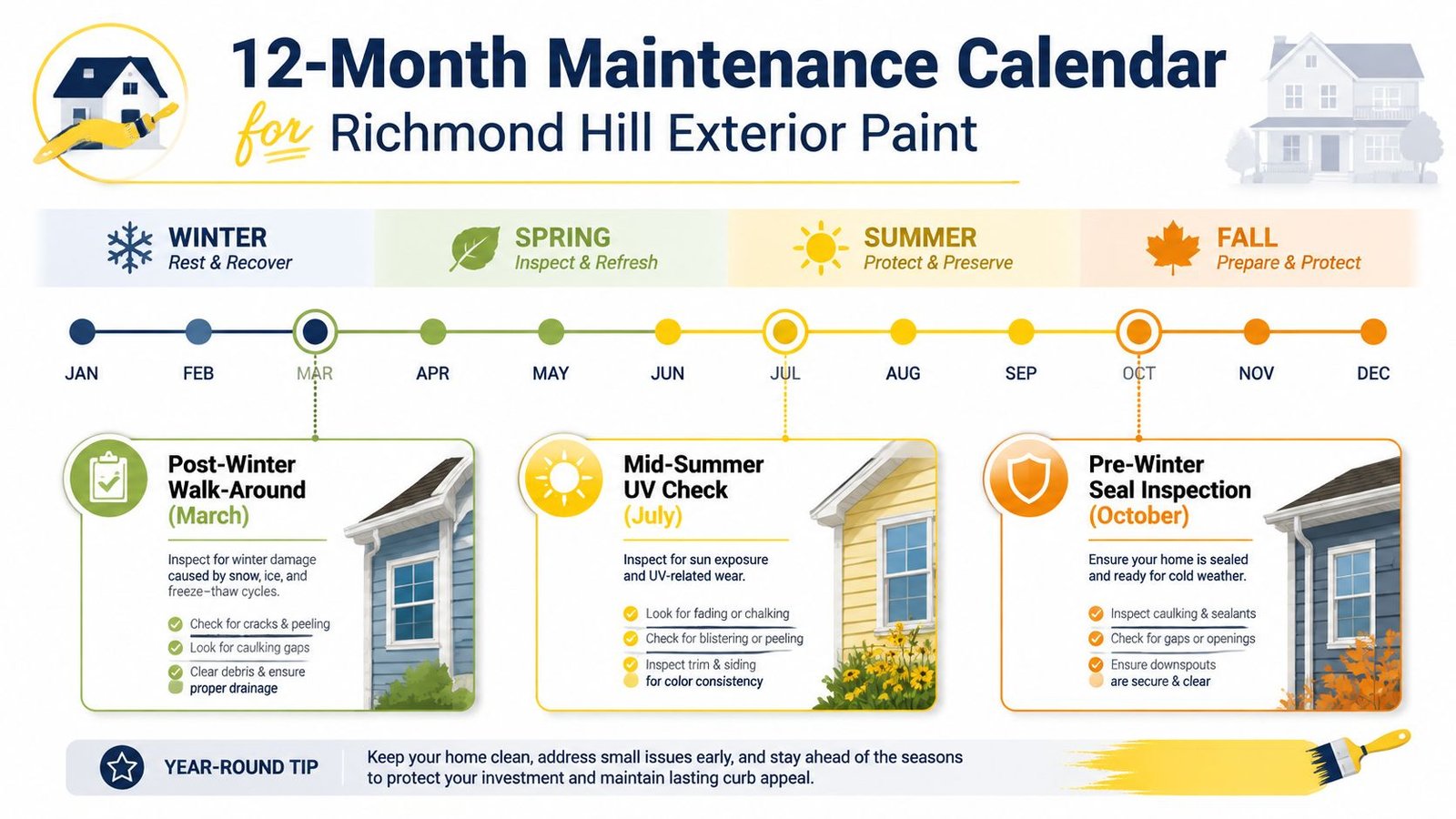
- March and April, post-winter walk-around: Look for lifted caulk, popped nails, cracked joints, peeling at trim, and water staining beneath gutters. Photograph defects before arranging repairs.
- May and June, spring cleaning: Remove dirt and pollen with a garden hose, soft brush, and mild soap. Avoid forcing water behind siding or into window joints.
- July, mid-summer check: Inspect south-facing walls for chalking and fading, and north-facing areas for algae streaks or persistent dampness. Remove spider webs before they collect dust.
- August and September, spot repair: Match the existing sheen, feather touch-up edges, and prime bare wood before applying finish paint.
- October, pre-winter review: Check gutters, downspouts, trim, and caulk before leaves and snow trap moisture against the exterior.
- November through February: Avoid unnecessary washing and monitor active leaks, damaged joints, and areas where snow sits against siding.
A garden hose and soft brush are safer for routine cleaning than aggressive pressure. If a pressure washer is necessary, keep it under 1,500 PSI and hold the nozzle 12 inches away from the surface. Direct spray at joints, vents, window seals, and damaged coating can create a problem that cleaning was supposed to prevent.
Manufacturer repaint guidance may describe eight to ten years for 100% acrylic on wood, but Richmond Hill performance varies by exposure, preparation, colour, substrate, and moisture. North-facing algae streaks, UV-darkened cedar-stained trim, and chalky south walls can each signal a different maintenance need.
Document repairs and warranty conditions
Keep the product names, colour codes, sheen, completion date, and maintenance photos. If a future touch-up is needed, the record helps match the coating and identify whether the problem came from impact, moisture intrusion, substrate movement, or application.
A warranty isn't a substitute for maintenance. Product warranties cover defined material conditions, while workmanship warranties cover the contractor's application under stated terms. Documented cleaning and prompt repairs can support a legitimate claim, but neither warranty usually covers unresolved leaks or substrate failure.
Richmond Hill Exterior Painting FAQs and Local Edge Cases
What weather readings should decide the painting day?
Calendar windows help with planning, but the wall itself decides whether coating can hold. A dry afternoon at 18°C may still be unsuitable if the surface is within 3°C of the dew point. Check substrate moisture, relative humidity, overnight lows, and the forecast for rain before starting. Coating above about 10°C is only one part of that decision.
Do low-VOC paints sacrifice durability?
Not automatically. Canadian rules cover 53 architectural-coating categories, with limits ranging from 100 g/L to 800 g/L (Canadian VOC category limits). A compliant low-VOC acrylic can suit homes where odour and return-to-use time matter. Confirm that the product matches the substrate, primer, film build, and exposure. Preparation and weather control often have more effect than the VOC label alone.
Do you need a building permit?
A straightforward repaint usually does not require a building permit. Alterations above $5,000 in some scopes may involve different requirements, and heritage or historically designated properties can require additional review. Confirm the scope with the Town of Richmond Hill Building Division before work begins, especially for older homes or exterior changes beyond painting.
What about homeowner associations and heritage areas?
Review colour, trim, fencing, and exterior-change rules before ordering paint. Oak Ridges and Jefferson include older pockets where neighbourhood, association, or heritage requirements may affect visible changes, even when the work appears cosmetic.
How do warranties really work?
Product and workmanship warranties cover different risks. Product coverage may be prorated and subject to exclusions, while a contractor may offer a one- or two-year workmanship guarantee. Moisture intrusion, movement, neglected maintenance, and substrate failure commonly fall outside contractor responsibility. Read the exclusions, required maintenance, and reporting process before signing.
What are the common edge cases?
- 1990s stucco: Repair cracks first, then choose a compatible elastomeric or breathable coating system.
- Older brick: Sound brick may be better left unpainted because paint can complicate moisture release.
- Aluminum siding: Remove oxidation and use a suitable bonding primer before the topcoat.
- On-site injuries: Confirm the contractor carries required coverage and explain how worker safety and claims are handled.
Before booking, define the surfaces included, compare written quotes, and record primer and coat requirements in the contract. At the final walkthrough, verify colour, sheen, cleanup, and unresolved repairs before releasing payment.
Contact Soca Services Painting for a site-specific exterior assessment, written estimate, and coating plan suited to Richmond Hill weather and your home's substrate. For Toronto, Vaughan, North York, or King City properties, visit Soca Services Painting to learn more and request a free estimate.