You can stand in a finished basement in Toronto, hold up a beautiful swatch, and still end up with a room that looks flat, muddy, or colder than you expected once the pot lights are on. That's why paint colours for basements need a different mindset from upstairs rooms. Below-grade spaces live or die on light, sheen, and prep, not just the name on the chip.
Why Basement Paint Colours Are a Different Game
A lot of homeowners pick a calm greige for the main floor, then carry it downstairs and wonder why the rec room suddenly looks like wet cardboard. I see that all the time in Toronto, Vaughan, North York, and King City, especially when a colour that looked soft upstairs turns dull under basement lighting. The problem usually isn't the colour name, it's the room conditions around it.

Three basement realities change the result
First, there's less natural light. Ontario's residential code treats light and ventilation as core livability issues for habitable rooms, which is why finished basements need colour choices that compensate for limited daylight rather than depend on it. In practice, that pushes most usable basement palettes toward warm whites, soft greiges, and light neutrals that bounce artificial light better than mid-tone wall colours. Sherwin-Williams frames basement colour this way for Toronto-area homes and property managers, because the room's function matters as much as its décor. Sherwin-Williams basement paint colours
Second, the light spectrum changes the paint. A colour that looks clean in a showroom can read green, beige, or grey at home once the bulbs are installed. That's why the bulb matters almost as much as the wall colour.
Third, the substrate matters. Concrete and block walls behave differently from upstairs drywall. They can hold moisture, show patching, and punish weak prep.
Practical rule: in a basement, colour is doing three jobs at once, it's a lighting tool, a moisture strategy, and a finish decision.
If you're reworking the room for a bedroom, office, or family zone, it helps to think in terms of livability, not just paint. A good place to browse layout ideas is functional basement design ideas from Aureli Construction, then come back to the colour plan with the space's real use in mind. For a local starting point, Soca Services' basement paint options page is a useful match-up with finishes and room types.
Understanding Light Reflectance Value for Basements
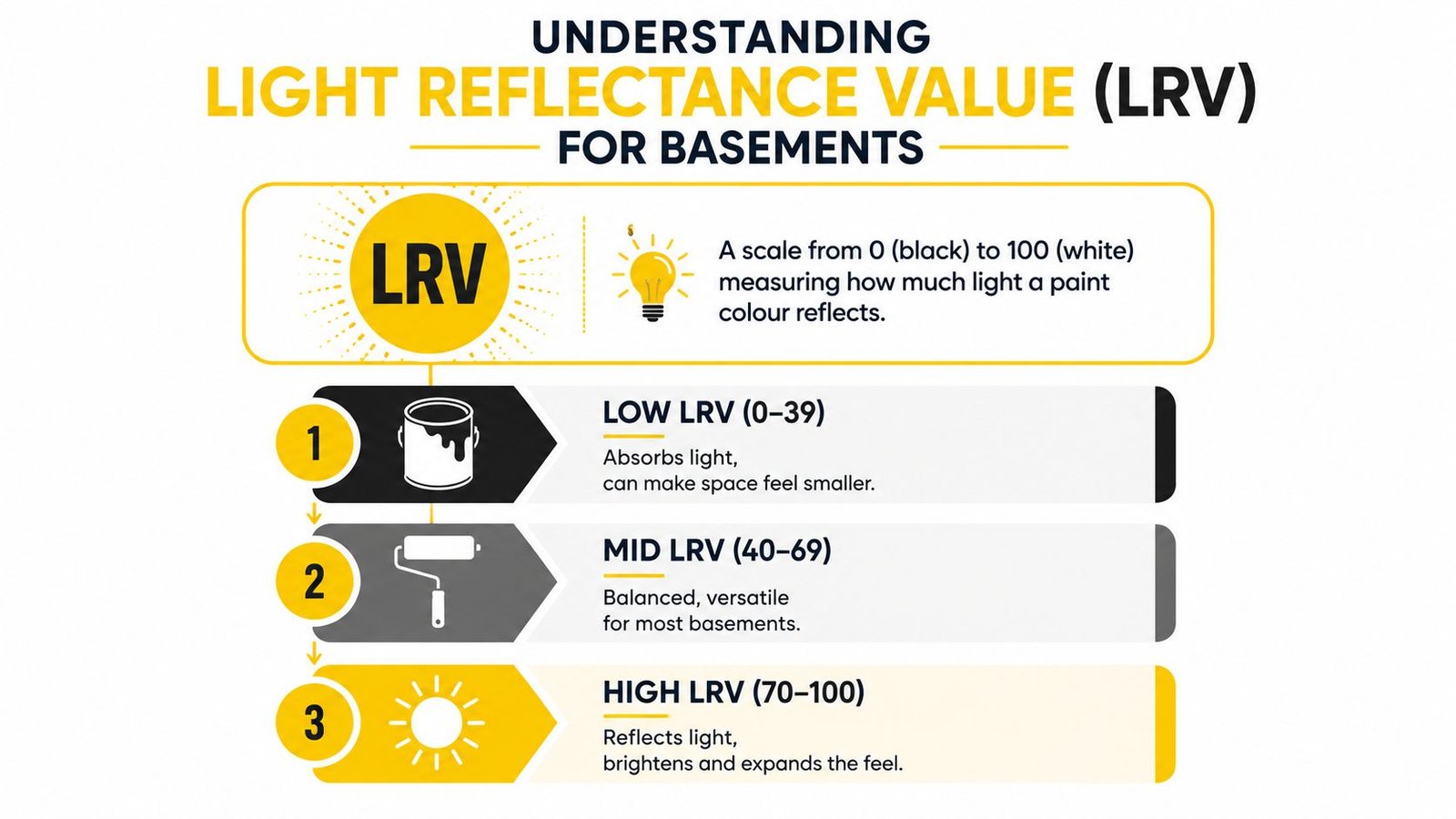
Light Reflectance Value, or LRV, is the number that tells you how much light a colour reflects. The scale runs from 0 to 100, with lower numbers absorbing light and higher numbers reflecting it. In a basement, that number matters more than the colour name on the fan deck.
The quick basement LRV test
For most below-grade walls, a practical rule is LRV 60 or higher. Ceilings usually work better at LRV 70+, and windowless basements often need LRV 75+ to feel open rather than boxed in. That's why high-LRV whites like Chantilly Lace (LRV 90.04) and Pure White (LRV 84) keep showing up in basement work, they bounce a lot more light than mid-tone colours and make a room feel less enclosed. PaintDB basement paint colours
A swatch can fool you in the store because store lighting is not basement lighting. If the sample sits under your pot lights and still looks lively, you're closer to a safe choice. If it falls below the LRV range above, expect the colour to read heavier, especially on long walls.
How to check LRV fast
Look at the product page or the colour spec, then read the LRV before you fall for the name. A lot of people love a colour like they'd love a fabric, then regret it once it lands in a low-light room. In a basement, numbers beat intuition.
If a colour only looks good when the room is bright, it probably isn't a basement colour.
For finish selection that supports low-light spaces, Soca Services points clients to its best interior paint finish for living rooms guidance when the basement is being treated as a true living zone. The same principle applies downstairs, choose the colour for the light you have, not the light you wish you had.
Building a Basement Colour Scheme That Works
A basement usually looks best when the palette stays tight. Painting experts often use the 60-30-10 split, with one dominant colour, one secondary colour, and one accent colour, and they keep the room to three main colours so the space doesn't feel crowded. Best Pick Reports on basement paint colours
Start with the dominant wall colour
In Toronto basements, the dominant colour should do most of the lifting. That usually means a warm white or soft greige on the largest wall areas, because those tones feel cleaner under artificial light and don't fight the concrete or the ceiling height. A cool greige can work, but if the room already feels dim, it can read flatter than it did on the chip.
Use undertones to steer the mood
Warm whites with a yellow or cream base usually feel more inviting under soft bulbs. Cool tones can work too, but they need better lighting and a room that can carry more colour. If the basement is used for family time, a warm neutral keeps the room from feeling clinical.
Pick one accent with a job
The accent colour should anchor the room, not compete with it. In a family room, a navy or forest wall behind the TV can add depth without making the whole basement feel smaller. In a legal suite, it's usually smarter to keep accents quieter and let the furniture carry personality.
A simple decision tree works well here:
- Main wall colour: choose the lightest colour that still feels warm under your bulbs.
- Secondary colour: use it on trim, one feature wall, or built-ins.
- Accent colour: keep it to one stronger note that supports the room's function.
Soca Services often compares these approaches with clients using Benjamin Moore and Sherwin-Williams decks, then trims the palette until the room feels calm instead of busy. If the basement is a media room or gym, a darker feature wall can still make sense. Just don't make every wall compete for attention.
Pairing Paint Colours with the Right Lighting
Most basement colour problems are lighting problems. A beige that looks balanced at noon can turn green under cheap LEDs, while a grey can pick up a purple cast and a white can go yellow. If the bulb is wrong, the paint will look wrong, no matter how good the brand is.
Choose the bulb for the room's use
For living rooms and media spaces, 2700K to 3000K lighting gives a warmer, softer feel. For gyms, offices, and laundry areas, 3000K to 3500K works better because it stays brighter and more task-friendly. High CRI, 90+, matters too, because it shows the undertone in the paint more accurately.
Practical rule: choose the colour under the bulb you'll actually live with.
Match the paint family to the light
Warm whites, soft greiges, and muted off-whites are the easiest colours to pair with warm LED lighting. Cooler shades can work, but they need enough pigment to stay interesting. A weak cool grey in a basement can feel lifeless fast.
| Basement Room Type | Bulb Kelvin | CRI Target | Best Paint Family |
|---|---|---|---|
| Family room | 2700K to 3000K | 90+ | Warm white, soft greige |
| Home office | 3000K to 3500K | 90+ | Light neutral, controlled grey |
| Gym | 3000K to 3500K | 90+ | Clean white, light grey |
| Laundry zone | 3000K to 3500K | 90+ | Bright white, pale neutral |
If the basement floor is also being updated, it helps to find the right floor shade before locking the wall colour, because floor tone changes how warm or cool the walls read. That pairing matters more than many expect. A wall colour that works with the floor and the bulbs usually wins over a trendy chip that only looks good alone.
Curated Palettes for Common Basement Types
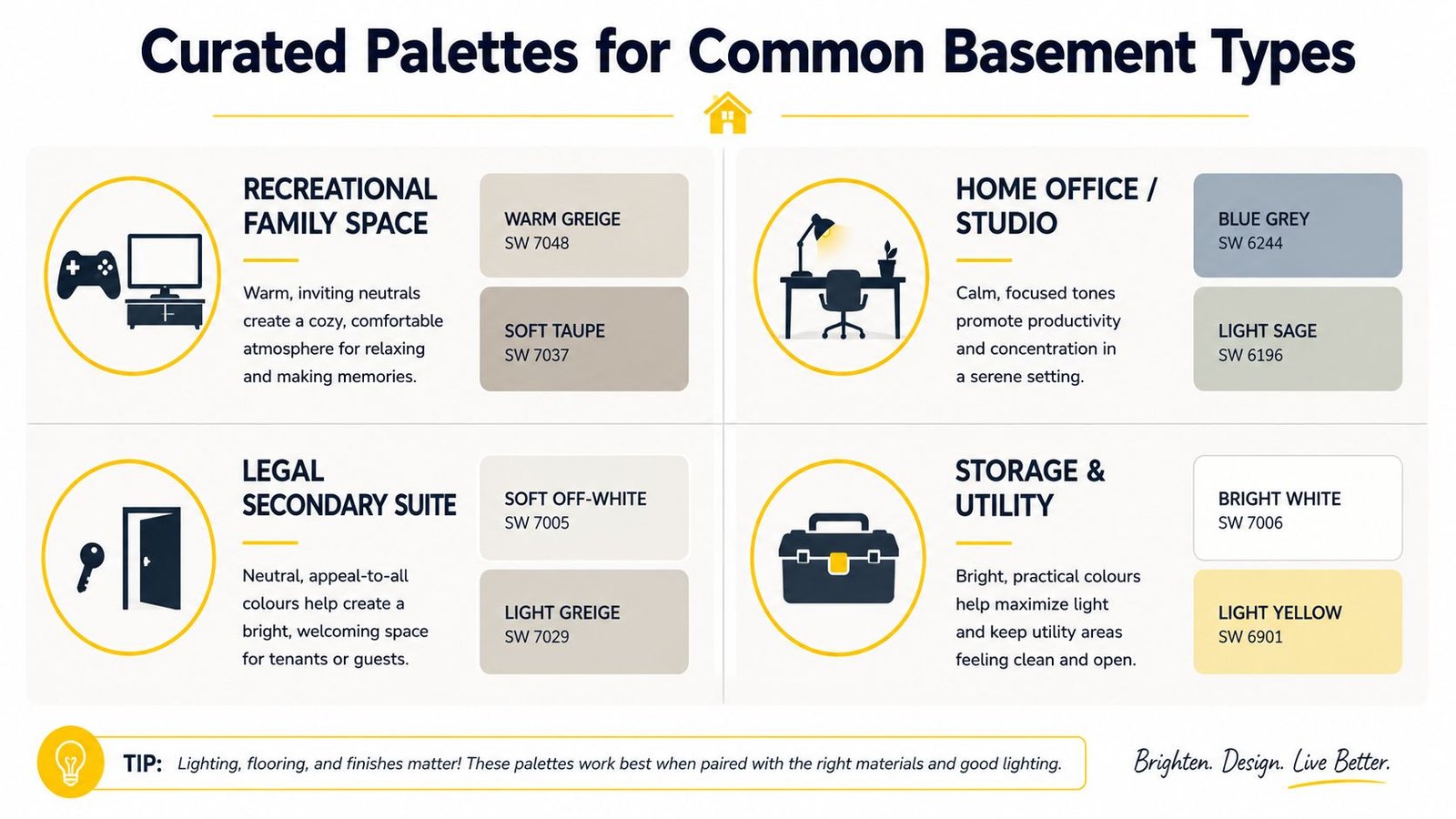
Finished family rec room
For a Toronto rec room with engineered flooring and pot lights, start with a warm off-white or soft greige on the walls. Benjamin Moore White Dove and Sherwin-Williams Alabaster are common starting points because they hold warmth without going yellow. Use a flat ceiling so seams and patching don't jump out, then finish the trim in a cleaner white for contrast.
A navy or forest accent wall behind the TV can work well if the rest of the room stays light. Eggshell on the walls is the practical default here, because it cleans better than flat but doesn't shine too much under basement lighting. For most family spaces, that balance beats a glossy look every time.
Rental or in-law suite
For a legal suite or tenant turnover space, I lean toward durable neutrals that can survive scuffs and still photograph well. Light greige, off-white, or a mild beige keeps the room flexible for different furniture and different tenants. This is one place where a slightly more forgiving tone often looks smarter than pure white.
On trim, go a touch cleaner so doors and casings separate from the walls. Satin is often a solid choice for higher-traffic suite walls, while semi-gloss can make sense on trim and bathroom details. The point is durability first, personality second.
Laundry and utility zone
Laundry rooms and utility rooms need colour that feels fresh, not precious. A pale grey or alabaster-style white works well because it keeps the room bright and still hides everyday wear better than a stark white. For walls near sinks or appliances, washable finishes matter more than trendy undertones.
Dark, low-ceiling basement
When the basement is especially low or light-starved, push the whole system brighter. Ceiling, trim, and walls should all stay near the high-LRV end so the room doesn't feel chopped up. In some cases, a true white on the ceiling and a gentle white on the walls is the cleanest answer.
For specialty floor systems, Sherwin-Williams recommends paint designed for concrete, and it notes that epoxy-based coatings are “super strong” and create a “shiny, tough finish” that resists chemicals, which makes them suitable for high-traffic basement spaces. Sherwin-Williams concrete paint guidance That's a floor decision, but it affects how the wall colour reads, especially in a brightened basement.
Sample Testing, Prep, and Sheen Selection
A basement swatch has to earn trust. Tape up large samples or poster-board squares on at least two walls, then look at them in morning light, evening light, and under the exact bulbs that will stay in the room. Small chips don't tell the truth in a below-grade space.

The simple workflow is this. Clean and patch first, because basement walls often carry dust, pores, or old patch marks. Prime next if the surface is stained, uneven, or especially porous. Then paint only after the test samples still look right under the fixtures.
A good basement prep plan should also account for moisture. If the room has had a leak or any musty history, dry the space properly before you paint, and use a finish system that can handle the environment. AMPM Restoration Services has useful our water leak drying tips that fit that concern well.
Sheen matters just as much as colour. Flat hides ceiling defects, eggshell works for most basement walls, satin suits kids' zones and rental units, and semi-gloss belongs on trim, bathrooms, and laundry rooms. For a full wall-prep sequence, Soca Services also keeps a practical guide on how to prepare walls for painting.
When to Call a Professional Toronto Painting Crew
A single-room refresh with one colour is often DIY-friendly if the walls are sound and the lighting is simple. Legal suites, moisture issues, multi-zone basements, and long feature walls are a different story. Those jobs pay off more often when a crew handles the assessment, prep, and finish together.
A professional team brings a few things that are hard to fake at home. The first is surface judgement, because basement walls can hide problems that don't show up until primer hits them. The second is consistency, especially on long walls where cutting in around trim, doors, and ceiling edges has to stay even across the whole room.
Soca Services Painting handles basement interior painting across Toronto, Vaughan, North York, and King City, and it can scope the work before anyone starts buying product. A free estimate usually clarifies room use, wall condition, product choice, and clean-up needs, which matters a lot in a lived-in house. If the basement has furniture, finished flooring, or tight access, that planning saves time and avoids mess.
Ask any contractor these four things before you sign: insurance, product specs, surface prep plan, and how they protect the rest of the home.
For a broader view on whether to hire out the work, Soca Services also offers a straight answer in its is professional interior painting worth it piece. If the basement is more than a cosmetic repaint, a professional crew is usually the safer route.
Your Basement Paint Checklist Before You Buy
Before you buy a can, check five things. Confirm the LRV on the colour you're considering. Match the bulbs to the room, usually warm for living spaces and a touch brighter for work areas. Test the sample for two full days on more than one wall.
Then make sure the primer and sheen fit the room's use, especially if the basement has moisture history or heavy traffic. If the project is bigger than a single accent wall, get a written quote from Soca Services so the scope, prep, and finish are clear before work starts.
If you're planning basement interior painting in Toronto, Vaughan, North York, or King City, Soca Services Painting can help you choose colours that work under basement light, not just on a chip. Visit Soca Services Painting to book a free estimate and get a practical plan for your walls, ceiling, trim, and finish.