Table of Contents
- Historic Home Exterior Restoration Techniques That Preserve Architectural Character
- Best Tools for Stripping Paint from Historic Wood Without Causing Damage
- Restoring Heritage Home Exterior Finishes: Regulatory Compliance and Material Compatibility
- Cost of Restoring a Historic Home Exterior: Restoration vs. Replacement Analysis
Last Updated: June 8, 2026
Restoring heritage home exterior finishes is one of the most technically demanding projects a homeowner can undertake. Soca Services Painting has worked with Toronto homeowners for over a decade, and the pattern is consistent: projects that go sideways almost always start with underestimating what authentic restoration requires.
Most guides treat heritage exterior work as a slightly fussier version of regular painting. It isn’t. Substrate assessment on century-old timber requires a different diagnostic mindset, finish choices carry legal implications, and using the wrong product, such as a non-breathable coating over original wood fibers, can cause moisture failures that cost far more to fix than the original project.
According to Parks Canada’s Standards and Guidelines for the Conservation of Historic Places, the principle of minimal intervention is the foundation of sound heritage stewardship: preserve first, restore second, replace only when necessary.
Historic Home Exterior Restoration Techniques That Preserve Architectural Character
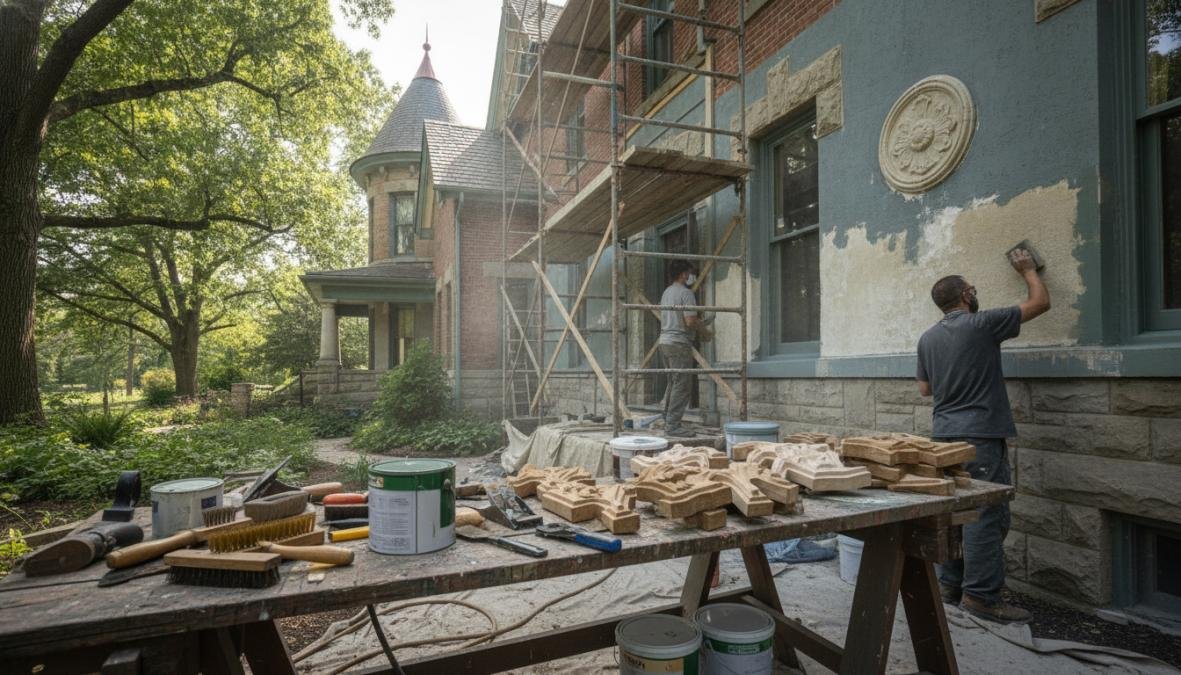
Before any product touches the surface, conduct a thorough substrate assessment: probe for rot, check moisture content, document decorative woodwork, and photograph every original feature.
Historic restoration returns a building’s exterior to a documented earlier appearance using period-consistent materials, a clear line from renovation, which changes rather than preserves.
For Toronto homes built between the 1880s and 1940s, the most common substrates are cedar siding, brick, and stucco. Each demands a different approach:
- Cedar siding: Non-breathable coatings trap water and accelerate rot. Use a penetrating oil or breathable finish, not film-forming latex.
- Brick and mortar: Repoint with historically matched mortar. Modern Portland cement is harder than historic brick and causes spalling.
- Stucco repair: Original stucco contains lime, which is more flexible than modern cement. Patching with incompatible material creates cracks within a few freeze-thaw cycles.
The goal is to work with each material’s natural behavior, seasonal wood expansion, vapor movement through masonry, slow lime cure. Treatments that ignore these properties create more problems than they solve.
Before selecting any finish product, test it on a small, inconspicuous section and observe it through at least one rain event. Breathability and adhesion behave very differently on weathered historic substrates than on new wood.
Best Tools for Stripping Paint from Historic Wood Without Causing Damage
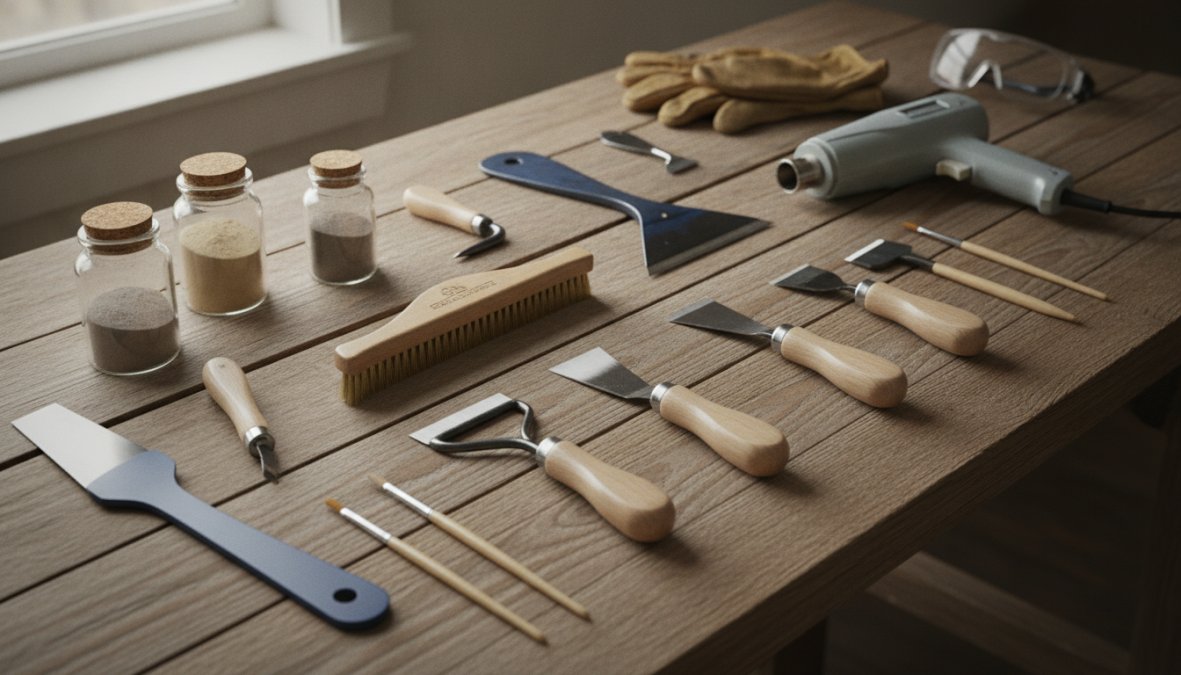
The best tools remove coatings without damaging the wood fibers beneath. Heat guns, infrared paint removers, and chemical strippers are the three main options, choosing the wrong one causes permanent damage to irreplaceable decorative woodwork.
1. Infrared paint removers
Infrared tools heat paint from below without scorching the wood, the preferred choice for detailed trim. They give precise control, minimize grain raising, and can be rented from most Toronto equipment suppliers.
2. Heat guns
Effective on flat cedar siding but require a careful hand near joints. Overheating causes charring and can release lead-based paint fumes in concentrated bursts.
3. Chemical strippers
Low-VOC, biodegradable strippers are safest for intricate profiles where heat tools are impractical. They require 30-60 minutes of dwell time, don’t raise grain, and are the only practical method for deeply carved surfaces.
Avoid power sanders on historic wood, they remove the patina and surface hardness old-growth timber develops over decades and can obliterate fine trim detail that cannot be replicated without custom millwork.
Never use a propane torch or open flame on historic wood exteriors. The heat is uncontrollable, will carbonize wood fibers, and creates hazardous fumes on lead-painted surfaces.
Use a flexible plastic scraper on curved profiles and a stiff steel scraper on flat stock, always pulling with the grain to prevent fiber tearout.
Restoring Heritage Home Exterior Finishes: Regulatory Compliance and Material Compatibility
In Toronto, properties designated under the Ontario Heritage Act require a Heritage Permit before any exterior work that changes character-defining elements, finish color, material type, or profile details. According to the City of Toronto’s Heritage Preservation Services guidelines, alterations must be consistent with the Standards and Guidelines for the Conservation of Historic Places in Canada.
Lead-based paint safety is a separate requirement. Ontario homes built before 1978 frequently have lead-based paint on exterior surfaces. Test with a lead test kit or hire a certified inspector before stripping. Confirmed lead triggers Ontario Occupational Health and Safety Act requirements for containment, respiratory protection, and proper disposal.
Material compatibility is the technical challenge that follows regulatory approval. Use this matrix as a starting reference:
| Substrate | Compatible Primer | Compatible Topcoat | Avoid |
|---|---|---|---|
| Old-growth cedar siding | Oil-based penetrating primer | Breathable latex or oil-based finish | 100% acrylic film-forming coatings |
| Lime stucco | Breathable mineral primer | Silicate or lime-based paint | Modern elastomeric coatings |
| Historic brick | None (unpainted preferred) | Breathable masonry stain | Waterproof sealers, latex paint |
| Original exterior trim | Shellac-based stain blocker | Oil-based finish or low-VOC alkyd | Water-based primer over bare knots |
Historic substrates manage moisture through vapor movement. Sealing them with non-breathable coatings traps moisture, accelerates rot, and in masonry leads to spalling. UV blockers added to oil-based finishes extend coating life without compromising breathability, one area where modern chemistry genuinely improves on historic materials.
The single most important compatibility rule: match your finish’s breathability to the substrate’s original vapor permeability. When in doubt, choose the more breathable option.
For properties in a Heritage Conservation District, including parts of Cabbagetown, Rosedale, and the Annex, check with your local planning department even if the individual property isn’t formally designated.
Cost of Restoring a Historic Home Exterior: Restoration vs. Replacement Analysis
Factors that increase restoration costs:
- Lead-based paint abatement on pre-1978 homes
- Custom millwork to replicate damaged decorative profiles
- Heritage permit fees and consultant review time
- Specialty breathable finishes, which cost more per litre than standard exterior paints
Factors that make restoration cost-competitive:
- Replacement materials for historic profiles often require custom fabrication anyway, eliminating the cost advantage
- Properly restored old-growth cedar or fir outlasts modern engineered substitutes when maintained correctly
- Heritage designation increases property value in Toronto’s market
- Replacement without a Heritage Permit on a designated property may require reversal at the owner’s expense
According to the National Trust for Historic Preservation’s guidance on restoration economics, the embodied energy and craftsmanship in original building materials cannot be cost-effectively replicated with modern substitutes in most cases.
Toronto’s climate, hot humid summers and freeze-thaw cycles from November through March, is hard on exterior finishes. A realistic maintenance schedule for a restored heritage exterior:
- Annual: Inspect caulking, clean mildew, check adhesion at south and west exposures
- Every 3-5 years: Recoat penetrating oil finishes on cedar siding and trim
- Every 8-12 years: Full surface preparation and recoat on painted surfaces
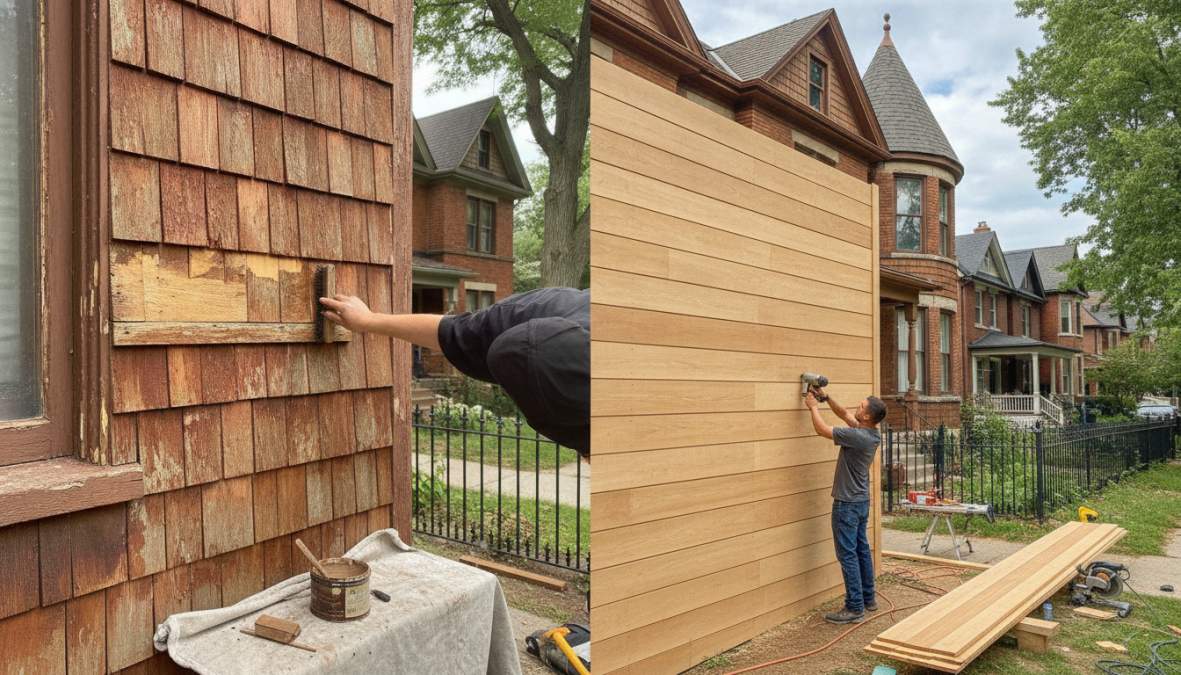
The real cost of replacing original features is often paid years later, in accelerated maintenance on inferior substitute materials, or in the irreversible loss of architectural character. A 100-year-old cedar board, properly stripped and refinished with the correct finish system, will outlast a modern finger-jointed pine substitute by a significant margin.
Restoring a heritage home exterior is genuinely complex work, and the stakes, financial and architectural, are high enough that execution matters as much as intention. Soca Services Painting brings over a decade of experience in exterior finishes across Toronto, with a simple 4-step process that starts with a detailed project proposal so you know exactly what you’re committing to before work begins. Get Your Free Estimate Today and protect the craftsmanship your home has carried for a century.
Frequently Asked Questions
How do you restore original exterior finishes on a historic home?
Restoring heritage home exterior finishes starts with a thorough substrate assessment to identify moisture damage, failing paint, and wood rot. From there, you strip old finishes safely, especially if lead-based paint is present, then apply historically appropriate, breathable finishes such as penetrating oils or low-VOC oil-based coatings. Matching the original material, colour, and sheen level is essential to preserving architectural character and meeting any historic society requirements.
What materials are best for heritage home exterior restoration?
The best materials for historic home exterior restoration are those that allow wood fibers to breathe while offering UV and moisture protection. Penetrating oils, linseed-oil-based paints, and low-VOC breathable coatings are commonly recommended. For cedar siding and decorative woodwork, oil-based finishes with a mildewcide additive perform well in Toronto's humid climate. Always verify material compatibility with your specific substrate before applying to avoid adhesion failures.
Do I need a permit to restore the exterior of a heritage home in Toronto?
In many cases, yes. Toronto has heritage designation bylaws that may require approval from the local historic society or the City's Heritage Preservation Services before altering exterior finishes, even for repainting. If your home is on the Heritage Register or within a Heritage Conservation District, you'll likely need a heritage permit. Always check with the City of Toronto before starting any restoration work to avoid fines or mandatory reversals.
How do you remove old paint from historic wood siding without damage?
The best tools for stripping paint from historic wood include infrared paint removers, low-temperature heat guns, and chemical strippers formulated for wood. Avoid sandblasters or aggressive mechanical grinders, which can destroy fine detailing on decorative woodwork and timber frames. If the home was built before 1978, test for lead-based paint first and follow proper remediation protocols. Work in small sections to control the process and minimize damage to original features.
What are the common mistakes to avoid when restoring heritage home exteriors?
The most common mistakes include skipping the substrate assessment, applying modern vapour-barrier paints over breathable historic finishes (which traps moisture), and using incompatible materials that cause paint adhesion failures. Many homeowners also underestimate lead-based paint risks or ignore historic society compliance requirements. Rushing surface preparation and neglecting a climate-appropriate maintenance schedule are equally costly errors that reduce the lifespan of your restored exterior finishes significantly.
This article was written using GrandRanker