

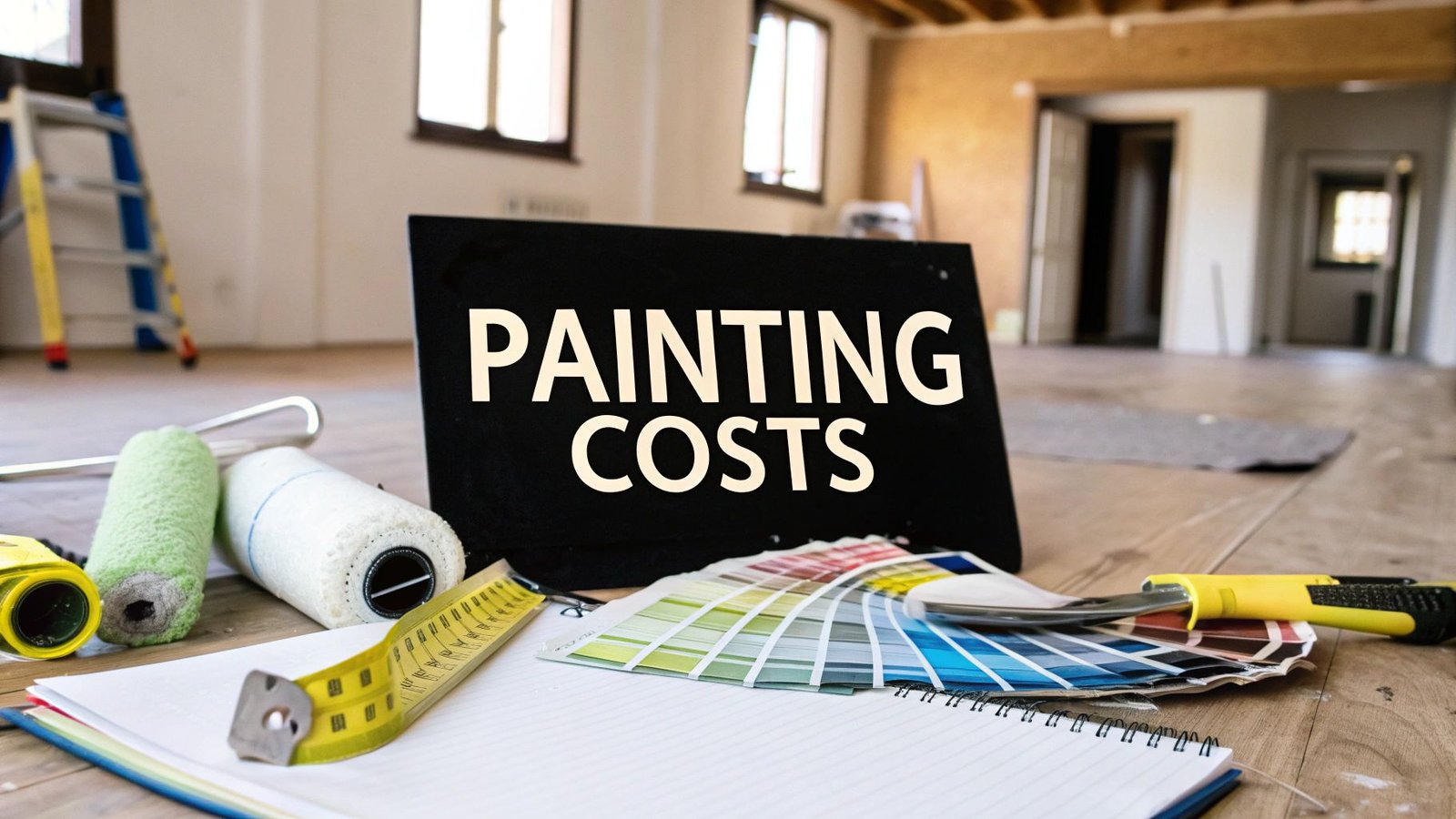
Planning to refresh a room with a new coat of paint is one of the most effective ways to transform a space. The primary question for homeowners in the Greater Toronto Area (GTA) is understanding the associated cost.
In the GTA, the average cost for a professional to paint a room is typically between $400 and $900. This estimate generally includes labour and high-quality materials for a standard 10×12 foot room. The final price can vary based on wall condition and the specific paint products selected.
A Guide to Room Painting Costs in the GTA
Determining the cost to paint a room is a process of evaluating several key variables. The final cost is an aggregate of choices made regarding preparation, materials, and scope of work. A simple refresh with a single coat of paint is a fundamentally different project than one requiring extensive prep work and a premium finish.
This guide provides a structured breakdown of a professional painting quote to help you establish a realistic budget. Whether you are looking for painters near you in downtown Toronto, Mississauga, or elsewhere in the GTA, understanding these factors will assist you in selecting the best contractor for your needs.
Key Factors That Shape Your Quote
Every painting estimate is unique, but they are all based on a few core components. The following elements will have the most significant influence on the price you are quoted:
- Labour: This is the largest component of the cost. It encompasses the painter’s expertise, all necessary preparation, and the final cleanup.
- Materials: This includes the paint and primer, as well as painter’s tape, drop cloths, rollers, and any other supplies required for a professional result.
- Room Size & Complexity: A larger room requires more materials and time. Features like high ceilings, intricate trim, or numerous windows also increase the labour and materials needed.
- Wall Condition: Walls with imperfections such as cracks, holes, or stains require additional preparation. This patching and sanding adds to the labour hours and, therefore, the overall cost.
It is crucial to consider the project in its entirety. For a more comprehensive analysis, our guide on the total https://socaservicespainting.com/house-painting-cost-toronto/ details how professionals construct their estimates.
A fresh coat of paint remains one of the most impactful and cost-effective ways to update a room. It is an investment that provides an immediate return in aesthetic value and enjoyment of your space.
To provide a clear expectation of what to budget for, let’s examine common price points for painting services across the GTA.
Estimated Cost to Paint a Standard Room in the GTA
This table provides a snapshot of potential costs for painting a standard 10×12 foot room, based on the chosen service level.
| Service Level | Average Cost Range (CAD) | What’s Included |
|---|---|---|
| DIY Project | $150 – $300 | This covers basic paint, primer, and essential supplies like brushes, rollers, and tape. |
| Standard Professional | $400 – $700 | Includes professional labour, mid-grade paint, minor wall preparation (e.g., filling small holes), and cleanup. |
| Premium Professional | $700 – $1,200+ | Includes top-tier, low-VOC paint, detailed prep work, ceiling painting, and meticulous trim work. |
Use this as a baseline. It helps set a realistic expectation before you begin gathering quotes from the best local painters and allows you to determine where your project falls on the spectrum.
Decoding Your Quote: Labour vs. Materials
When reviewing a painting quote, it is important to analyze the breakdown beyond the final price. To understand the value, you must consider the core components. A professional painting quote is built on two primary elements: labour and materials. In a competitive market like the GTA, one of these components consistently accounts for the majority of the cost.
The True Cost of a Professional’s Time
Labour constitutes the largest portion of a painting invoice. This is because professional labour extends beyond paint application; it includes the experience, meticulous preparation, and efficiency required to achieve a durable, high-quality finish.
In high-demand areas from downtown Toronto to Mississauga, the time of a skilled painter is a significant investment. The labour cost covers every step of the project:
- Thorough Preparation: This is the critical foundation of a quality paint job. Professionals dedicate a significant amount of time to protecting furniture and flooring, patching all nail holes, sanding imperfections, and precisely taping trim.
- Expert Application: Applying paint smoothly without drips, streaks, or inconsistencies is a developed skill. It involves precise “cutting in” along ceilings and applying multiple, even coats for rich, uniform colour.
- Efficiency and Equipment: Professional crews utilize specialized tools and established systems to complete the job more quickly than a DIY approach, minimizing disruption to your household.
- Complete Cleanup: The project concludes only after the site is left clean, with all materials removed and the space ready for immediate use.
Labour represents the technical skill behind the painting process. It is the steady hand, the trained eye, and the commitment to a perfect result. This expertise is what you are investing in.
When evaluating labour costs, recognize that you are paying for a seamless, stress-free process and a result that will endure.
More Than Just a Can of Paint: Breaking Down Materials
While labour is the primary cost driver, high-quality materials are essential for a professional outcome. A painter’s quote includes a comprehensive toolkit of supplies beyond just the paint.
This encompasses premium primers that enhance colour vibrancy, specialized rollers for different wall textures, high-adhesion painter’s tape that protects baseboards, durable drop cloths, and high-quality brushes for detailed trim work. Using inferior materials can lead to issues like peeling paint and a finish that is difficult to maintain.
For more information on what a comprehensive quote includes, our guide on house painting quotes in Toronto is a valuable resource.
The cost structure is consistent across North America: labour comprises the majority of the expense. Many professional painters charge between $2 and $6 per square foot for walls alone. These rates can increase depending on the room’s condition and complexity, underscoring that the painter’s time and skill are the most significant investment.
How Room Size and Details Drive Up Costs
While it is logical to assume a larger room costs more to paint, the floor plan is only part of the equation. The primary cost driver is not square footage but the total paintable surface area. This is the metric the best painters in Toronto and Mississauga use for accurate project scoping, as it accounts for every surface requiring paint.
More Than Just Floor Space
Consider two rooms, both 10×12 feet. One is a simple bedroom with standard eight-foot ceilings. The other is a dining room with ten-foot ceilings, crown moulding, a bay window, and wainscoting. Although the floor dimensions are identical, the dining room is a larger and more complex project.
The higher ceilings significantly increase the wall surface area. Each additional architectural feature adds time, requires precision, and increases the labour cost.
These elements transform a standard job into a showcase of craftsmanship:
- Crown Moulding & Trim: Requires meticulous taping and precise brushwork for clean lines.
- Windows & Doors: Each casing must be prepped and painted separately, often with a more durable semi-gloss paint.
- Built-in Shelving: These contain multiple surfaces and tight corners, requiring detailed work that cannot be done with a roller.
- High Ceilings: Working on ladders or scaffolding slows the process and introduces complexity and risk.
This is why a quote based solely on room size can be inaccurate. A detailed estimate from a professional painter in the GTA will always account for these features.
Calculating Your Paintable Surface Area
Professionals calculate the total paintable surface area by measuring the perimeter of the room and multiplying it by the ceiling height. This calculation provides the total wall square footage.
As a general rule, one gallon of paint covers 300 to 400 square feet for a single coat. Since professionals typically apply two coats for a durable, even finish, both paint and labour requirements are effectively doubled. You can learn more about how room dimensions impact painting costs and material calculations.
A room’s architectural details—trim, windows, and unique features—define its character. For a painter, these details represent time, skill, and meticulous effort, which are the components of a flawless finish.
This calculation is fundamental. It determines not only the quantity of paint needed but also provides a baseline for estimating the labour hours required.
The Impact on Your Final Quote
Let’s compare our two 10×12 foot rooms to illustrate the impact on a real-world quote.
Room A: The Simple Bedroom
- Surface: Four flat walls, one door, one window, standard baseboards.
- Complexity: Low. The work is straightforward and can be completed efficiently.
- Estimated Time: A professional can typically prep, paint, and clean up in one day.
Room B: The Detailed Dining Room
- Surface: Four tall walls, crown moulding, wainscoting, a bay window, two doorways.
- Complexity: High. This room requires extensive taping, careful brushwork (“cutting-in”), and the use of multiple paint sheens.
- Estimated Time: This project could easily extend to two days or more for perfect execution.
The difference in labour for Room B could add $300 to $600 or more to the final cost compared to Room A. The price is determined not by floor space but by the time and skill needed to manage the complexity.
Choosing the Right Paint Quality and Finish
The paint selected for a project is a critical decision, influencing the final appearance, durability, and long-term maintenance of the walls. This choice is a significant component of the cost to paint a room. Viewing high-quality paint as an investment rather than an expense is prudent, as it often yields better and more lasting results.
Premium materials can streamline the application process and extend the life of the paint job.
Understanding Paint Tiers
Paint is typically available in three quality tiers, each with a different price and performance level. The best painters in Toronto will advise using at least a mid-grade paint for most residential applications, as it provides an optimal balance of cost and quality.
Here is a breakdown of the tiers:
- Economy Paint: A budget-friendly option suitable for low-traffic areas or temporary solutions where durability is not a primary concern. It often requires more coats for adequate coverage and offers minimal resistance to scuffs and stains.
- Mid-Grade Paint: Offers significantly better coverage and a more durable finish. It is the standard for most residential projects, providing a professional appearance at a moderate cost.
- Premium Paint: The highest quality option, formulated with superior resins and pigments. This results in excellent coverage (sometimes in a single coat), superior washability, and enhanced colour retention. Many premium paints are low-VOC (Volatile Organic Compounds), improving indoor air quality.
Investing in a premium, low-VOC paint contributes to a healthier home environment. The higher upfront cost is often offset by requiring fewer coats and providing a finish that withstands daily life for years.
The chart below illustrates how the cost to paint a room scales with size, highlighting the importance of paint quality.
In larger spaces, the superior coverage of a premium paint can reduce both labour time and material costs.
Decoding Paint Finishes
In addition to quality, the paint’s finish or sheen is crucial for both aesthetics and functionality. The correct finish can conceal minor wall imperfections, facilitate cleaning, and add visual depth.
Here is a comparison of different paint finishes and their ideal applications in a home.
Paint Finish and Quality Cost Comparison
| Paint Finish / Quality | Average Cost per Gallon (CAD) | Best For | Durability |
|---|---|---|---|
| Economy Matte | $30 – $45 | Ceilings, closets, very low-traffic areas | Low |
| Mid-Grade Eggshell | $55 – $75 | Living rooms, bedrooms, hallways | Medium |
| Premium Satin | $75 – $95 | Kitchens, kids’ rooms, high-traffic areas | High |
| Premium Semi-Gloss | $80 – $100+ | Trim, doors, bathrooms, laundry rooms | Very High |
Matching the sheen to the room’s function is key to a long-lasting paint job.
- Matte (Flat): Has no sheen, making it excellent for hiding minor surface flaws. It has a velvety appearance but is the least durable and most difficult to clean. Best for low-traffic areas like formal dining rooms or ceilings.
- Eggshell: A popular choice with a slight lustre. It is more durable and easier to clean than matte, making it ideal for living rooms, hallways, and bedrooms.
- Satin: Offers a soft sheen and is more durable and wipeable than eggshell. A great choice for active areas like kids’ rooms and kitchens.
- Semi-Gloss: A tough, moisture-resistant, and easy-to-clean finish. Its noticeable shine makes it perfect for trim, baseboards, doors, and bathrooms.
The choice of finish is as important as the colour. After painting, knowing how to decorate walls effectively can complete the room’s transformation.
Comparing Painter Prices in Toronto vs. Mississauga
Within the Greater Toronto Area, geographic location significantly influences the cost of home improvement services, including the cost to paint a room. A painting contractor operating in downtown Toronto faces different logistical and economic challenges than one based in a suburban area like Mississauga, and these factors are reflected in their pricing.
Why Your Neighbourhood Affects the Painting Quote
While the core service—a professionally painted room—remains the same, the cost of delivering that service varies across the GTA.
Key factors contributing to price differences include:
- Overhead Costs: Businesses in downtown Toronto typically have higher rent and operational taxes, which are factored into their pricing structure.
- Travel and Logistics: Navigating downtown traffic, finding parking, and transporting equipment to high-rise buildings is more time-consuming and costly than operating in suburban locations with easier access. This additional time is a direct labour cost.
- Local Market Demand: The demand for high-quality painters in Toronto’s core is consistently high due to ongoing renovations and new construction. This competitive market can sustain higher price points compared to suburban areas.
Consequently, a quote from a Toronto-based painter may be 10-20% higher than a quote for the identical job in Mississauga.
Price Ranges Across the GTA
To establish a realistic budget, it is helpful to be aware of the typical price-per-square-foot ranges for professional wall painting in different parts of the GTA.
- Downtown Toronto: Prices typically range from $3.00 to $5.50 per square foot. The higher end of this range often applies to condos with difficult access or luxury homes with exceptionally high finishing standards.
- Mississauga & Brampton: The market in these areas is generally more competitive, with prices often between $2.50 and $4.50 per square foot. Simplified logistics and lower overhead for local businesses can result in more budget-friendly rates.
- Outer GTA (e.g., Markham, Vaughan): Pricing is often comparable to Mississauga, although travel time can become a cost factor if the contractor is based further away.
This location-based pricing model is not unique to Toronto. In other major North American cities, the average cost to paint an interior is approximately $2.75 per square foot for walls, rising to nearly $4.70 per square foot when including detailed trim work.
Finding the Best Local Pro Near Me
While it may be tempting to select the lowest bid, the best value is often provided by a contractor local to your area. A painter based in Mississauga will have a better understanding of scheduling and logistics for a project there than a crew travelling from a distant part of the GTA.
Hiring a local professional offers distinct advantages. They are more likely to provide an accurate quote because they are familiar with the specific challenges of working in your neighbourhood. This local expertise typically results in a more efficient and reliable project. Our guide to interior house painting prices outlines what to look for in a quality estimate.
Understanding these regional price variations allows you to set a more accurate budget and ask informed questions, positioning you to find a professional who delivers a superior finish at a fair, transparent price for your location.
DIY vs. Hiring a Pro: Where Should You Put Your Money?
With an understanding of the factors that determine the cost of painting a room, the final decision is whether to undertake the project yourself (DIY) or hire a professional. This choice significantly impacts your budget, timeline, and the quality of the final result.
The decision involves weighing monetary cost against your time, effort, and desired outcome. The DIY approach appears less expensive initially but requires a significant time commitment and physical work. Hiring a professional costs more upfront but guarantees a high-quality, durable finish with no personal labour.
The Real Price Tag on a DIY Paint Job
The primary appeal of a DIY project is eliminating labour costs, which is the largest expense in a professional quote. However, the total cost extends beyond the paint itself. A comprehensive DIY budget must account for all necessary tools and supplies.
Achieving a professional-looking finish requires proper equipment:
- Essential Supplies: High-quality painter’s tape, drop cloths, roller trays, and sandpaper.
- Application Tools: Quality brushes for cutting in, rollers appropriate for your wall texture, and an extension pole for ceilings.
- Preparation Gear: A putty knife, spackle for filling holes, and a sanding block for smoothing walls.
- Potential Rentals: For rooms with high or vaulted ceilings, renting a stable ladder or scaffolding may be necessary for safety.
These supplies can quickly add up to $150 to $300 for a single room. For those committed to the DIY path, researching essential acrylic painting tips for beginners can improve the final outcome.
Bringing in a Professional Painter in the GTA
Hiring one of the best painters in Toronto or Mississauga is an investment in skill, efficiency, and peace of mind. While the initial quote is higher, you are purchasing a guaranteed, high-quality result. A quote from a reputable house interior painter consolidates all costs—labour, materials, and expertise—into a single price.
Hiring a professional provides a complete, end-to-end service, not just paint application.
A professional painter provides a full-service experience that includes meticulous preparation, flawless application with professional-grade equipment, and thorough cleanup. This saves you time and ensures a lasting, high-quality result.
The best practice is to obtain at least three quotes. When comparing them, look beyond the total price. Evaluate the brand of paint being used, the extent of preparation work included, and the projected timeline. This allows for an objective comparison and helps you make the best choice for your home.
Your Top Questions About Painting Costs, Answered
When planning a painting project in the GTA, several common questions arise. Here are objective answers to frequently asked questions from homeowners in Toronto and Mississauga.
What’s the Cost to Paint Just the Trim and Doors?
Painting trim, baseboards, and doors is often more time-consuming than painting walls due to the detailed nature of the work. This precision work requires more skill and time.
Most professional painters price this work separately, either per linear foot for trim or at a flat rate per door. This can add $200 to $600+ to the total room cost, depending on the amount and condition of the woodwork.
Is Painting a Ceiling More Expensive Than Walls?
Yes, painting a ceiling is generally more expensive. It is physically demanding, requires working overhead, and demands skill to achieve a uniform finish without drips or streaks on a large, continuous surface.
A ceiling is typically quoted as a separate line item and can add another $150 to $400 to the total project cost.
How Long Should It Take a Pro to Paint One Room?
For a standard 10×12 foot room with no significant issues, a professional painter can typically complete the job in one day, or 4-8 hours.
This timeline can be extended if the walls require extensive repairs, if there is a dramatic colour change requiring primer, or if the room features complex trim work. In such cases, the project could take two days or more. This variability is a primary reason for differences in labour costs.
For detailed information on painting a room, including an accurate estimate of costs, please visit our website where you can use our comprehensive and easy-to-use painting cost calculator. https://www.socaservicespainting.com




2 Comments