Fresh paint can make a room look brand new, but that sharp smell can also make people uneasy. If you've ever stood in a freshly painted bedroom in Toronto or a renovated condo in Vaughan and thought, “Is this normal, or is something off?”, you've already met VOCs. They're a big reason some paints feel easy to live with and others need time, airflow, and patience before a room feels comfortable again.
For homeowners, property managers, and commercial clients, what is VOC in paint is more than a label question. It affects indoor air quality, odour, cleanup timing, and how soon a space is ready for everyday use. The tricky part is that the number on the can doesn't always tell the full story, especially once colourants are added at the paint counter.
Understanding VOCs and Why They Show Up in Paint
You can have a can that looks harmless on the shelf and still end up with a room that smells strong after the roller work is done. That gap is where VOCs show up. VOC stands for volatile organic compounds, and in paint, those are the ingredients that leave the liquid coating as it dries and cures.
That smell people call “new paint smell” is usually the vapour side of that drying process. The EPA describes VOCs as compounds commonly found in paints and related products because they are used as industrial solvents in manufacturing and application, and it notes that they are emitted as gases from liquid products (EPA indoor air quality guidance). In a closed bedroom in North York or a fresh rental turnover in Vaughan, those vapours can linger longer than the job itself, especially if the windows stay shut.
For a homeowner, that means the can label only tells part of the story. A property manager in Toronto can approve a paint spec that looks low-odour on paper and still get complaints once the colour is mixed and applied. That matters because the can you pick at the counter is not always the same as the finish that ends up on the wall.
Paint chemistry has been shaped by air-quality rules for a long time. Consumer Reports notes that historical federal caps were 250 g/L for flat finishes and 380 g/L for other finishes, while California's South Coast Air Quality Management District set a much stricter 50 g/L limit for all finishes. Those examples show why lower-emission products became more common in the first place, and why Ontario buyers still need to look past the front label when they compare products (Consumer Reports).
Practical rule: if a room still smells strong, the coating is still releasing vapours, even if the walls already look dry.
Manufacturers also use VOC-containing ingredients for reasons that matter on the job. Benjamin Moore says VOCs are often added for better open time and freeze-thaw resistance, and that they are emitted as gases as paint dries (Benjamin Moore). That helps explain why paint has to do more than just cover a wall. It needs to spread well, level smoothly, and hold up in storage and during application, so the chemistry is doing several jobs at once.
There is also a tinting gap that catches a lot of Ontario buyers off guard. If you are comparing a line like Benjamin Moore vs Sherwin-Williams interior paint, the base can may start with one VOC level, then change once colourants are added at the store. In plain terms, the final tinted product can release more vapours than the shelf label suggests, which is why deep colours and custom mixes deserve extra attention.
A fresh coat works a bit like a temporary liquid film. As it dries, the volatile ingredients leave the coating, and the part that stays behind becomes the finished surface on your wall. Once you understand that process, it gets easier to choose the right finish, read paint labels with a little scepticism, and pick products that make sense for a home repaint or a commercial job.
How VOC Content Is Measured and What Labels Really Mean
A paint can may list a tidy VOC number, yet that number is only part of the story. VOC content is measured as mass per volume, usually in grams per litre (g/L) or pounds per gallon, because regulators care about how much solvent can be released from a fixed amount of product. A percentage sounds simpler, but it does not give the same compliance picture.
That measurement method matters because the number on the label comes from the coating formula itself. The MACLAC VOC guide explains that VOC calculations look at coating composition, water, and exempt solvents, not just the marketing language printed on the can (VOC calculation guidance). For a homeowner, that means the label is useful, but it is only the first check.
The gap gets bigger after tinting. Green Seal notes that paint labels do not include VOCs added through colourants at the point of sale, and those colourants can raise the final VOC level quite a bit (Green Seal VOC guide). A base paint on the shelf can look low-VOC, then the finished product changes once the store adds the colour. That matters for deep feature walls, rental suites, and office repaints, where the colour choice is often made after the can leaves the shelf.
A paint can is a bit like a nutrition label that leaves out the toppings added at the counter. The base looks one way, the finished serving can look very different.
Ontario buyers see this problem a lot when they compare labels and final colour mixes. If you are comparing products such as Sherwin-Williams and Benjamin Moore, the practical question is not only what the base can says, but what the tinted result becomes at the counter. For a broader product comparison, see the related guide on Benjamin Moore vs Sherwin-Williams interior paint.
The common reference points are still useful. Low-VOC flat paint is often defined as under 50 g/L, and zero-VOC as under 5 g/L (Alameda County Environmental Health paint fact sheet). That does not mean every product at those levels performs the same, but it gives you a technical benchmark instead of a vague “eco-friendly” claim.
For Toronto and Vaughan homeowners, the safest habit is simple. Ask for the VOC number after tinting, not only before it. That one question can change how a paint behaves in an occupied bedroom, hallway, or suite, especially when indoor comfort and quick turnaround both matter.
Comparing High-VOC, Low-VOC, and Zero-VOC Paints
A can with a cleaner label does not always mean a cleaner jobsite. Once paint is tinted, mixed, and opened in a real room, the odour, cure time, and indoor exposure can feel different from what the shelf tag suggests. That is the gap Ontario homeowners and property managers run into, especially on condo refreshes, rental turnovers, and occupied offices where the room has to be usable again soon.
The simplest way to compare paint types is by VOC level, odour, and how well each product fits the space you are painting.
| Paint Categories at a Glance | VOC Level (g/L) | Best Use Case | Durability | Odour Level |
|---|---|---|---|---|
| High-VOC paint | Higher than low-emission options | Some exterior or specialty uses where product performance is prioritised | Can perform well, depending on formulation | Stronger |
| Low-VOC paint | Under 50 g/L for flat paint, as commonly cited (Consumer Reports, Alameda County fact sheet) | Bedrooms, living areas, rentals, many commercial interiors | Often a solid balance of performance and comfort | Milder |
| Zero-VOC paint | Under 5 g/L as commonly cited (Alameda County fact sheet) | Occupied interiors, sensitive spaces, quick-return projects | Can be excellent, but product selection matters | Lowest |
High-VOC paint still has a place in the market because certain formulas are built for harder conditions or specialized job requirements. In practical terms, a contractor may still choose it for a situation where the coating needs more working time on the wall, stronger leveling, or better tolerance for storage and weather stress. That can make sense on the right project, but it also means more odour and a higher exposure burden in a room that stays occupied.
Low-VOC paint is the middle ground many Toronto and Vaughan clients end up asking for. It usually gives a better balance between application feel, day-to-day comfort, and the kind of durability people expect in bedrooms, hallways, rentals, and office interiors. For property managers, that middle ground matters because it helps keep the unit practical for occupants without pushing the project into the harsh smell that can come with older, higher-emission coatings.
Zero-VOC paint is often the first choice for bedrooms, nurseries, and closed-in rooms where people want the least noticeable odour. It also fits projects that need a quicker return to normal use, such as a condo bedroom that has to be back in service fast or a suite that cannot sit empty for long. The trade-off shows up after tinting. A zero-VOC base can pick up additional VOCs from colourants, so the finished can may not stay as clean on paper as the base label suggested.
That is why the can label alone is only part of the story. The better question is how the fully tinted paint will behave in the room you live or work in. If you are comparing products and want a cleaner finish strategy for an occupied home, the guide on eco-friendly painting in Richmond Hill is a useful companion.
Canadian and Ontario VOC Regulations You Should Know
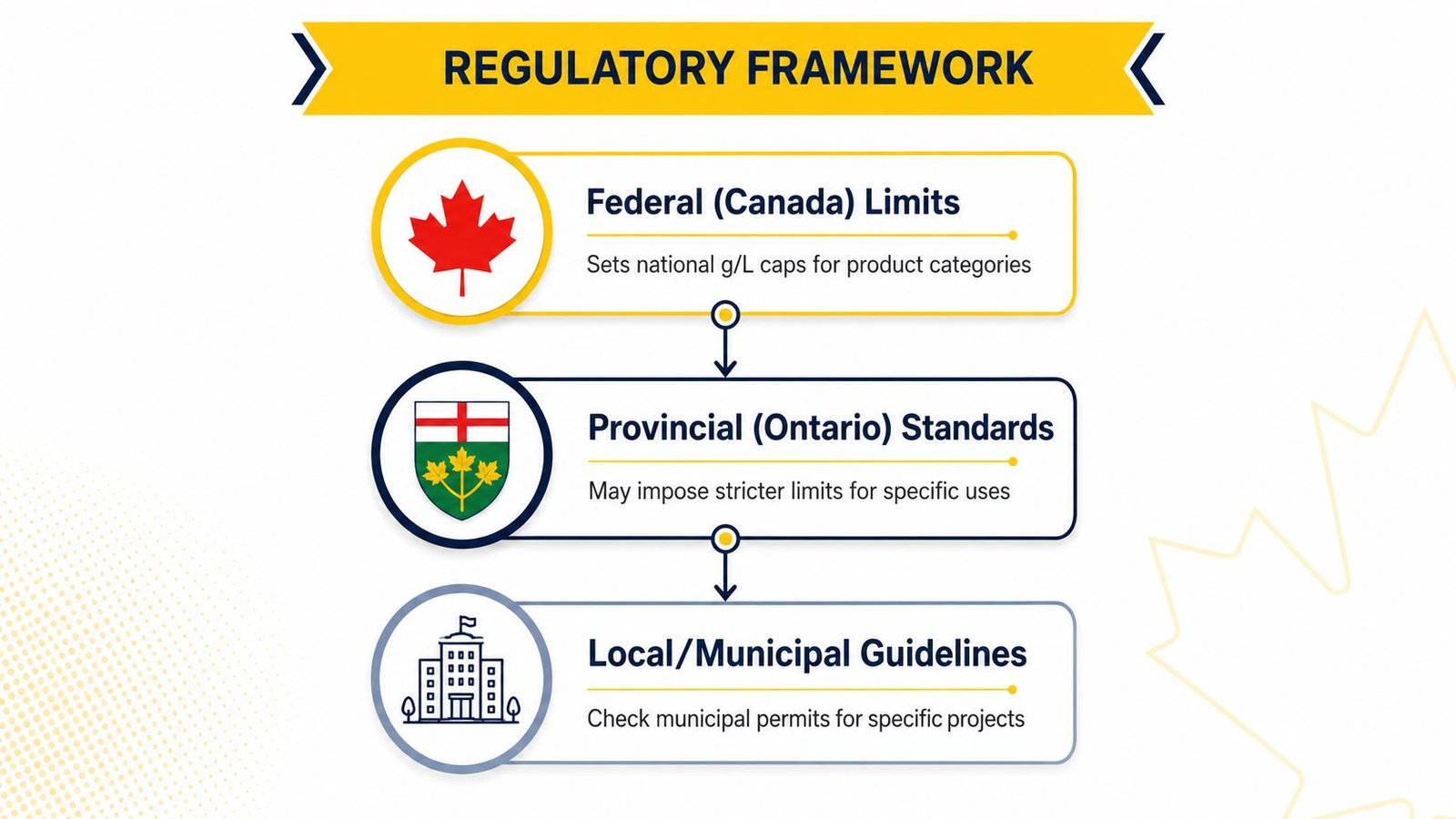
A paint can on a shelf in Ontario looks straightforward, but the rules behind it are layered. Federal VOC limits for architectural coatings set the baseline in Canada, then municipal requirements, building policies, and environmental certification targets can shape what gets used on a job. For a homeowner, that usually means the product choices already available in stores have passed through a regulated market, yet the label still does not tell the whole story.
The key point is simple. Regulations set maximum limits, they do not guarantee the cleanest option in the room. A can that meets the rule can still release more VOCs than another compliant product, especially after tinting. If you are choosing interior coatings for a house in Vaughan or a multi-unit property in Toronto, compare the technical data sheet, ask about the VOC level in the fully tinted finish, and confirm the product suits occupied spaces.
Heritage projects need that same careful reading, sometimes more. Older homes often bring extra variables, such as trim details, plaster, and previous coatings that can affect how a repaint performs. If you are sorting out that kind of work, the guide on painting heritage homes in Ontario is a useful reference.
Check the documentation, not just the marketing language. If a product is specified for a rental portfolio, commercial unit, or building audit, the technical data sheet should line up with the job.
Municipal rules can also affect permits and project planning, especially on larger or more complex work. That is why commercial clients often ask for product documentation before the crew starts, not after. The practical habit is straightforward. Confirm the VOC category, ask for the final tinted version if colour matters, and keep the product sheet with the job file. That small step helps avoid surprises if a project is reviewed, inspected, or handed off to another contractor.
Minimizing VOC Exposure During Your Painting Project
A paint job can look harmless from the hallway and still leave a room heavy with vapours after the first coat. That is why the work starts with airflow, not just colour. Opening one window helps a little, but larger jobs need cross-ventilation, so fresh air comes in from one side of the space and leaves from another. An exhaust fan can help pull that air through the room, especially in bathrooms, kitchens, basements, and enclosed offices where fumes tend to hang around.
The next layer is protection. A basic dust mask is not the same as a respirator, and it does not do the same job. If you are painting inside a closed room or using a stronger coating, wear a proper respirator that fits well, and keep the space supplied with fresh air. For many occupied-space projects in Toronto and North York, that combination is one of the simplest ways to keep the work more comfortable for everyone nearby.
A short field checklist helps keep things under control:
- Open windows and use fans early: Start airflow before the first coat goes on, not after the room already smells strong.
- Seal containers between coats: Close the can while you are working so vapours do not keep escaping.
- Plan breaks around airflow: Step outside when the smell builds up, especially in smaller rooms or hallways.
- Store leftover paint properly: Keep lids tight and label cans clearly so old product does not turn into a guessing problem later.
- Handle disposal responsibly: Follow local waste rules for leftover paint, empty cans, and solvents instead of pouring anything down a drain.
If odor is the part your household notices first, a practical guide on how to get rid of paint odours pairs well with the ventilation habits above.
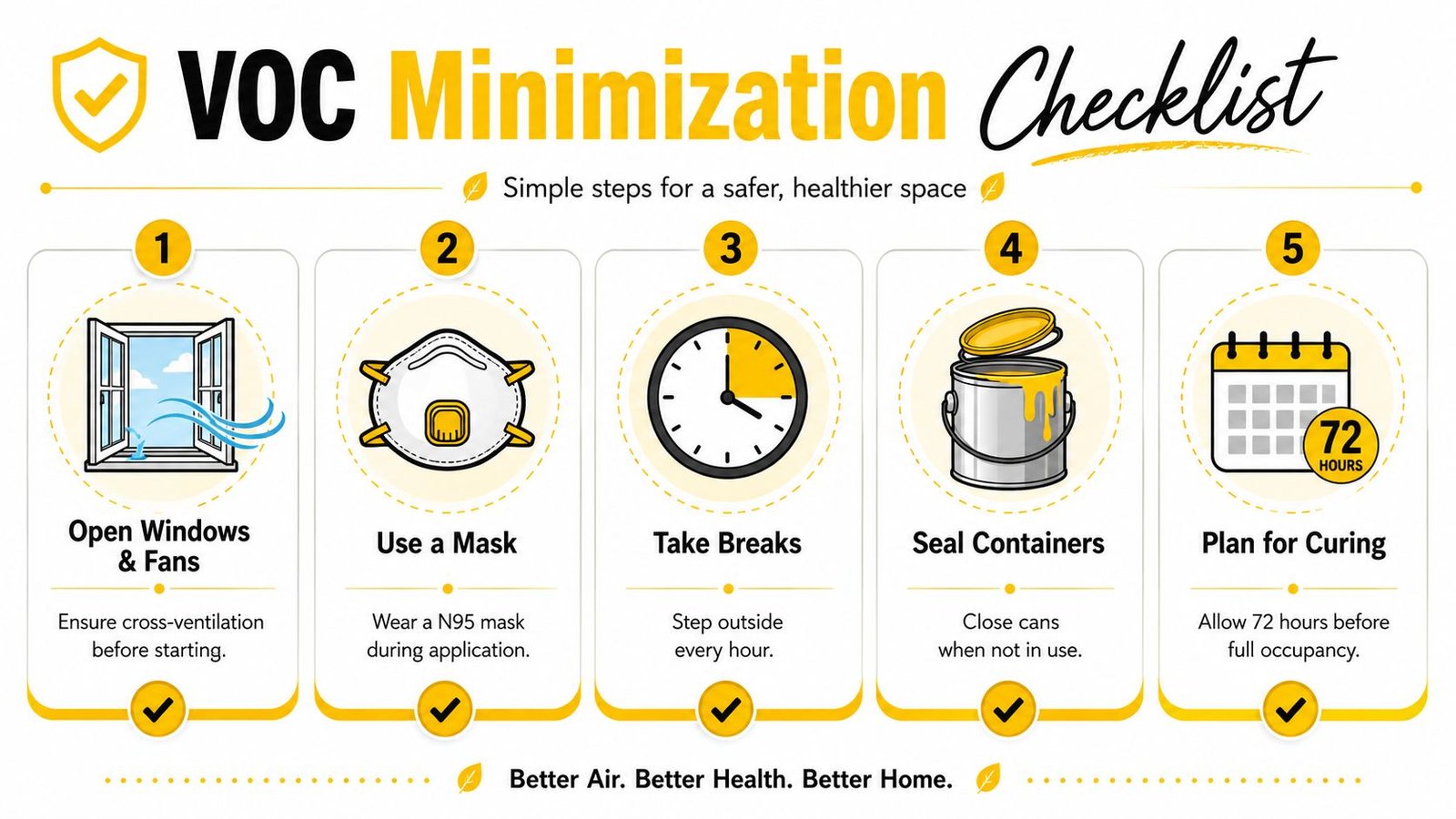
Cure time creates another point of confusion. A paint can may carry a low-VOC or zero-VOC label, but that does not mean the room is ready the moment the roller tray is cleaned out. Airflow, room size, coating thickness, and the specific product all affect how long vapours linger, especially after tinting. The Benjamin Moore product guidance notes that zero-VOC or emission-free claims are tied to how the coating performs after application, not just what is printed on the can. That is the hidden gap many Ontario homeowners and property managers miss. The label may look reassuring at the store, yet the fully tinted finish can behave differently on site.
This is why a room can still smell fresh, and still need time. In practice, the safer approach is to treat the can label as a starting point, then judge the finished space by the room itself, not by the marketing language on the shelf.
There is also a difference between a product being low-odor and a room being ready for people to live or work in. For a fuller look at practical odor control after painting, see the guide on how to get rid of paint odours. The same habits that move air through the space also help the finish settle down more evenly.
Why Professional Painters Make a Difference with VOC Management
A paint crew can do more than roll colour onto walls. On a real job, an experienced team looks at product choice, room occupancy, airflow, drying conditions, and cleanup before the first can is opened. VOC management sits inside that planning, not after the fact.
That planning matters because the label on the can is only part of the story. A painter who understands how tinting, coating thickness, and room use affect exposure can make better choices for occupied homes, rentals, and workplaces. In Toronto and Vaughan, that usually means balancing finish quality with the time people need to stay out of the space.
Professional painters also apply coatings more efficiently. Careful prep, the right roller cover, and the right finish selection can improve coverage and durability, which often cuts down on the need for extra coats. Fewer coats mean less product in the room, fewer passes across the same surface, and less time breathing the jobsite air. For property managers and commercial owners, that can make the difference between a project that disrupts the schedule and one that stays on track.
Product knowledge matters too. A painter who works with different brands and surface types knows that wall paint, trim paint, and cabinet coatings do not behave the same way. If you are comparing cabinet finishes, the Arsh Art Cabinet Refinishing paint guide is a useful reference for how product selection changes with the surface and the job. The same thinking applies across the rest of the home. A professional who knows those differences can help avoid choosing a coating that looks right on paper but performs poorly once it is mixed, tinted, and applied.
Local experience helps with the practical side as well. Crews who work in occupied homes and active businesses know how to stage rooms, reduce disruption, and keep dust, odour, and vapours under control while the project moves forward. That kind of process matters in rentals and commercial interiors, where the work has to look clean and be usable again without unnecessary delay.
For Toronto and Vaughan homeowners comparing contractors, the benefits of hiring professional painters in Toronto often show up in the parts people do not see right away. Better planning, steadier communication, and a cleaner jobsite all reduce the chance of complaints, rework, or a space that stays out of service longer than expected.
The best paint job is the one people notice for the finish, not for the smell.
If you are weighing DIY against hiring out, consider the hidden cost of rework. A repaint done too quickly, with the wrong product or weak ventilation, can lead to complaints, delays, and a second round of labour. Professional planning lowers those risks and usually gives you a better result the first time.
Your Next Steps for Safer and Smarter Paint Choices
Start with the room, not the can. If it’s a bedroom, office, rental unit, or any occupied interior, ask what VOC level makes sense after tinting, not just before. Then look at airflow, drying time, and how quickly the space needs to be usable again.
If you manage properties, build a simple specification standard. Decide which rooms need low-VOC or zero-VOC products, keep the data sheets on file, and make sure contractors understand the occupancy schedule before work starts. If you’re a contractor, stay current on product changes and local compliance expectations so you can give clients clear answers instead of sales talk.
For homeowners, the easiest path is three steps. First, check the VOC category and the final colourant impact. Second, match the product to the room and its ventilation. Third, plan the project so people aren’t forced back into a space before it’s ready.
Understanding VOCs isn’t about fear. It’s about making cleaner choices, reducing surprises, and getting a finish that looks good and lives well in the world.
If you’re planning an interior repaint in Toronto, Vaughan, North York, or King City, Soca Services Painting can help you choose the right products and handle the work with care. Visit Soca Services Painting to learn more about their professional painting services and book a consultation for your next project.