Table of Contents
-
Why Toronto Homeowners Invest in Professional Exterior Deck Staining Services
-
Best Deck Stain for Ontario Climate: Stain Type Comparison Guide
-
How to Prepare a Deck for Staining: Step-by-Step Inspection Checklist
-
Cost of Deck Staining in Toronto and How to Get Your Free Estimate
Last Updated: June 2, 2026
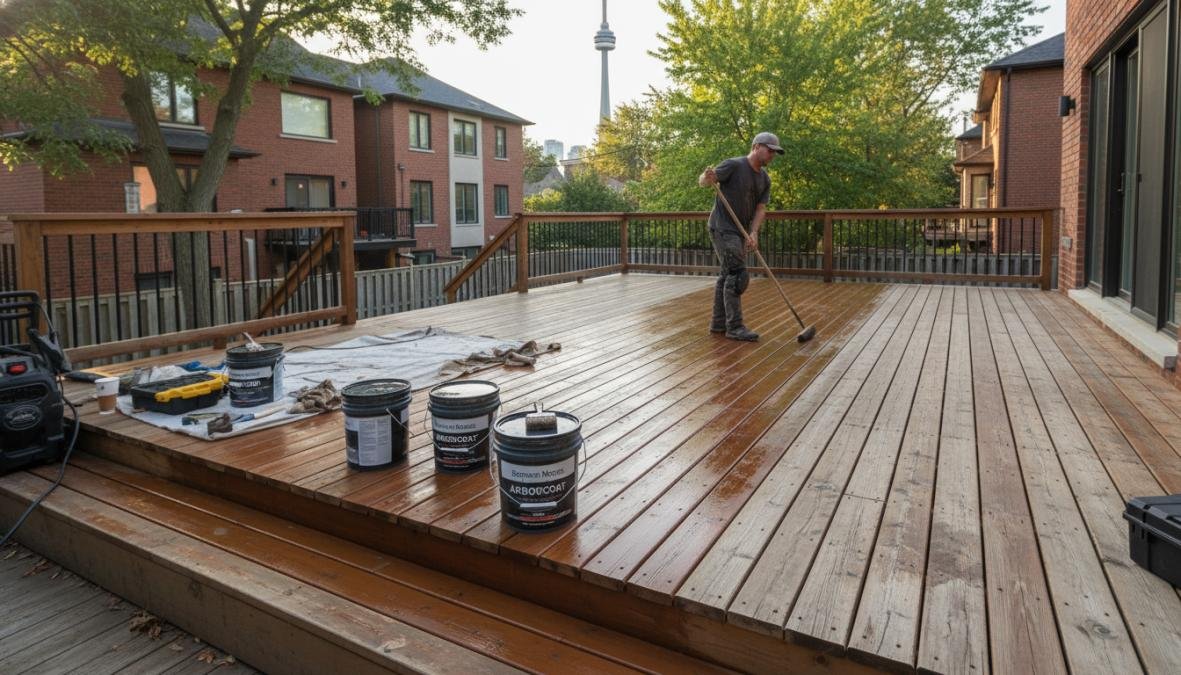
Toronto homeowners who invest in exterior deck staining services toronto know one hard truth: the city’s climate is brutal on wood. Freeze-thaw cycles, summer UV exposure, and heavy spring rains crack, grey, and rot unprotected deck boards within a few seasons. At Soca Services Painting, we’ve seen how the difference between a deck that lasts a decade and one needing full replacement in five years often comes down to one decision: professional staining versus hoping for the best.
Why Toronto Homeowners Invest in Professional Exterior Deck Staining Services
Toronto’s climate is one of the harshest environments for exterior wood in North America. Sub-zero winters and humid summers create the temperature swings that kill unprotected decks fastest.
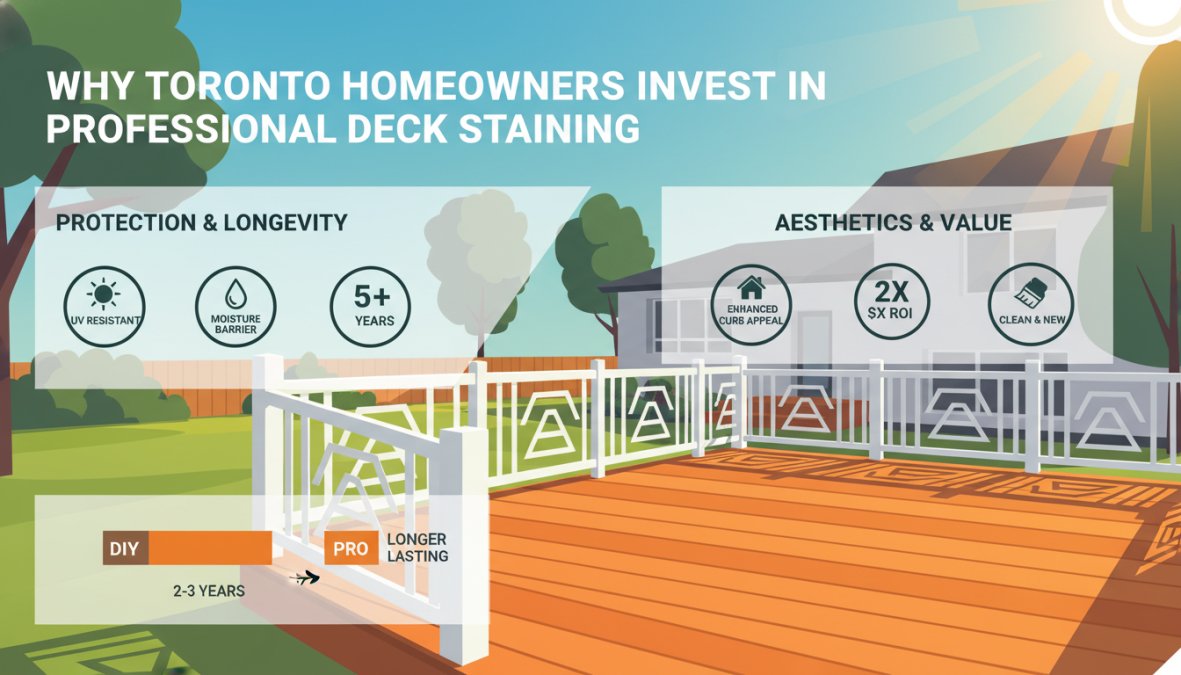
Wood is porous. Moisture penetrates fibers in fall, freezes and expands in winter, and forces those fibers apart. Repeated over two or three seasons, the result is warping, cracking, and rot. A quality moisture barrier applied through professional staining stops that cycle before it starts. A properly stained deck also signals a well-maintained home to buyers, a distinction that matters for GTA resale value.
The case for professional staining over DIY comes down to three things:
-
Surface preparation: Professionals use pressure washing, wood brightener, and stripping to open the wood grain. Skipping this means stain sits on dead wood cells and peels within a season.
-
Product selection: Professional-grade stains formulated for Ontario’s climate outperform consumer products on freeze-thaw cycles, UV protection, and moisture resistance.
-
Application consistency: Lap marks, missed boards, and over-application are common DIY mistakes that cause uneven absorption and premature failure.
According to the Canadian Wood Council’s guidance on exterior wood maintenance, proper sealing and staining can extend the functional lifespan of exterior wood structures by several years compared to untreated surfaces.
Best Deck Stain for Ontario Climate: Stain Type Comparison Guide
Choosing the best deck stain for Ontario climate is not a one-size-fits-all decision. Wood species, deck age, previous treatments, and exposure level all affect which product performs best.
|
Stain Type |
Best For |
Durability |
Maintenance Frequency |
Notes |
|---|---|---|---|---|
|
Oil-based stain |
Cedar, pressure-treated wood, older decks |
High |
Every 2-3 years |
Penetrates deep into wood fibers; excellent moisture barrier |
|
Water-based stain |
New wood, composite-adjacent, low-VOC preference |
Moderate-High |
Every 1-2 years |
Faster dry time; easier cleanup; improved UV protection in modern formulas |
|
Semi-transparent stain |
Showing natural wood grain while adding colour |
Moderate |
Every 1-2 years |
Best aesthetic balance; less hiding power than solid stains |
|
Solid stain |
Heavily weathered or damaged wood |
High |
Every 3-5 years |
Acts more like paint; hides grain but protects compromised surfaces |
Oil-based stains remain the preferred choice for cedar and pressure-treated wood in Toronto’s climate, penetrating deeply to resist freeze-thaw damage. Water-based stains have closed the performance gap significantly, many GTA professionals now use them as their default for new pressure-treated wood. Semi-transparent vs. solid is an aesthetic and condition decision: semi-transparent preserves natural grain on sound wood; solid stain is more forgiving on greyed or previously painted surfaces.
For exotic hardwoods like Ipe, Cumaru, or Tigerwood, standard stains won’t work. As documented in the Wood Finishing Enterprises technical resource on hardwood deck care, these dense woods require specialized penetrating oils and specific preparation to accept any coating.
How to Prepare a Deck for Staining: Step-by-Step Inspection Checklist
Most deck staining failures trace back to inadequate preparation, not product choice. The prep work is where the job is won or lost.
Step-by-Step Deck Inspection and Preparation Checklist:
-
Structural inspection: Press a screwdriver into suspect boards. If it sinks more than 6mm, replace the board before staining.
-
Fastener check: Replace raised nails, loose screws, and corroded fasteners with stainless or coated deck screws.
-
Mould and mildew assessment: Treat mould with a wood cleaner before washing, don’t just pressure-wash over it.
-
Previous finish condition: Perform the water bead test. Peeling or flaking finish must be stripped before new stain is applied.
-
Pressure washing: Wash the entire deck at appropriate PSI for the wood species. Cedar and older pressure-treated wood require lower pressure.
-
Wood brightener application: Apply an oxalic acid-based brightener to neutralize alkalinity and open the wood grain for better stain absorption.
-
Dry time: Allow 48-72 hours of dry weather after washing before staining.
-
Sand and stain preparation: Lightly sand rough areas and raised wood fibers after drying for even stain penetration.
-
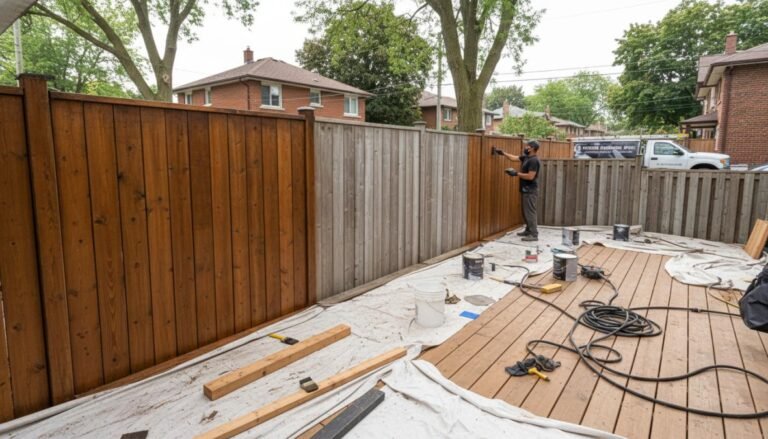
Masking: Protect siding, glass, and adjacent surfaces with painter’s tape and drop sheets.
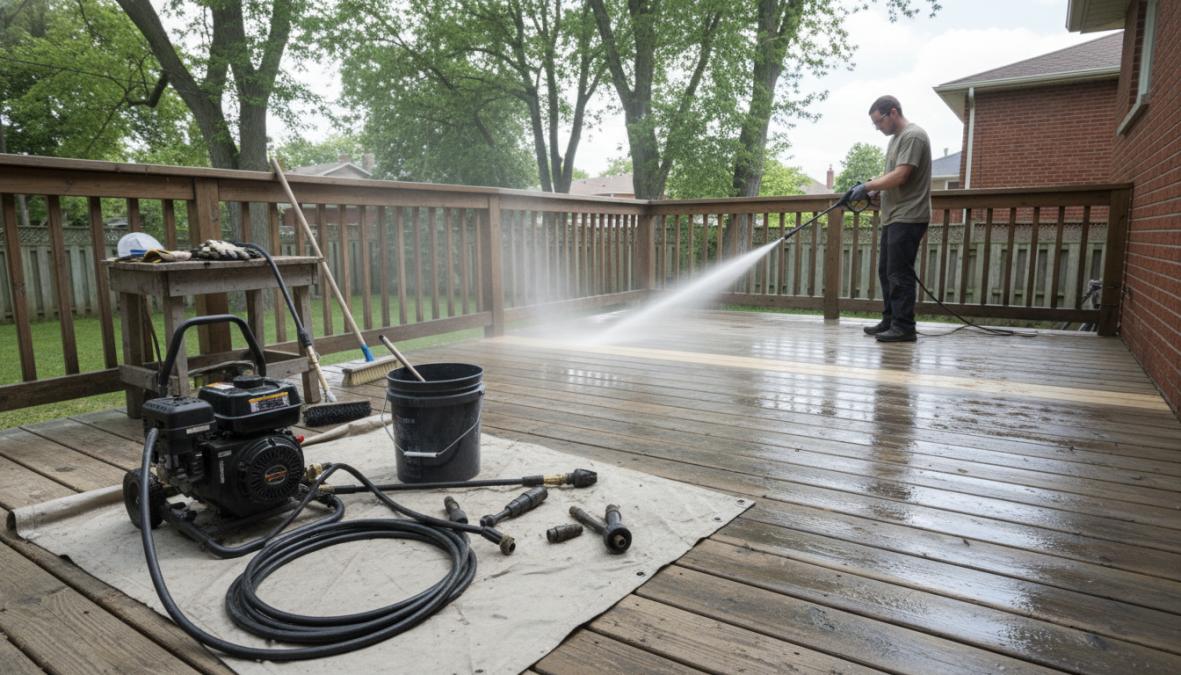
Pressure washing alone is not sufficient. It removes surface dirt but also raises the wood grain slightly. Sanding after washing smooths that raised grain so stain penetrates evenly rather than absorbing unevenly into rough patches.
As referenced in Natural Resources Canada’s guide to wood products and exterior durability, surface preparation quality is the primary determinant of coating longevity on exterior wood.
Cost of Deck Staining in Toronto and How to Get Your Free Estimate
The cost of deck staining in Toronto varies based on deck size, wood condition, stain type, and preparation required. Project costs range from several hundred dollars for basic maintenance staining to several thousand for full restoration work.
Factors that affect your final cost:
-
Deck size: Measured in square footage, including railings and stairs
-
Wood condition: Weathered wood requires more prep time and sometimes stripping
-
Number of coats: New wood often needs two coats; restoration may need more
-
Stain product chosen: Professional-grade products cost more but deliver better longevity
-
Accessibility: Multi-level decks requiring ladders add labour time
-
Repairs: Rot replacement, fastener replacement, and structural fixes are typically quoted separately
What to expect from a professional estimate:
-
A physical inspection of the deck, not just a measurement
-
A clear breakdown of prep work versus staining labour
-
Specific product recommendations with reasoning
-
A written proposal with scope, timeline, and materials
Soca Services Painting provides detailed project proposals outlining exactly what’s included, which products will be used, and the timeline. With over a decade of experience in Toronto and the broader GTA, including North York and Vaughan, the team brings precision to exterior staining that prevents callbacks and re-dos. According to the Ontario College of Trades guidance on contractor standards, consumers should always request written scope documentation before authorizing exterior restoration work.
Liability insurance and WSIB compliance are non-negotiable when hiring any contractor for exterior deck staining services toronto. Ask for proof of both before signing anything.
Toronto’s climate gives wood no favours. A deck without proper staining is on a slow countdown to replacement. Soca Services Painting brings over ten years of experience, a stress-free 4-step process, and detailed project proposals that leave nothing ambiguous. Get your free estimate today and find out exactly what your deck needs to perform through 2026 and beyond.
Frequently Asked Questions
How much does professional deck staining cost in Toronto?
The cost of deck staining in Toronto typically ranges from roughly $800 to $5,000 or more depending on deck size, wood condition, stain type, and whether surface preparation like pressure washing or sanding is required. Smaller decks in good condition cost less, while larger decks needing full wood restoration and refinishing will be on the higher end. Soca Services Painting offers a free estimate so you get an accurate, no-obligation quote before any work begins.
What is the best type of stain for Toronto's weather?
For the Ontario climate, a weather-resistant stain with strong UV protection and moisture barrier properties is essential. Oil-based stains penetrate deeply into wood fibers and offer excellent protection against warping and rot caused by Toronto's freeze-thaw cycles. Water-based stains are lower in VOCs, dry faster, and have improved considerably in durability. For cedar and pressure-treated wood, a semi-transparent oil-based or premium water-based formula designed for Canadian winters is generally recommended.
When is the best time of year to stain a deck in Toronto?
Late spring through early fall — roughly May to September — is the ideal window for exterior deck staining services in Toronto. Temperatures should be consistently above 10°C with no rain forecast for at least 24–48 hours after application. Avoid staining in direct midday sun, as this can cause the stain to dry too quickly and result in uneven absorption. Booking early in the season helps secure scheduling before peak demand.
How often should you stain your deck in Ontario?
Most decks in Ontario should be restained every 2 to 3 years, though this varies by wood type, stain quality, and sun and moisture exposure. Cedar and pressure-treated wood in high-traffic or sun-exposed areas may need attention every 1 to 2 years. A simple annual inspection — checking for graying, cracking, or water absorption — helps you catch the right time before costly wood restoration is needed. Soca Services Painting can advise on a maintenance schedule during your free estimate.
Is it worth hiring a professional for deck staining in the GTA?
Yes, for most homeowners, professional exterior deck staining services in Toronto are worth the investment. Professionals use professional-grade products, proper surface preparation including pressure washing and sanding, and have liability insurance and WSIB compliance. DIY staining without correct prep — especially skipping wood stripping or brightener steps — often leads to peeling and premature failure. A professional finish lasts longer, looks better, and protects your deck's structural integrity against Ontario's harsh climate.