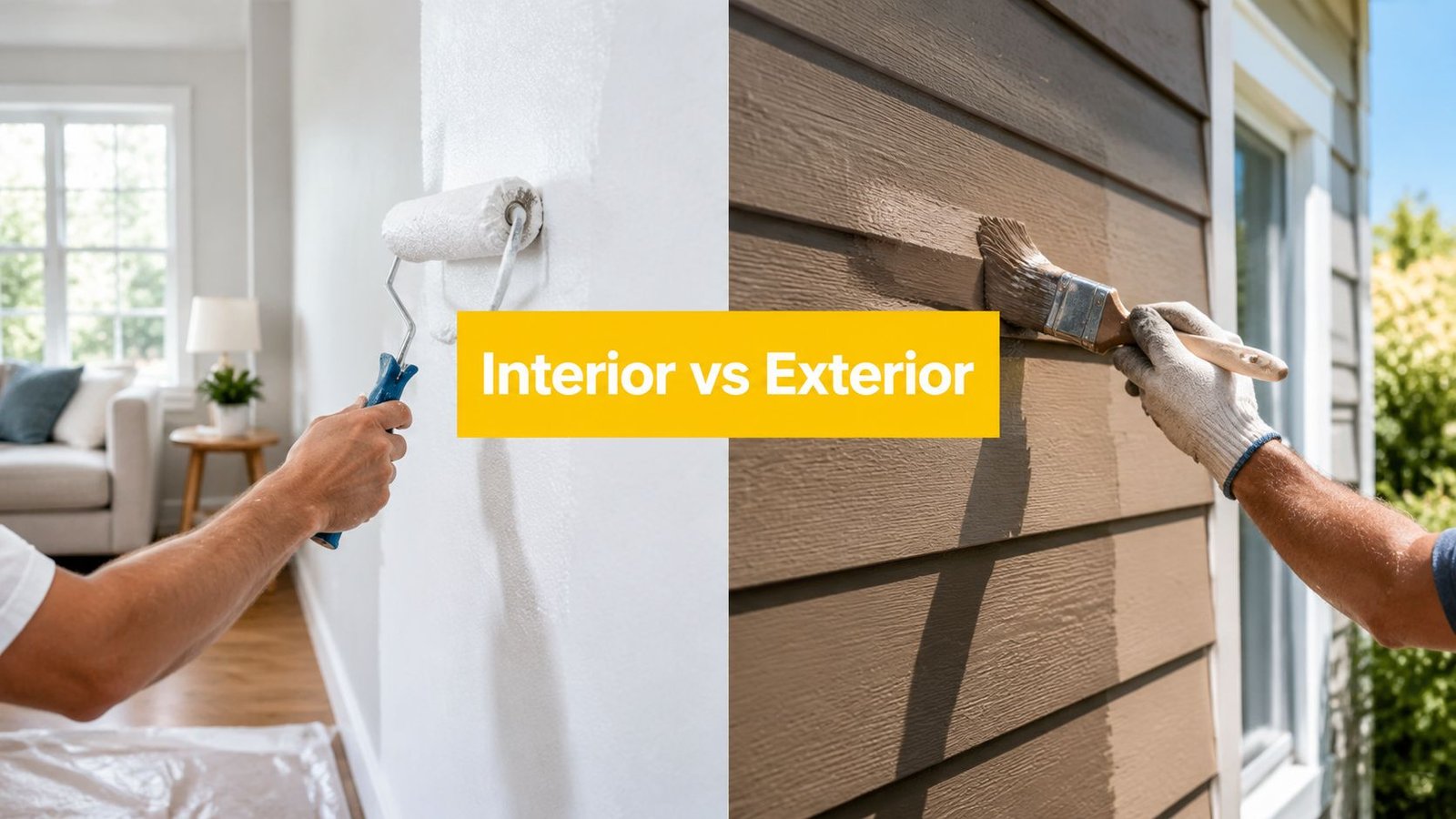
You're standing in a paint aisle with a colour sample in one hand and two nearly identical cans in the other. One says interior, the other says exterior, and both promise a durable, professional finish. For a Toronto-area home, that label isn't marketing fluff. It tells you how the coating was designed to behave on drywall, trim, siding, masonry, or any other surface facing Ontario weather.
The wrong choice can look fine on day one and still fail once the surface starts absorbing moisture, expanding, contracting, or taking daily abuse. This guide breaks down interior paint vs exterior paint through formulation, durability, sheen, VOC rules, surface preparation, and the conditions a real job faces from Toronto and North York to Vaughan and King City.
Why the Can Label Matters for Toronto Homeowners
A North York homeowner once picked up a can of bedroom paint at a big-box store on Wilson Avenue. The plan sounded harmless: refresh the spare bedroom, then use the leftover paint on a backyard fence. The colour matched the house, the label mentioned durability, and saving half a can felt sensible.
It wasn't.
The interior paint had been designed for a relatively stable indoor environment, not for wet wood, direct sunlight, snow, and repeated temperature changes. After one freeze-thaw cycle, the east-facing fence began losing adhesion. The film softened, cracked, and peeled where the boards moved. Inside the house, the opposite mistake caused a different problem. Exterior paint applied to a living-room wall left a stronger odour and brought outdoor-focused additives into an enclosed space. Dampness near the wall later showed through as mildew staining because the coating choice hadn't addressed the moisture source.
I've been called back to jobs where the colour was perfectly acceptable but the product category was wrong. Repainting those surfaces costs more than choosing the correct coating at the beginning, especially when failed paint has to be scraped, sanded, cleaned, and primed before a new finish can adhere.
The label identifies the coating's job
Interior paint prioritizes low odour, washability, stain resistance, and a smooth appearance. Exterior paint prioritizes flexibility, moisture resistance, UV protection, and adhesion during weather changes. Those priorities overlap slightly, but they aren't interchangeable.
Toronto homes also face a climate that makes shortcuts visible. A sheltered porch, a sunny south wall, a damp north elevation, and an unheated garage all place different demands on a coating. King City properties may also have exposed siding, outbuildings, and wood features that move more dramatically through seasonal weather.
Three questions guide a sound recommendation:
- Formulation intent: Was the resin designed for indoor cleaning or outdoor movement?
- Performance expectation: Does the surface need scrub resistance, flexibility, fade resistance, or moisture control?
- Regulatory context: Does the product meet the applicable Canadian VOC category and fit the location where it'll be used?
Practical rule: Choose paint for the surface and exposure, not because the leftover colour happens to be available.
How Interior and Exterior Paint Are Formulated Differently
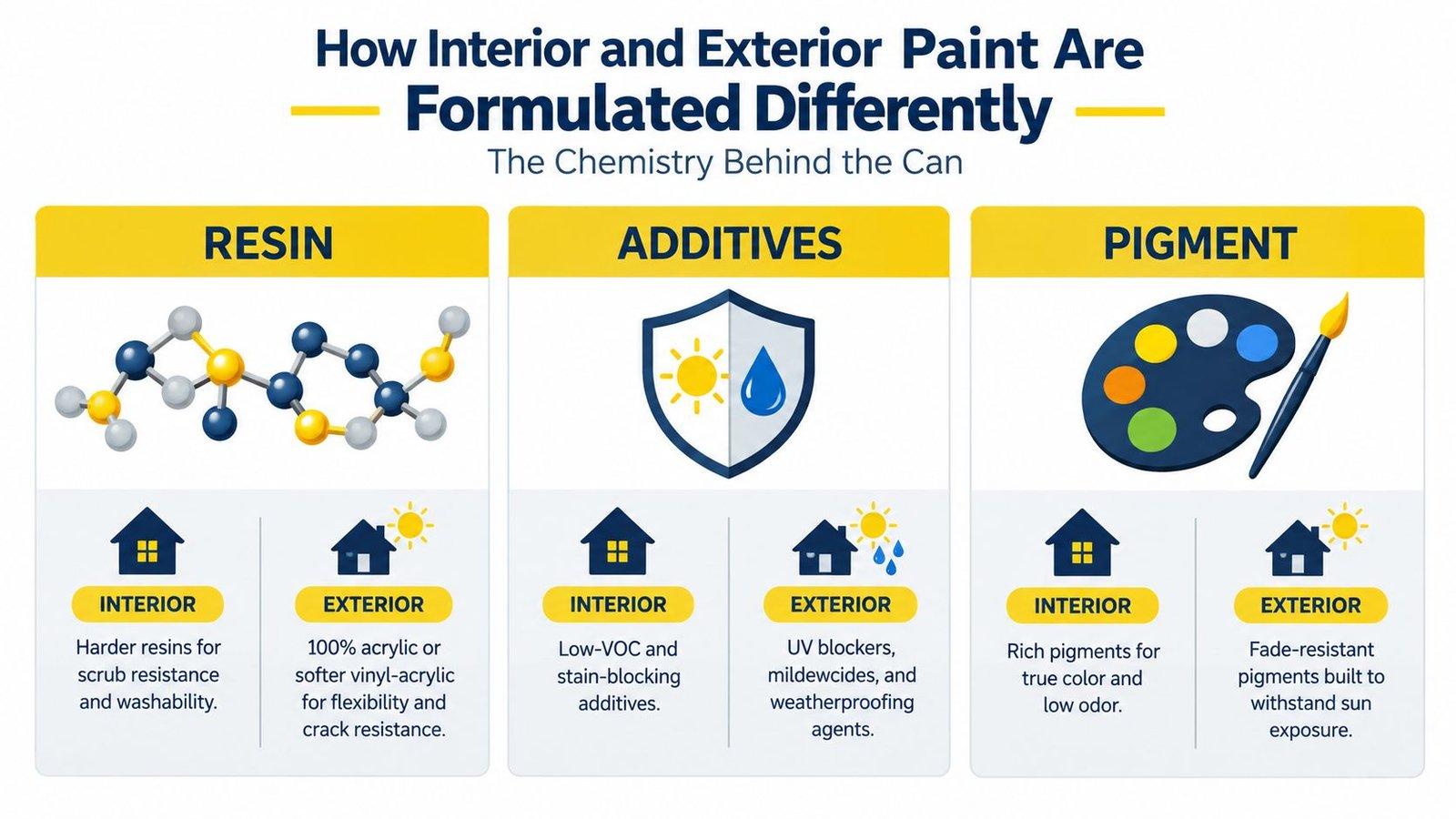
The simplest way to understand the difference is to look at three parts of the coating: resin, additives, and pigment. You don't need a chemistry background to use this framework. Each part solves a different problem, and the balance changes between a bedroom wall and an exposed exterior.
Resin controls movement and toughness
Exterior coatings commonly use 100% acrylic or softer vinyl-acrylic resins. These films can flex as wood siding, trim, and other substrates expand and contract with temperature and moisture. That flexibility helps reduce premature cracking and peeling.
Interior paints often use harder styrene-acrylic or alkyd-modified resin systems. The goal is different. A hallway wall needs to tolerate fingerprints, furniture contact, and repeated cleaning without becoming rough or losing its sheen. A harder interior film can provide the scrub resistance that homeowners notice around light switches, doors, and children's rooms.
That doesn't mean one resin is universally stronger. It means each one is tuned for a different kind of stress. A flexible exterior film may not provide the same hard, washable feel indoors, while a hard interior film can become brittle when exposed to outdoor movement.
For projects involving older woodwork or historic exteriors, the choice may also involve oil-based and water-based systems, compatibility, and primer selection. Soca Services' guidance on oil-based versus water-based paint for historic exteriors is useful when the existing coating makes a simple water-based topcoat risky.
Additives protect against different threats
Exterior formulas may include mildewcides, UV absorbers, and weather-resistance additives. These ingredients support performance in sun, rain, and damp conditions. They're appropriate for an outdoor film, but that doesn't make the product suitable for an enclosed bedroom or living room.
Interior formulas instead emphasize low odour, stain blocking, smooth levelling, and comfortable application in occupied spaces. Putting exterior paint inside can create an unsuitable indoor-air-quality situation, while putting interior paint outdoors leaves the film without the protection it needs.
Pigment affects colour stability
Exterior pigments are selected to resist fading and breakdown under sunlight. Interior pigments focus more on colour richness, coverage, and a refined finish under controlled lighting. The result is practical: a wall colour that looks accurate indoors may not retain the same appearance on a sunny exterior elevation.
A product's colour, sheen, and brand matter, but the underlying category matters first. Benjamin Moore and Sherwin-Williams both offer lines for distinct interior and exterior applications, and a professional specification still needs to match the product to the substrate rather than relying on the brand name alone.
Side-by-Side Performance Comparison
Interior and exterior paint can share similar colour families, but they behave differently once the surface starts working. Interior walls usually encounter abrasion, cleaning, cooking residue, and changes in humidity. Exterior surfaces face sunlight, precipitation, wind, biological growth, and repeated expansion and contraction.
| Criteria | Interior Paint | Exterior Paint |
|---|---|---|
| Durability | Resists scuffs, stains, and household cleaning in a stable environment | Resists UV exposure, moisture, weathering, and substrate movement |
| Flexibility | Generally prioritizes a harder, washable film | Prioritizes flexibility to reduce cracking and peeling outdoors |
| Washability | Available in products designed for frequent wiping and scrubbing | Cleaning performance matters, but outdoor protection and adhesion come first |
| Fade resistance | Designed mainly for indoor light conditions | Uses exterior-grade pigments and protection for outdoor exposure |
| Sheen options | Matte, eggshell, satin, semi-gloss, and glossier trim products | Often flatter or low-sheen to reduce visible surface wear and UV breakdown |
| Dry-film thickness | Usually selected for smooth coverage and a refined indoor appearance | May be specified for added build or specialized protection on exposed substrates |
| VOC considerations | Low-VOC options are commonly favoured for enclosed living spaces | Category-specific additives and performance requirements affect product selection |
| Adhesion | Suited to prepared drywall, plaster, wood trim, and interior masonry | Suited to prepared siding, exterior wood, stucco, masonry, and metal systems |
Sheen changes what you see and clean
Interior sheens climb higher where cleaning matters. Kitchens, bathrooms, doors, and trim often benefit from satin or semi-gloss because the film can tolerate wiping and moisture better than a flat finish. Matte and eggshell remain useful in living rooms and bedrooms because they soften wall imperfections and create a quieter appearance.
Exterior sheens tend to stay flatter. Higher gloss can make surface irregularities more obvious and can emphasize breakdown under strong sunlight. The correct sheen still depends on the substrate, but exterior walls usually need a finish that supports a consistent appearance across a larger, more exposed surface.
Adhesion depends on preparation
Neither category can overcome a dirty, chalky, glossy, or damp surface. Exterior work commonly requires washing, scraping, sanding, spot priming, and checking for failed caulking. Interior work may require repairing nail pops, degreasing kitchen walls, sealing stains, or bonding to an old oil-based coating.
The expected result also affects the product. On a Toronto rental property, a washable interior wall system may matter more than a premium flat finish. On a sun-exposed Vaughan exterior, colour retention and flexible adhesion may matter more than a high-sheen appearance.
For planning purposes, Soca Services' guide to how long paint lasts can help frame the discussion around exposure, preparation, product selection, and maintenance rather than colour alone.
VOC Rules and Weather Exposure in Ontario
Canadian VOC regulation makes paint selection a category decision, not a low-odour preference. Federal rules for architectural coatings cover 53 categories, with permitted concentration limits ranging from 100 g/L to 800 g/L depending on the category, as outlined by Environment and Climate Change Canada.
That range exists because a wall paint, roof coating, waterproofing sealer, and specialty industrial coating don't perform the same job. A product's permitted limit reflects its category and intended function. It shouldn't be used as a reason to select a high-emission coating indoors when a suitable lower-emission option is available.
| Category | Typical VOC Range (g/L) | Key Additives | Ontario Climate Stressors |
|---|---|---|---|
| Interior architectural paint | Category-specific limits under Canadian rules | Low-odour, stain-resistant, washable systems | Stable indoor conditions, cleaning, household humidity |
| Exterior architectural paint | Category-specific limits under Canadian rules | UV protection, mildew resistance, flexible resins | Sun, rain, snow, freeze-thaw movement |
| Waterproofing and roof coatings | Some categories may allow substantially higher limits | Film-build, water resistance, adhesion additives | Persistent moisture, ponding risk, thermal movement |
Regulation meets real weather
Toronto-area exteriors don't get a mild environment just because a product says exterior. Walls experience sharp seasonal changes, wet periods, snow, and strong summer sun. Poorly sealed siding can blister when moisture enters behind the coating, while an inflexible film can crack as the substrate moves.
Exterior products may need fungicides, mildewcides, and UV stabilizers that wouldn't be appropriate in an enclosed living area. Interior rooms have different priorities. Children's bedrooms, nurseries, and occupied commercial spaces generally call for low-emission interior products with manageable odour and proper ventilation during application.
California provides a useful example of why regional rules matter. Its framework distinguishes interior categories under CALGreen, including flat coatings capped at 50 g/L, non-flat coatings at 100 g/L, and high-gloss coatings at 150 g/L, while some California guidance defines low VOC as under 50 g/L and zero VOC as under 5 g/L in relevant contexts, as summarized in this California architectural paint fact sheet. Those figures aren't Ontario limits, but they show why a U.S.-focused answer can't be copied into a Canadian specification.
If odour or occupied-space concerns are significant, Purified Air Duct Cleaning's paint fume removal resource offers practical background on managing indoor air after painting. The core specification remains simple: choose the lowest-VOC product that still provides the exterior durability the elevation and substrate require. For a deeper explanation of the term itself, Soca Services also covers what VOC means in paint.
Matching Paint Type to Room and Surface
A room-by-room approach prevents most mistakes. Start with where the surface lives, then consider moisture, traffic, cleaning, and substrate movement. A bathroom wall and a sheltered porch may both need moisture resistance, but they still require different paint systems because one is indoors and the other is exposed to weather.
Interior rooms
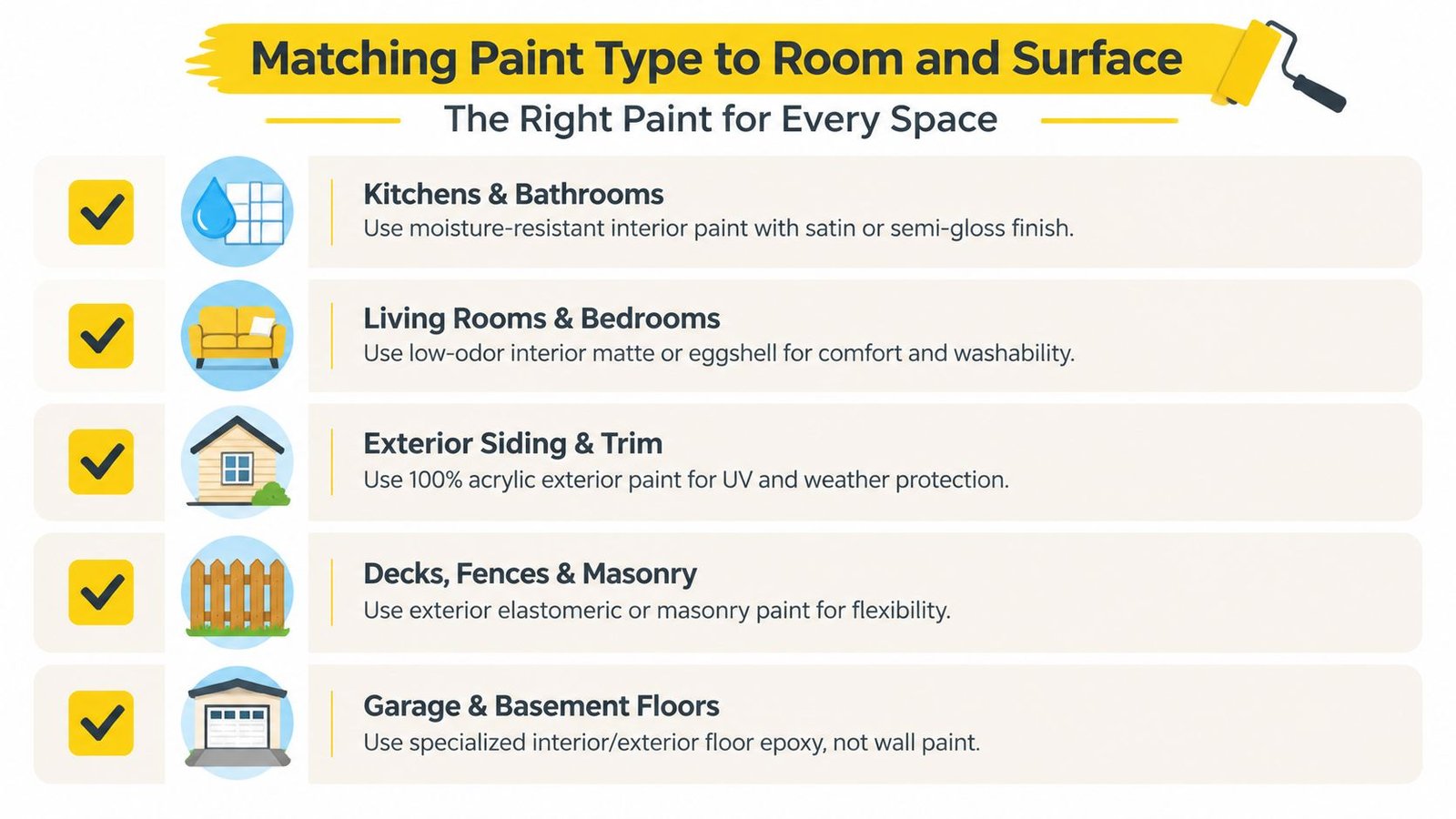
Kitchens and bathrooms need moisture-resistant interior paint, usually in a satin or semi-gloss sheen. The finish should tolerate wiping and condensation, but exterior paint still doesn't belong on these walls. If ventilation is poor or a leak exists, paint alone won't solve the moisture problem.
Living rooms and bedrooms generally suit low-odour interior matte, eggshell, or washable finishes. Matte hides minor drywall irregularities, while eggshell gives a little more cleaning ability. For wall colours in a North York condo, the best finish may be different from the one chosen for a busy family hallway.
Trim, doors, and cabinets need tougher products. Enamel-grade interior coatings or alkyd hybrids can provide the harder finish required for repeated handling. They're a better choice than trying to use exterior paint for indoor durability.
For colour planning around existing wood floors, Flacks Flooring's guide to paint colours that complement hardwoods provides useful design context. Colour harmony matters, but the coating still has to suit the room.
Exterior surfaces
Wood siding needs an exterior formula that can move with the boards. Stucco and brick require breathable masonry-compatible coatings, while concrete porches may need a product designed for masonry traffic and moisture. Aluminum soffits and metal components require cleaning, suitable adhesion, and often a compatible primer before the topcoat.
Fences and decks should use exterior stain, solid stain, or an exterior paint system intended for the substrate. A fence is not a spare interior wall. It absorbs moisture, dries in the sun, and moves at its joints.
Garage floors require specialized floor coatings, not ordinary wall paint. Basement walls need interior masonry sealers or coatings selected for the actual moisture condition. If water is entering through the foundation, coating over it without correcting the source can trap problems behind the finish.
Soca Services' guidance on the best paint for bathroom walls is relevant when moisture, sheen, and cleaning needs overlap. The quick decision rule is straightforward: if a surface faces weather or moves with temperature, specify exterior paint; if it sits inside the conditioned envelope, specify interior paint.
When Cross-Using Is a Mistake and When It Works
The most common DIY shortcut is using leftover paint because the job is small. A half-can of exterior paint seems suitable for a basement wall, while leftover interior paint seems good enough for a shed. Both choices can create problems that don't appear until the coating has already cured.
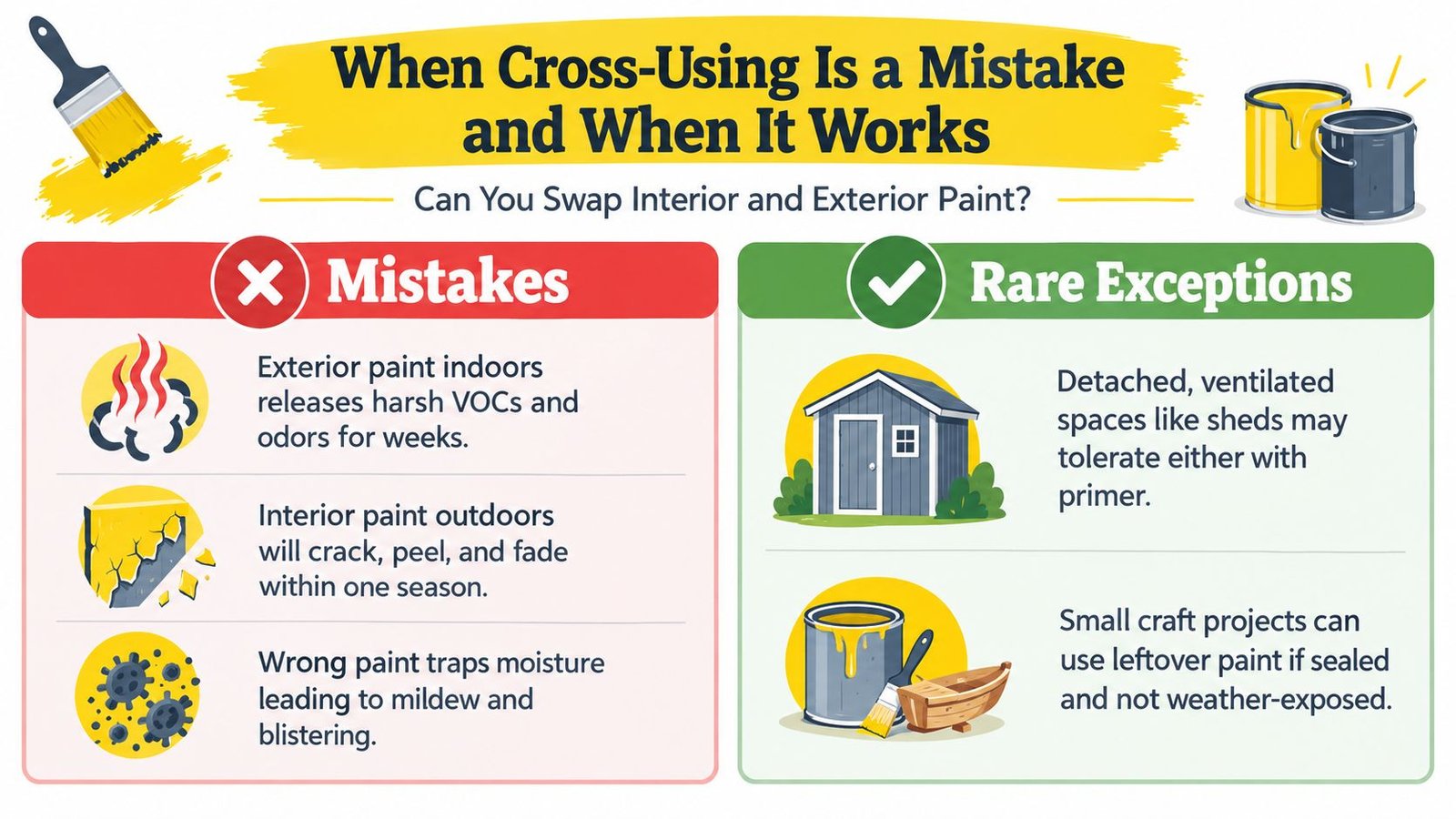
Exterior paint indoors can bring outdoor-oriented additives and stronger odour into an enclosed space. Interior paint outdoors lacks the flexibility, UV protection, and mildew resistance needed for exposed siding, fences, and sheds. It may look acceptable after application, then lose adhesion as rain, sunlight, and temperature changes work on the film.
The crossover exceptions are narrow
There are a few utility situations where a contractor might consider a crossover product, but they require full surface preparation and clear expectations:
- Primed metal railings: A railing already coated with a compatible exterior system may accept a suitable maintenance coat after cleaning and abrasion.
- Unconditioned garages: Exterior-grade trim may be considered inside an unheated garage when the product and substrate are compatible.
- Craft projects: A sealed, non-weather-exposed project can use leftover paint when long-term architectural durability doesn't matter.
Those exceptions don't justify crossing over on walls, ceilings, weather-exposed siding, or living spaces. They also don't remove the need to check the product label, primer compatibility, ventilation, and warranty requirements.
A leftover can is not a specification. It's only useful when its category, condition, and intended surface all line up.
On a professional job, label matching also protects warranty coverage. If a manufacturer specifies an exterior acrylic system over a compatible primer, substituting an interior product can invalidate the expected performance. Tell the contractor what's already on the surface, even if the existing paint is only present in a small area.
Choosing the Right Spec for Your Next Project
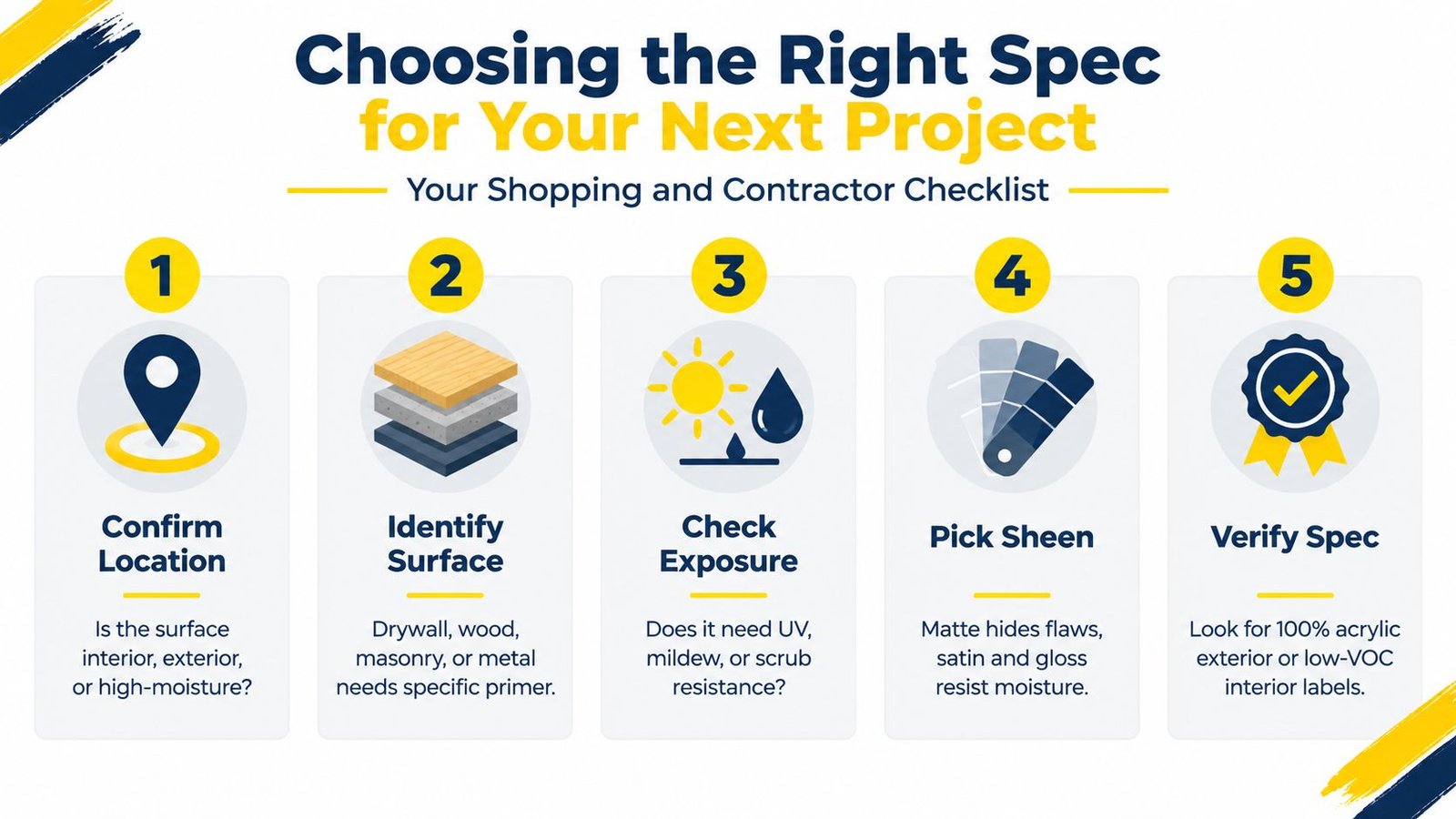
Before buying paint, write down five details: location, substrate, exposure, sheen, and cleaning demand. This short specification prevents most aisle-side guesses and gives a contractor enough information to recommend a complete system rather than a single topcoat.
- Confirm the location. Is the surface inside, outside, in a bathroom, in an unheated garage, or in another high-moisture area?
- Identify the substrate. Drywall, wood, masonry, metal, and previously painted surfaces need different preparation and primers.
- Check exposure. Note direct sun, wind-driven rain, damp shade, snow contact, and expected movement.
- Choose the sheen. Matte can hide flaws, while satin and semi-gloss generally support cleaning and moisture resistance.
- Verify the product specification. Look for a suitable 100% acrylic exterior system or a low-VOC interior line matched to the room and surface.
For interior walls, lines such as Benjamin Moore Aura or Sherwin-Williams Harmony may be considered when low odour and indoor comfort are priorities. On exterior work, a 100% acrylic product is often a sensible starting point, but the substrate and exposure still determine the final specification. Alkyd hybrids belong mainly on trim, doors, and cabinets where enamel-like hardness matters.
Primer can override the topcoat decision. Bare wood, masonry, glossy surfaces, stains, and previously oil-based walls may need a bonding, stain-blocking, masonry, or other specialized primer before the finish coat. Skipping that step can make a premium paint perform like a poor one.
Homeowners comparing contractors can also compare paint job pricing while remembering that preparation, repairs, primer, access, and product specification affect the scope. For Toronto-area exterior planning, Soca Services' guidance on the best exterior paint for Toronto weather adds useful local context.
For homeowners, property managers, and renovation teams in Toronto, Vaughan, North York, and King City, the practical choice is to match the resin, additives, sheen, and primer to the surface instead of defaulting to one product throughout the property.
Soca Services Painting provides professional interior and exterior painting for residential and commercial properties, with specifications matched to the substrate, exposure, sheen, and intended use. Contact Soca Services Painting to request a free estimate and written recommendation for your next Toronto-area project.