Table of Contents
- Is Professional Surface Staining Worth It? Understanding the Value Proposition
- DIY vs Professional Staining: A Practical Comparison
- Professional Wood Staining Cost: What You’ll Actually Pay
- How to Prepare Surfaces for Staining: The Foundation of Quality Results
Is Professional Surface Staining Worth It? A 2026 Guide
Last Updated: June 29, 2026
When deciding whether to tackle surface staining yourself or hire a professional, the real question is whether results justify the investment. Is professional surface staining worth it? At Soca Services Painting, we’ve guided hundreds of Toronto-area homeowners through this decision. The answer depends on several factors that go beyond what most guides cover.
The difference between professional and amateur staining comes down to surface preparation, application technique, and material selection. Rushing through prep work or choosing the wrong stain type leads to blotchy finishes, uneven color, or premature failure.
Is Professional Surface Staining Worth It? Understanding the Value Proposition
Professional surface staining delivers consistent, durable finishes that protect wood while enhancing its natural grain. Professionals assess wood absorbency and understand how different stains interact with wood pores, knowledge that determines whether a surface needs oil-based or water-based finishes.
Professional-grade stains combined with proper application typically last 3-5 years on exterior surfaces. DIY stains applied without proper prep often fail within 12-18 months, especially on decks or exterior wood exposed to weathering.
The single biggest predictor of professional staining success is surface preparation. Professionals spend 60-70% of project time on prep work (sanding, pressure washing, filling gaps). DIYers typically spend 20-30% here, which is why their results fail faster.
DIY vs Professional Staining: A Practical Comparison
DIY staining requires specialized equipment (orbital sanders, pressure washers, quality brushes or sprayers), knowledge of wood preparation techniques, and physical stamina to sand large surfaces properly.
Professional staining services handle the heavy lifting with commercial-grade equipment and experience diagnosing common problems before they happen. For example, they’ll identify whether your deck has trapped moisture or whether your interior wood has been sealed in ways that prevent stain absorption.
| Factor | DIY Approach | Professional Service |
|---|---|---|
| Time Investment | 40-80 hours for typical deck | 20-30 hours with crew |
| Equipment Costs | $300-800 (sander, sprayer, supplies) | Included in service |
| Material Waste | 15-25% (learning curve) | 5-10% (efficiency) |
| Result Consistency | Variable (skill-dependent) | Consistent across surface |
| Durability | 12-24 months typical | 36-60 months typical |
DIY makes sense if you have moderate skills and time availability. Professional staining makes sense if you want durability, consistency, and your time is better spent elsewhere.
A common mistake is buying premium stain brands without doing proper prep. Stain quality doesn’t matter if the surface isn’t prepared correctly, you’ll still get blotchy, uneven results that fail prematurely.
Professional Wood Staining Cost: What You’ll Actually Pay
Professional staining costs vary by location, surface type, and complexity. In Toronto and surrounding areas, exterior deck staining typically runs moderate to higher investment depending on current surface condition. Heavily weathered decks requiring power washing and significant sanding cost more than decks needing only a refresh coat.
What affects your final cost:
- Surface condition: Weathered exterior wood costs more to prep
- Wood species: Some woods require specialized stain types
- Stain type: Oil-based penetrates deeper but requires longer dry times; water-based dries faster
- Application method: Brush costs less than spray but spray delivers more uniform coverage
- Square footage: Larger projects have lower per-unit costs
Get a free estimate from Soca Services Painting to understand pricing for your specific project.
The ROI on professional staining appears in year two and three when DIY stains fail and need recoating while professional finishes still look fresh. A professional stain lasting 4 years is often cheaper over time than DIY stains requiring recoating every 18 months.
How to Prepare Surfaces for Staining: The Foundation of Quality Results
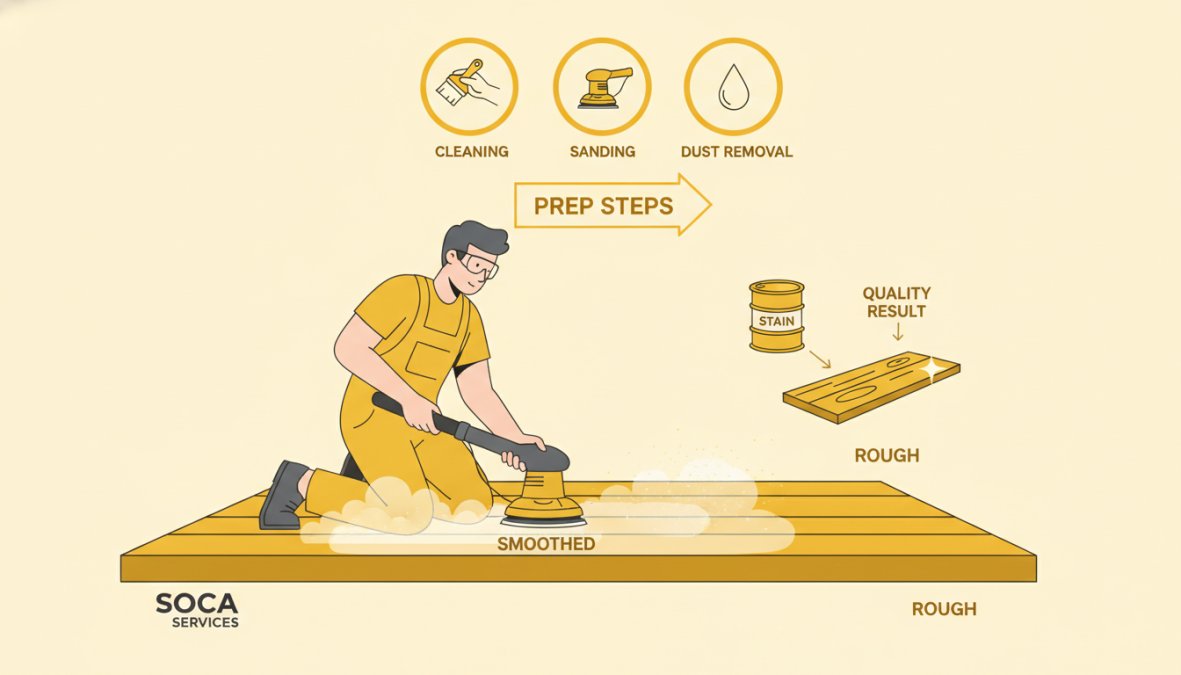
Surface preparation determines whether stain absorbs evenly and lasts years or blotches and fails within months. Professionals understand that prep work is 70% of the job.
For exterior wood:
- Pressure washing removes dirt, mold, and loose finish at 1500-2500 PSI
- Sanding removes old stain and opens pores for absorption, progressing from 80-120 grit to 150-180 grit
- Filling gaps prevents stain from pooling unevenly
- Drying time is critical, wood must reach 12-16% moisture content before staining (48-72 hours after pressure washing)
For interior wood:
- Sanding opens pores without over-roughening (120-150 grit)
- Dust removal is essential using tack cloths or vacuum-sanding systems
- Stain testing on inconspicuous areas confirms color and absorption before applying to visible surfaces
Wood absorbency determines how much stain the surface accepts. Dense hardwoods absorb stain slowly and evenly; soft woods absorb quickly and unevenly unless pre-conditioned.
Oil-Based vs Water-Based Stains: Choosing the Right Finish
Oil-based stains:
- Penetrate deeper, enhancing grain visibility
- Provide richer color saturation
- Require 24-48 hours drying between coats
- Better UV protection and longer durability (3-5 years exterior)
Water-based stains:
- Dry faster (2-4 hours between coats)
- Easier cleanup (water only)
- Lower VOC content
- Slightly less color depth
For Toronto homeowners, exterior decks benefit from oil-based stains’ superior weathering protection. Interior wood often works better with water-based stains because lower VOC content matters in living spaces.
Durability and Longevity: Why Professional Staining Lasts Longer
Professional stains last 3-5 years on exterior surfaces because professionals understand factors that extend finish life. DIY stains typically last 12-24 months.
The durability difference comes from proper surface preparation, correct stain saturation, appropriate topcoat selection, and maintenance guidance. Quality stain combined with proper topcoat and annual maintenance protects wood for years.
Application Methods: Brush vs. Rag vs. Sprayer
Brush application: Best for detailed work and small surfaces; allows precise control but risks brush marks.
Rag application: Best for natural, blended finishes; preferred for fine wood where grain visibility matters.
Sprayer application: Fastest for large surfaces; delivers uniform coverage but requires proper technique to avoid overspray and runs.
Most professional services use sprayers for speed and consistency on large exterior projects, then finish with brush or rag for detail work.
Maintenance and Re-Coating Intervals: Keeping Your Stain Fresh
Exterior wood maintenance:
- Annual cleaning removes dirt and mold
- Inspect for stain failure (peeling, discoloration, water absorption)
- Recoat when water no longer beads on the surface
- Typical recoating interval: every 2-3 years for high-traffic areas, 3-5 years for moderate-use surfaces
Interior wood maintenance:
- Regular dusting and occasional damp cleaning
- Avoid excessive moisture exposure
- Recoat when finish shows wear in high-traffic areas
- Typical recoating interval: 5-7 years for hardwood floors, 7-10 years for cabinets and trim
Water absorption is the key indicator that recoating is needed. If water beads on the surface, the protective barrier is intact. If water soaks in, recoating is due.
The decision to hire professional surface staining comes down to whether you value consistent, durable results over time. If you’re planning to stay in your Toronto, Vaughan, or North York home for several years and want wood surfaces that look fresh and protected, professional staining delivers measurable ROI through durability and appearance. Contact Soca Services Painting for a free estimate and learn exactly what professional surface staining would cost for your specific project.
Frequently Asked Questions
How long does professional surface staining last?
Professional surface staining typically lasts 3-5 years for interior surfaces and 2-3 years for exterior wood exposed to weather and UV protection challenges. Durability depends on wood species, climate, maintenance cycles, and the quality of the topcoat applied. Regular maintenance, such as cleaning and periodic re-coating, extends the finish lifespan significantly. Professional application ensures proper penetrating stain saturation and bonding, which maximizes longevity compared to DIY methods.
Is it cheaper to stain surfaces yourself or hire a professional?
DIY staining appears cheaper upfront, but hidden costs add up quickly: equipment rental, materials, mistakes requiring refinishing, and your time. Professional wood staining cost includes labor expertise, quality materials like Sherwin-Williams or Benjamin Moore finishes, proper surface preparation, and guaranteed results. When you factor in durability and the cost of redoing failed stains, professional service often delivers better ROI and saves money long-term, especially for visible or high-traffic surfaces.
What factors affect the cost of professional surface staining?
Key cost factors include surface area, wood species (some require different prep), existing finish condition, complexity of the design, travel distance in Toronto or surrounding areas like Vaughan and North York, and material selection. High-quality stains with better UV protection and lower VOC content may cost more but provide superior durability. Additional services like pressure washing, sanding, or multiple topcoats also influence final pricing. Soca Services provides detailed project proposals so you know exactly what to expect.
Can you stain over an existing surface finish?
Staining over existing finishes is possible but risky. If the old finish is sealed (paint or polyurethane), new stain won't penetrate properly and will fail. Professional staining requires stripping or sanding to bare wood so the stain can bond and the wood grain accepts color evenly. This is why proper surface preparation, a critical step professionals handle, determines success or failure. DIY attempts to skip this step are the most common cause of poor results and wasted materials.
This article was written using GrandRanker