

Trying to nail down the painting rate per sq ft for your home in Toronto can feel like chasing a moving target. To give you an objective starting point, most professional interior jobs in the GTA land somewhere between $3.00 and $5.00.
Think of that range as your foundational budget number for any project, whether you’re searching for painters in Toronto, Mississauga, or anywhere “near me” in the Greater Toronto Area. This guide provides a clear structure to help you understand what the best painters will charge.
Your Quick Guide To GTA Painting Costs

Getting a handle on the average cost is the best first step you can take. The “per square foot” rate is a standard unit of measurement that gives you a simple, objective way to compare quotes and get a ballpark idea of your total spend.
Of course, that’s just the beginning. These numbers are benchmarks, not guarantees. The final quote you get from the best painters in the GTA will hinge on key details that we’ll unpack throughout this guide.
A quick but crucial point: when a painter talks about “square footage,” they almost always mean the actual wall surface area they’ll be painting, not the floor space of the room. Getting this right is key to an accurate budget.
To give you a clearer picture right from the get-go, here’s a quick, objective look at what you can generally expect to pay for professional painting services in Toronto and Mississauga.
Average Painting Rates in Toronto & GTA (Per Sq. Ft.)
Here’s a structured breakdown of the typical cost ranges you’ll encounter for professional painting projects across the Greater Toronto Area.
| Project Type | Average Low End Cost (Per Sq. Ft.) | Average High End Cost (Per Sq. Ft.) |
|---|---|---|
| Interior Painting | $3.00 | $7.00 |
| Exterior Painting | $2.50 | $6.50 |
These figures give you a solid foundation for planning. As we go, we’ll break down exactly what pushes a project toward the lower or higher end of these price points. If you’re looking for an even more detailed breakdown, check out our complete guide on how much painting costs. It will arm you with the knowledge you need for a confident chat with the best painters in the GTA.
What Really Drives Your Final Painting Quote
Ever get two painting quotes for the same room that are worlds apart? It’s a common scenario in the GTA. While using an average rate per square foot is a decent starting point, the number on that final estimate is shaped by a handful of critical variables.
Understanding what goes into a professional quote is the key to making an objective decision, whether you’re hiring painters in Toronto or Mississauga. It’s about more than just the size of the room.
Think of it this way: your walls are the canvas. A brand-new, perfectly smooth canvas is a dream to paint on. But what if that canvas is old, has a few tears, and is dotted with nail holes? That’s where the real work—and cost—comes in. The more time a painter has to spend before a can of paint is even opened, the more it will be reflected in the labour costs.
The Condition of Your Walls
The single biggest driver of your final quote is the current state of your walls and surfaces. Any of the best painters will tell you that 80% of a flawless finish happens during the prep stage. This isn’t just painting; it’s restoration.
This prep work can involve a whole range of tasks, and each one adds time and complexity to the job:
- Cleaning: Walls need to be free of grease, grime, and especially nicotine stains for the new paint to stick properly.
- Patching and Repair: This is all about filling nail holes, fixing dents, and sealing up cracks to create a perfectly smooth surface.
- Sanding: Smoothing out old paint drips or rough patches is non-negotiable for a professional, even finish.
- Major Repairs: Tackling bigger problems like water stains or damaged drywall requires a lot more intensive work and expertise.
A room with pristine walls might only need a light scuff-sand, keeping your project on the lower end of the cost spectrum. On the other hand, an older home in the GTA with plaster cracks and a history of wear and tear will demand far more labour, pushing the price per square foot higher.
Project Complexity and Detail
Let’s be clear: not all painting projects are the same. A simple, boxy room with four flat walls is about as straightforward as it gets. The complexity of the architecture and the amount of detail work, however, can dramatically change the scope of the project.
Costs start to climb when you introduce features that demand precision, patience, and a very steady hand.
The more “cutting-in” a job requires, the more labour-intensive it becomes. This delicate work involves painting clean lines around trim, windows, and crown moulding, where careful taping and expert brushwork are essential.
Here are a few elements that add a layer of complexity:
- High Ceilings: Vaulted or two-storey ceilings mean bringing in ladders or even scaffolding, which adds time and safety considerations to the job.
- Trim, Baseboards, and Crown Moulding: Each piece needs to be prepped, taped off, and painted individually, often with a different type of paint or finish.
- Doors and Windows: Painting frames, sills, and casings is detailed work that takes considerably more time than just rolling a flat wall.
For homeowners who want to dig deeper into these factors, understanding the full cost of house painting can provide a much clearer picture of how these details add up. Armed with this knowledge, you can review estimates with confidence, knowing exactly what you’re paying for.
Interior vs. Exterior Painting Cost Breakdown
Trying to compare the cost per square foot for interior versus exterior painting is a bit like comparing the work of a jeweller to a shipbuilder. Both crafts demand incredible skill, but the environments, tools, and challenges they face are worlds apart. One is all about fine detail in a controlled space, while the other is an all-out battle against the elements.
When you bring in a painting crew for an interior job in your Toronto home, their world shrinks to the finer details. They’re carefully navigating around furniture, laying down protective coverings, and aiming for those perfectly crisp lines where the wall meets the trim. It’s a job defined by precision and achieving a flawless finish that you’ll see up close every day.
Step outside, however, and the game changes completely. Exterior painting, whether in Mississauga or elsewhere in the GTA, is a whole different beast. The focus shifts from delicate touches to durability and large-scale preparation. Suddenly, the scope of work gets much bigger, and a host of new challenges pop up.
The Exterior Painting Gauntlet
Exterior projects almost always demand far more prep work than their indoor counterparts. Think about it: these surfaces are constantly battered by rain, sun, and snow. They need some serious TLC before a single drop of new paint can be applied.
This preparation stage often involves:
- Power Washing: You have to blast away years of caked-on dirt, mildew, and grime. If you don’t, the new paint simply won’t stick.
- Scraping and Sanding: All that old, peeling, and bubbling paint has to go. It’s a labour-intensive step, but it’s absolutely critical for a finish that lasts.
- Repairs: This could mean anything from caulking cracks and gaps to fixing damaged siding or even dealing with wood rot. Each repair adds time and cost to the project.
An exterior paint job is your home’s first line of defence against the Canadian climate. The higher cost reflects the specialized, weather-resistant paints and the extensive labour required to ensure that shield is strong and durable.
Material and Equipment Differences
The materials themselves are a big part of the price difference. Exterior paints are complex chemical formulas, packed with additives to resist UV fading, fight off mould, and block moisture. These high-performance products understandably cost more than standard interior paints.
The equipment needed for an exterior job also ramps up the cost. Painting a two- or three-storey home isn’t something you can do with just a stepladder. It often requires setting up scaffolding or bringing in specialized lifts to work safely and efficiently, which adds another significant line item to the quote. To see how these variables add up, you can find a complete guide on the cost to paint an exterior house.
Understanding these key distinctions is the first step in setting an objective budget for your next project, inside or out.
How To Calculate Your Project Cost
So, how do you go from a rough idea to a real-world budget? Our structure makes it straightforward. Let’s walk through how to estimate your painting costs, starting with measuring your space correctly and then applying the average painting rate per sq ft to get a solid starting number.
The biggest mistake homeowners make is using their floor’s square footage. You’re not painting the floor! We need the total surface area of the walls that will actually get painted. Getting this number right is the key to an accurate estimate.
Measuring Your Paintable Square Footage
Here’s the simple formula the best professional painters use. Just follow these steps:
- First, measure the perimeter of the room. That just means adding the lengths of all the walls together.
- Next, measure the height of the walls, from the floor right up to the ceiling.
- Then, multiply the perimeter by the height. This gives you the total wall area.
- Finally, you need to subtract the area of windows and doors. Just measure their height and width, multiply to get their individual areas, and subtract them from your total wall area.
What you’re left with is the final paintable square footage—the exact number a professional painter in Toronto will use to build your quote.
This infographic really simplifies the three key steps to budgeting your project.
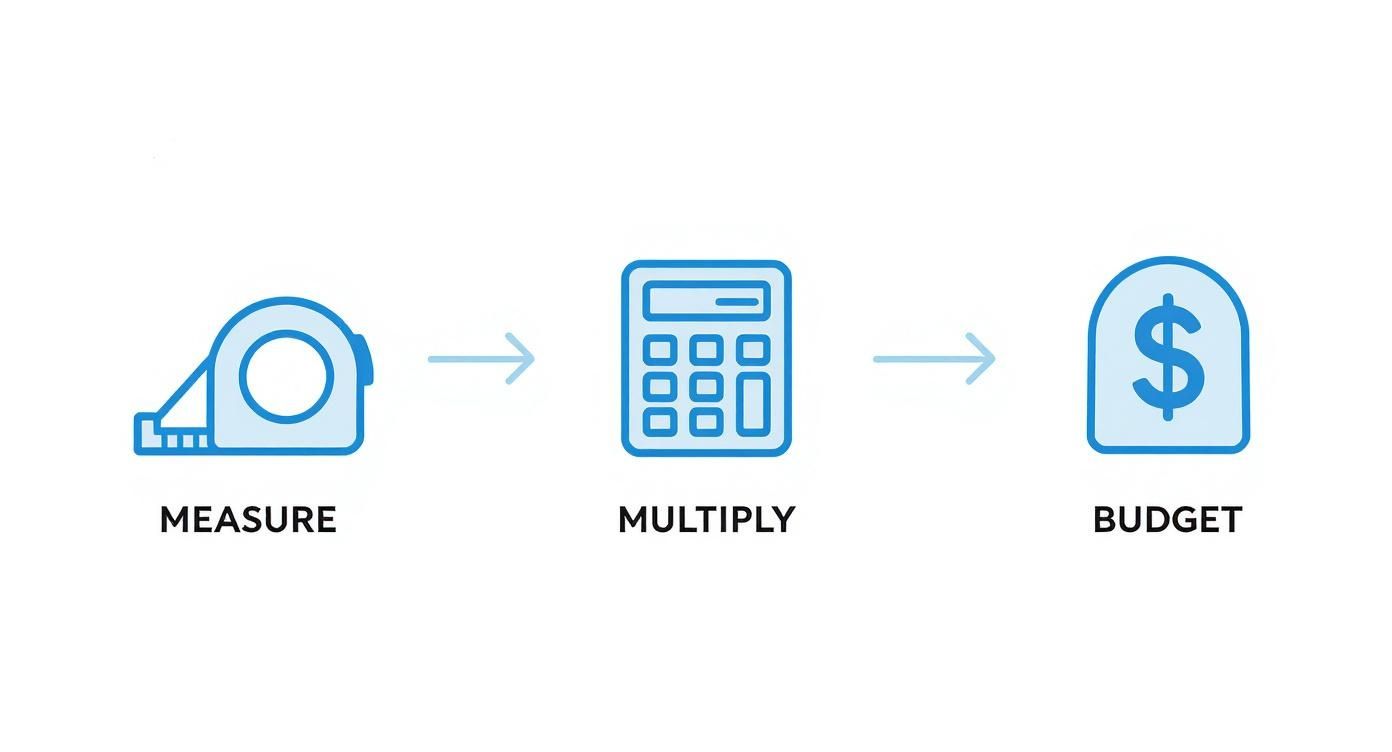
The main thing to remember is that a reliable budget always starts with careful measurements. Once you have that, the math is easy.
Example 1: Toronto Condo Bedroom
Let’s apply this to a real-life situation. Imagine you want to paint a standard 12 ft by 12 ft bedroom in a downtown Toronto condo.
- Perimeter: 12 ft + 12 ft + 12 ft + 12 ft = 48 ft
- Wall Height: We’ll assume a standard 8 ft ceiling.
- Total Wall Area: 48 ft x 8 ft = 384 sq ft
- Subtract Openings: Let’s account for a standard door (around 21 sq ft) and a window (around 15 sq ft), which totals 36 sq ft.
- Paintable Area: 384 sq ft – 36 sq ft = 348 sq ft
Now, if we use an average GTA rate of $4.00 per sq ft, the calculation is simply 348 sq ft x $4.00 = $1,392. This figure gives you a strong baseline for what to expect. For a deeper dive, you can find more detailed breakdowns in guides on interior home painting prices.
Example 2: Mississauga Suburban Home Exterior
Calculating an exterior is a bit of a different animal. Directly measuring the outside of a house can be tricky, so we often use a handy rule of thumb instead. We take the home’s total floor square footage and multiply it by a factor, usually between 1.5 and 2.5, to estimate the exterior wall surface.
Let’s say we’re budgeting for a 2,000 sq ft home in a Mississauga suburb.
- Estimated Exterior Surface: 2,000 sq ft x 1.5 = 3,000 sq ft
- Assumed Rate: We’ll use a rate of $3.50 per sq ft, which is a realistic figure that accounts for the extra prep work and more durable paint required for exteriors.
- Estimated Cost: 3,000 sq ft x $3.50 = $10,500.
Keep in mind, this is a starting point. Things like multi-story homes, intricate trim work, or the need for significant repairs will definitely adjust the final quote you get from the best local painters.
Proper budgeting goes beyond a single paint job, especially for property owners. Learning about mastering rental property maintenance costs can give you a broader perspective on planning for all your property’s needs.
Sample Painting Project Cost Scenarios
To help you visualize these numbers, the table below shows a few common residential painting projects in the GTA. It illustrates how different room sizes and project types can influence the final cost.
| Project Scenario | Total Sq. Ft. | Assumed Rate/Sq. Ft. | Estimated Total Cost |
|---|---|---|---|
| Small Office/Den (10’x10′) | 300 sq ft | $4.50 | $1,350 |
| Average Bedroom (12’x12′) | 348 sq ft | $4.00 | $1,392 |
| Large Living Room (15’x20′) | 540 sq ft | $4.25 | $2,295 |
| Small Bungalow Exterior | 1,500 sq ft | $3.50 | $5,250 |
These examples should give you a clearer picture of how a simple square footage calculation can provide a surprisingly accurate budget forecast for your next painting project.
Finding The Best Painters In The GTA
Getting a great price is one thing, but it’s the quality of the work that you’ll live with every day. Once you have a solid idea of the going rate for painting, your next step is finding the best painters in Toronto, Mississauga, or anywhere in the GTA to actually do the job. This goes way beyond a quick search for “painters near me”; it’s about doing your homework to protect your investment.
The search for a great painter shares a lot in common with finding reliable service professionals in your area—you need to dig into reviews, check their local reputation, and see who’s available. The best painters will hand you a detailed, itemized quote that breaks everything down. If all you get is a vague, single-line estimate, consider it a major red flag.
Questions To Ask Every Potential Painter
Before you hire someone, you need to ask some direct questions. Their answers will tell you almost everything you need to know about their professionalism and whether you can trust them in your home. Think of it as a quick interview to see if they’re the right partner for your project.
Here’s what you absolutely must ask:
- Are you fully insured and do you have WSIB coverage? This is non-negotiable. Liability insurance protects your home from accidental damage, while WSIB (Workplace Safety and Insurance Board) coverage protects you financially if a worker gets hurt on your property. Never hire a contractor without both.
- Can you provide recent references? Any painter who’s confident in their work will be happy to connect you with recent clients right here in the GTA.
- What specific brand and type of paint do you use? The quote should spell this out clearly. This ensures that a low price isn’t just a result of them using cheap, low-quality paint that will scuff and fade in a year.
- What does your preparation process look like? We’ve already talked about how prep work is the secret to a lasting finish. Get them to walk you through their exact steps for cleaning surfaces, patching holes, and sanding.
Comparing Estimates The Smart Way
It’s standard practice to get a few different quotes, but knowing how to compare them properly is what really matters. Don’t just skip to the final number. Lay each estimate out side-by-side and really scrutinize the details for an objective comparison.
A professional quote is a roadmap for your project. It should clearly outline the scope of work, the materials to be used, the preparation steps included, and a projected timeline. If these details are missing, the quote isn’t worth the paper it’s written on.
Check for consistency in what’s being offered. If one quote comes in significantly lower than the others, you need to find out why. Did they leave out a crucial prep step? Are they planning to use a bargain-bin paint brand? A careful comparison ensures you’re making a decision based on true value, not just the cheapest price tag.
For a deeper dive into choosing the right team, our guide on finding the best painters offers even more practical advice. Making an informed choice is the key to getting that flawless, professional finish that you’ll love for years to come.
Smart Ways to Save on Your Painting Project
Getting a professional-quality paint job doesn’t have to break the bank. With a bit of planning and some smart moves, you can bring down the total cost of your project without sacrificing the beautiful finish you’re after. Most of the best painters in Toronto and Mississauga are happy to adjust their pricing if you can help make their work more efficient.
The single biggest way to lower your quote is to take on some of the simple prep work yourself. Think about tasks like moving all the furniture to the centre of the room, taking down photos and artwork, and removing outlet covers. While these seem like small jobs, they can save a painter a surprising amount of time. Since labour is the largest chunk of any painting quote, that time saved translates directly into money saved for you.
Optimize Your Timing and Materials
Another great strategy is to think about when you schedule your project. The demand for painters across the GTA usually dips in the late fall and winter. If you can book your interior painting during this off-season, you’ll often find a more competitive painting rate per sq ft as contractors are keen to keep their crews busy.
One of the smartest long-term savings moves is to invest in high-quality paint from the start. It might cost more per can, but premium paint provides better coverage—meaning you might only need two coats instead of three—and it’s much more durable. You’ll save money down the road on touch-ups and repaints.
By putting these simple, practical tips into action, you can make savvy choices that ensure you get fantastic value for your home improvement investment.
Got Questions About Painting Costs? We’ve Got Answers.
When you’re planning a painting project, a lot of questions can come up. It’s completely normal. To help you feel more confident about your decisions, we’ve put together straightforward, objective answers to the most common questions we hear from homeowners across Toronto, Mississauga, and the GTA.
Does the Painter’s Rate Per Square Foot Include the Paint?
In most cases, yes. When a professional painter gives you a quote, it almost always bundles in the cost of good-quality, standard paint from brands they trust.
That said, you should always get this in writing. If you have your heart set on a specific premium or specialty paint, the price will naturally go up to reflect that higher material cost. The best practice? Always ask for a detailed quote that breaks down exactly what’s included. No surprises that way.
What’s the Ballpark Cost to Paint a 1500 Sq Ft House Interior in Toronto?
This is a great question, but the answer isn’t as simple as multiplying 1500 by a set rate. The actual paintable surface area in a 1500 sq ft house is usually much larger—think closer to 3,000 to 4,500 sq ft once you account for all the walls.
Working with the typical Toronto range of $3.00 to $5.00 per square foot, you’re looking at a very rough estimate of $9,000 to $22,500.
Why such a wide range? Because so many things affect the final price: the height of your ceilings, the amount of detailed trim work, and the current condition of your walls all play a huge role. The only way to get a real number is to have one of the best local painters come out and give you a specific, on-site quote.
Is It Cheaper If I Buy the Paint Myself?
It’s a common thought, but it almost never works out to be cheaper. In fact, it can sometimes cost you more.
Professional painters get significant contractor discounts on paint—often much better than the prices you’d find at a retail store. They also have the experience to calculate the exact amount of paint needed for the job, so you don’t end up with a garage full of half-used cans or have to make a last-minute run for more.
Plus, when the pros supply the paint, it’s typically covered under their workmanship warranty. For peace of mind and your wallet, it’s almost always better to let them handle the materials.
Ready for a flawless finish from the best painters in the GTA? For a detailed, objective, and transparent quote for your home in Toronto or Mississauga, contact Soca Services Painting today. Visit us at https://www.socaservicespainting.com to schedule your consultation.


7 Comments