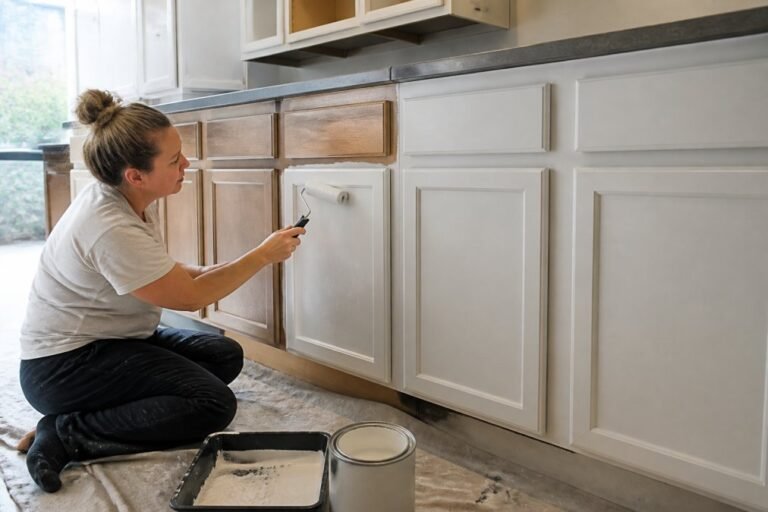
Choosing the best paint primer for walls is dependent on the specific requirements of the project. For most interior drywall applications in Toronto and the GTA, a quality water-based (latex) primer is the optimal choice. For surfaces with difficult stains, an oil-based primer offers superior blocking, and for sealing significant smoke or water damage, shellac-based primers are unparalleled. A correct initial priming step is fundamental to achieving a professional paint finish.
Choosing the Right Primer for a Flawless Finish
Initiating a painting project involves more than selecting the final colour. The most critical step for ensuring a professional and durable finish is the application of the correct primer. A high-quality primer is essential for guaranteeing that the chosen paint colour appears true and vibrant, avoiding a patchy or dull appearance. It is a foundational element for any paint job, from Mississauga to the rest of the GTA.
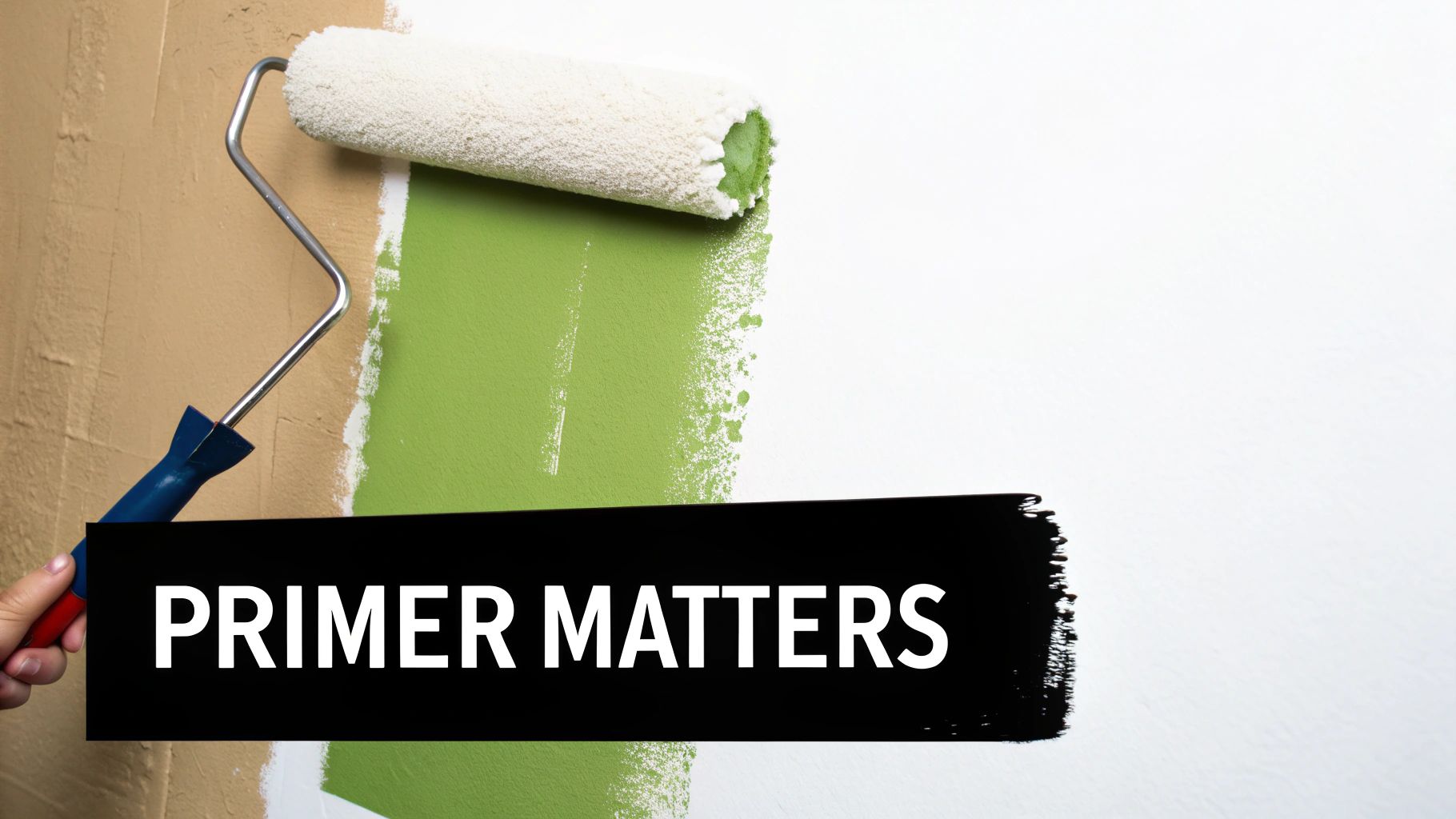
Primer performs several key functions that paint alone cannot. It establishes a consistent, adhesive surface for the topcoat, which is necessary for a smooth, uniform result. It also seals the substrate and blocks stains, preventing previous water marks, ink, or dark colours from bleeding through and compromising the new paint. For new, porous surfaces like bare drywall, primer is mandatory. It seals the material to prevent excessive absorption of the more expensive topcoat.
Understanding the Core Primer Types
To select the best paint primer for your walls, it is important to understand the three main categories available at hardware stores across the GTA. Each is formulated for different conditions, and selecting the incorrect type can lead to suboptimal results. After determining the correct primer, our guide on the best interior paint for walls can assist in choosing the topcoat.
Here is an objective breakdown of the three fundamental primer types:
| Primer Type | Primary Use Case | Key Advantage | Common Applications in GTA Homes |
|---|---|---|---|
| Water-Based (Latex) | General purpose interior drywall priming. | Low odour, fast-drying, and flexible. | Prepping new drywall, covering minor scuffs, and painting over light colours. |
| Oil-Based (Alkyd) | Blocking stubborn stains and priming glossy surfaces. | Superior adhesion and exceptional stain blocking. | Covering wood trim, blocking water or ink stains, and priming over oil-based paint. |
| Shellac-Based | Sealing severe stains and odours. | Unmatched at sealing tough stains like smoke and rust. | Remediation after water damage, sealing smoke-damaged walls, and blocking wood tannins. |
Understanding these distinctions provides a clear roadmap for your project. A superior finish begins with the correct foundation, which is always the appropriate primer.
A Primer on Primers: Latex, Oil-Based, and Shellac
The selection of the right primer is one of the most important decisions in a painting project. Not all primers are equivalent, and a product suitable for a minor touch-up in a Mississauga condo may be ineffective for covering severe stains in a historic Toronto home. Familiarity with the three main primer families—latex, oil-based, and shellac—is essential for achieving a flawless, long-lasting finish.
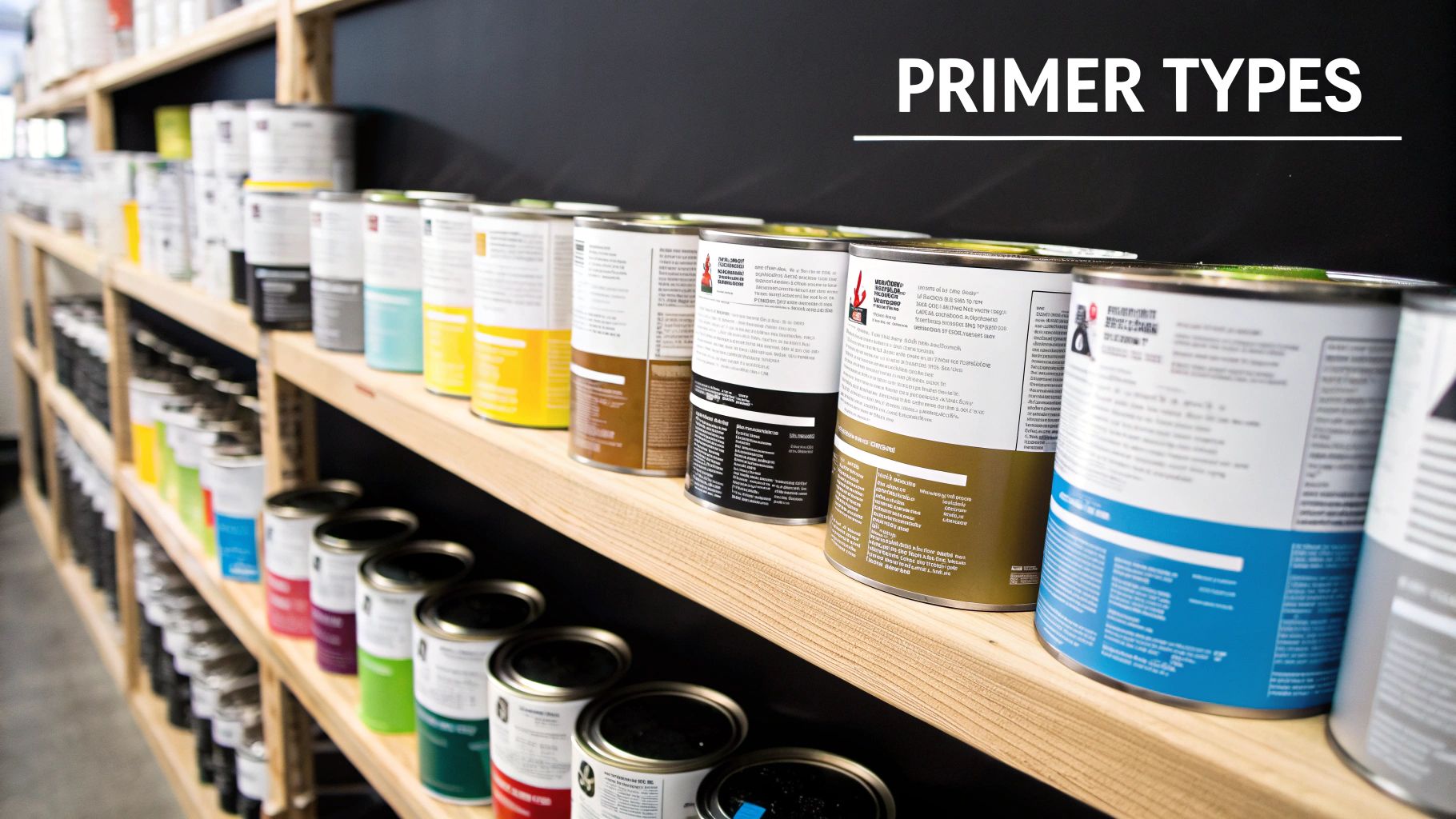
Each of these types is formulated with a different base solvent, which determines its performance characteristics, drying time, and ideal applications. Making the correct choice from the outset can prevent common issues such as peeling paint, stain bleed-through, and inconsistent colour.
Water-Based (Latex) Primers
Water-based primers, commonly labelled as latex primers, are the most versatile option for general interior wall applications. Their popularity stems from several factors: they allow for easy cleanup with soap and water, they dry quickly, and they maintain flexibility to resist cracking. Furthermore, their low level of volatile organic compounds (VOCs) makes them a preferable choice for maintaining indoor air quality.
The trend towards lower VOC content has significantly influenced the paint industry. Stricter environmental regulations have led manufacturers to develop high-performance primers with VOC levels often below 100 grams per litre, benefiting consumers.
When to Use Latex Primer:
For new drywall, minor scuffs, or painting over an existing water-based paint, a latex primer is the recommended choice. It provides an ideal, even base for the topcoat without the strong odours associated with solvent-based options.
Oil-Based (Alkyd) Primers
Oil-based primers, also known as alkyd primers, are the heavy-duty solution for paint preparation. Their primary strengths are superior adhesion and stain-blocking capabilities. They form a durable film that can adhere to slick surfaces where latex primers may fail, such as glossy trim, metal, or walls previously coated with oil-based paint.
Additionally, oil-based primers are highly effective at sealing stubborn stains. They block water spots, ink, nicotine, and tannins from woods like cedar, preventing them from bleeding through the topcoat. While they have a stronger odour and require mineral spirits for cleanup, their performance on challenging surfaces is exceptional. For specialized surfaces, our guide on the best primer for kitchen cabinets offers more detailed advice.
Shellac-Based Primers
For the most severe stains and odours, shellac-based primers are the ultimate problem-solvers. Formulated with an alcohol base, they dry extremely quickly and can seal virtually any surface contaminant. They are the primary choice for covering severe water and smoke damage, rust, and persistent odours from fire or pets.
For a look at another versatile option, the Leyland Trade Acrylic Primer Undercoat Paint is a good example of a product that combines priming and undercoating properties. However, in terms of sheer sealing power, shellac remains in a class of its own. It creates a complete vapour barrier, ensuring that no underlying issues will compromise the new paint.
Comparing Primer Performance on Common Wall Issues
Choosing the correct wall primer involves matching the product's specific strengths to the unique conditions of your walls. Homes across Toronto, Mississauga, and the wider GTA present various challenges, from high-humidity bathrooms to walls with accumulated stains. A primer that performs well in one environment may not be suitable for another, making a direct comparison essential for a durable paint job.

This section provides an objective breakdown of how water-based, oil-based, and shellac primers perform against the most common wall issues. We will analyze factors from stain blocking and adhesion to durability and air quality to offer a practical guide for your project's specific demands.
Stain Blocking Capabilities
Stains are a common issue in residential painting. Whether covering old water marks, nicotine stains, or crayon, a primer must create an effective barrier.
- Water-Based (Latex) Primer: Suitable for minor jobs. It can cover light scuffs and faint discolouration but lacks the capacity to block severe bleed-through from water or smoke.
- Oil-Based (Alkyd) Primer: The standard choice for most household stains. Its dense film is effective at blocking water spots, ink, and nicotine.
- Shellac-Based Primer: The most powerful option for severe issues. It is the only reliable choice for sealing heavy smoke and fire damage, persistent rust, and dark water stains.
Adhesion on Difficult Surfaces
Proper adhesion is the most critical factor for a long-lasting paint job. Without it, peeling will occur. Not all primers can adhere to challenging surfaces like glossy paint or panelling. If this issue is already present, our guide on how to fix peeling paint provides targeted solutions.
Oil-based primers are known for their ability to adhere to difficult surfaces, including old glossy trim and metal. Latex primers bond well with porous surfaces like new drywall but may struggle with non-porous surfaces without thorough sanding.
Durability and Moisture Resistance
For high-traffic areas or moisture-prone environments like bathrooms, durability is essential. Oil-based primers cure to a hard, wear-resistant finish that performs well against scuffs and moisture. In rooms with constant high humidity, understanding general waterproofing materials is also beneficial.
The following table summarizes how each primer type addresses common wall problems.
Primer Performance Comparison for Common Wall Issues
This table compares Latex, Oil-Based, and Shellac primers across key performance metrics to help you select the best option for your specific wall condition.
| Performance Metric | Water-Based (Latex) Primer | Oil-Based (Alkyd) Primer | Shellac-Based Primer |
|---|---|---|---|
| Minor Stains (Scuffs, Light Marks) | Excellent | Very Good | Very Good |
| Major Stains (Water, Smoke) | Poor | Excellent | Unbeatable |
| Adhesion to Porous Surfaces | Excellent | Good | Good |
| Adhesion to Glossy Surfaces | Fair (Needs Sanding) | Excellent | Very Good |
| Moisture Resistance | Good | Excellent | Good |
| Durability / Scrubbability | Good | Excellent | Very Good |
| Low Odour / Low VOCs | Excellent | Poor | Poor |
| Drying Time | Fast | Slow | Very Fast |
As the data shows, there is a trade-off. The superior problem-solving capabilities of oil or shellac primers come at the cost of ease of use and indoor air quality. The goal is to select the right tool for the specific job.
VOC Levels and Indoor Air Quality
The impact on indoor air quality is a significant consideration for any interior project. Volatile Organic Compounds (VOCs) are chemicals that off-gas from paint products as they dry.
- Water-Based (Latex) Primer: This is the best choice for low VOCs. It is the standard for bedrooms, living rooms, and any space where minimizing fumes is a priority.
- Oil-Based & Shellac-Based Primers: These have much higher VOC levels and produce strong, lingering odours. They require excellent ventilation during and after application. Their use should be restricted to situations where their heavy-duty performance is necessary.
Matching the Primer to Your Painting Project
Applying theory to achieve a flawless paint job requires selecting the right primer for the specific challenge. Every painting project is unique, especially within the diverse housing stock of the Toronto and GTA region. The strategy must adapt, whether covering a dark colour or preparing new, porous drywall.
This section serves as a practical decision-making guide. We will examine the most common scenarios faced by homeowners and identify the best paint primer for walls in each situation, enabling you to approach your project with confidence.
For Covering Bold or Dark Colours
Painting over a saturated colour like deep red or navy blue can be challenging, as the old hue can bleed through multiple topcoats. In this scenario, a tinted grey primer is the most effective solution.
A grey primer establishes a neutral base that is more effective at concealing the underlying colour than standard white primer. This significantly reduces the number of topcoats required to achieve the true new colour, saving time and material costs. Paint suppliers in Mississauga and across the GTA can tint primer to a medium grey for optimal results.
Pro Tip: When covering a vibrant red or orange, a grey primer is essential. These pigments are known to show through white primers, but a neutral grey base will block them effectively, often reducing the topcoat requirement from four coats to two.
For Sealing Stains and Odours
Issues like old water leaks or lingering smoke odours require a heavy-duty solution. Standard latex primers do not possess the chemical composition to create a permanent barrier against these problems.
For these jobs, a powerful stain-blocking primer is necessary:
- Oil-Based Primer: This is the best option for most common stains, including water marks, ink, and crayon. It creates a durable, impermeable film.
- Shellac-Based Primer: For the most severe issues—heavy smoke damage, fire residue, or pervasive odours—shellac provides the ultimate solution. It dries very quickly and creates a complete vapour barrier.
For New Drywall and Porous Surfaces
New drywall, bare wood, and plaster are highly porous surfaces that absorb liquids like a sponge. Applying paint directly will result in a blotchy, uneven finish due to inconsistent absorption.
To achieve a professional result, a PVA (polyvinyl acetate) latex primer must be used. This type of primer is specifically formulated to seal porous surfaces, creating a uniform, non-absorbent base. This step ensures the topcoat applies smoothly and evenly. Similar principles apply to other porous materials; learn more about the needs of painting concrete walls in our detailed guide.
This chart compares key metrics for top primers, helping you visualize the trade-offs between coverage, cost, and drying time.
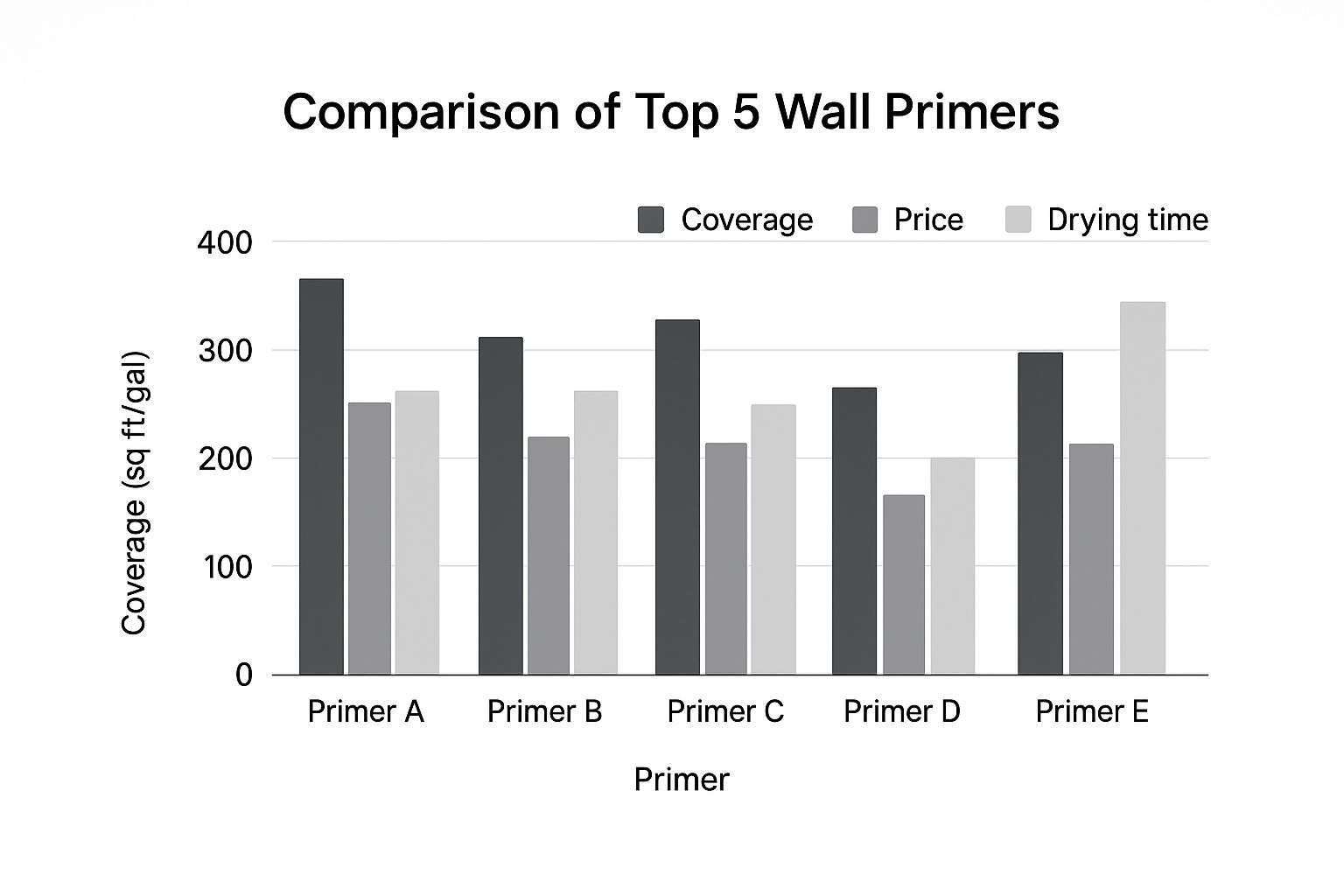
The data indicates that while premium stain-blocking primers may have a higher initial cost, their faster drying times can accelerate the project timeline significantly.
For Glossy or Hard-to-Paint Surfaces
Painting over a glossy or semi-gloss finish is a common challenge. The slick surface provides poor adhesion for new paint, leading to chipping and peeling.
To ensure proper adhesion, an adhesion or bonding primer must be used. These are typically oil-based or specialized water-based formulas engineered to adhere to non-porous surfaces. After light scuff-sanding to de-gloss the surface, a bonding primer creates a reliable foundation for the topcoat.
Getting to Grips with Primer Cost vs. Coverage
Budgeting is a critical component of any home improvement project, and primer cost can be deceptive. The price per can is only part of the equation; the most important metric is coverage—the area a single litre can prepare. Understanding this balance is key to making a cost-effective decision.
At hardware stores in Toronto or Mississauga, there is a clear price hierarchy. Water-based (latex) primers are generally the most affordable. Oil-based (alkyd) primers are mid-range, and specialty shellac-based primers are typically the most expensive. However, the lowest-priced can is not always the most economical choice.
Figuring Out the True Cost Per Square Foot
To find the best paint primer for your walls within your budget, look beyond the sticker price. A premium primer may have a higher upfront cost but contains a higher concentration of solids. This results in thicker application, greater coverage, and better hiding capabilities. This superior coverage can eliminate the need for a second coat of primer and potentially an extra coat of finish paint.
Consider this comparison:
- Economy Primer: A lower-cost can might cover only 250 square feet and may require a second coat to block a dark colour.
- Premium Primer: A higher-cost option could cover up to 400 square feet with a single coat, making it more economical on a per-square-foot basis.
A high-quality primer should be viewed as an investment in efficiency. It creates a superior base in a single application, which often reduces the amount of finish paint required. This saves both money and labour in the long run.
Factoring in Overall Project Savings
The value of a quality primer extends beyond material costs. It also saves time and effort by reducing the number of coats needed. When hiring professional painters in the GTA, reducing labour time can result in significant cost savings, often more than justifying the higher price of a premium primer. This is a crucial aspect of learning how to paint a room correctly.
Recent market data shows a consumer shift towards quality. One analysis found that while the average paint purchase was $76 in 2024, at specialty suppliers like Sherwin Williams, the average rose to $139. This indicates a willingness among homeowners and professionals to invest in high-performance materials for a better result. A U.S. paints and primers market share analysis provides deeper insight. The conclusion is clear: investing in the right foundation for your walls is a prudent decision that improves the final aesthetic and the overall project cost.
Common Primer Questions for Toronto Homeowners
Certain questions consistently arise during painting preparations, particularly for homeowners in Toronto and the GTA. Obtaining correct information at the outset ensures a smooth project and a satisfactory result. This section addresses the most frequent questions about selecting the best paint primer for walls.
Whether you are searching for a primer "near me" in downtown Toronto or in a suburb like Mississauga, this guide will help you navigate the options.
Do I Really Need a Separate Primer?
In almost all situations, yes. Using a separate, dedicated primer is essential for a professional and durable paint job. A primer is formulated to perform functions that a topcoat cannot, primarily creating a uniform, adhesive surface for the finish paint.
Skipping this step often results in a blotchy, uneven finish due to inconsistent absorption into the wall. It also typically requires applying more coats of expensive topcoat paint to achieve adequate coverage, increasing both time and material costs for an inferior outcome.
Are "Paint and Primer in One" Products Good Enough?
"Paint and primer in one" products are suitable only for specific, limited applications. They are essentially thicker paints, making them adequate for simple tasks like repainting over a similar light colour on a wall that is already in good condition.
However, they are not a substitute for a dedicated primer when facing significant challenges.
When dealing with drastic colour changes, sealing new drywall, blocking water stains, or painting over a glossy surface, a purpose-built primer is non-negotiable. A dedicated primer will always provide superior adhesion and sealing for demanding jobs.
How Many Coats of Primer Do I Need?
For most interior painting projects, one coat of a quality primer is sufficient. This is typically the case when:
- Sealing new, unpainted drywall.
- Making a minor colour change (e.g., from light beige to light grey).
- Prepping a clean, uniform wall for a new coat of paint.
A second coat is advisable in certain situations. Plan for two coats when covering a very dark or intense colour, such as a deep navy or vibrant orange. A second coat is also recommended for stubborn water or smoke stains that remain visible after the first coat has dried.
What's the Difference Between a Primer and a Sealer?
While the terms are often used interchangeably, primers and sealers have different primary functions. A primer is engineered for adhesion. Its purpose is to create a surface with "tooth" or grip to which the topcoat can securely bond.
A sealer, in contrast, functions as a barrier. Its main role is to prevent substances like stains or wood tannins from bleeding through the paint. It also prevents the paint from being absorbed into porous surfaces such as new plaster or bare drywall.
Many modern products available in stores across Toronto and Mississauga are classified as "primer-sealers," performing both functions adequately for general use. However, for the most challenging problems, such as sealing major stains or odours, a dedicated oil-based or shellac-based sealer is more powerful and reliable.
Ready to start your project with a flawless foundation? The experts at Soca Services Painting can help you choose the perfect primer and deliver a professional finish that lasts. Contact us today for a consultation