
You're standing in a Toronto bedroom, staring up at a ceiling that looked fine under soft evening light. After painting it, the roller marks appear as soon as daylight hits the surface, coverage looks uneven near the drywall joints, and the paint odour lingers longer than expected. The can said “ceiling paint,” but that label alone didn't guarantee a clean finish or a comfortable room.
The best paint for ceiling projects in Canadian homes isn't the cheapest flat white. You need the right sheen, low-emission formulation, coverage characteristics, and application method for the room. A bedroom in a North York condo, a humid bathroom in Vaughan, and a rental turnover in Toronto all place different demands on the coating.
For most standard ceilings, I recommend a quality flat or dead-flat acrylic ceiling paint, preferably with low-VOC or zero-VOC positioning when the home is occupied. Benjamin Moore, BEHR, Dulux, and Sherwin-Williams all offer practical options, but the product has to match the surface and the schedule. Soca Services Painting applies these finishes across Toronto, Vaughan, North York, and King City, where older plaster, repaired drywall, water marks, and changing indoor humidity are common realities.
Why Ceiling Paint Choice Matters More Than You Think
Most homeowners choose ceiling paint as an afterthought. They pick a white product from the same shelf as their wall paint, roll it on quickly, and expect the ceiling to disappear. That approach often fails because overhead surfaces reveal defects differently from walls.
The problem usually appears after the job seems finished. A homeowner may see lap marks, thin areas, roller stipple, or a patch that reflects light differently from the surrounding ceiling. A slightly shiny finish can make drywall seams and uneven repairs stand out, especially when sunlight enters from a low window angle. Flat ceiling paint reduces that visual distraction because it reflects less light.

The ceiling has different working conditions
Painting overhead changes everything. Gravity encourages spatter, the painter works in an awkward position, and a small variation in film thickness can become visible across a broad, uninterrupted plane. A ceiling coating designed for overhead application should roll smoothly, resist spatter, and maintain an even, non-reflective appearance.
The product also matters for indoor air quality. In a tightly sealed Canadian home, lingering odour becomes an immediate concern for families, tenants, and anyone sleeping in the space soon after painting. Understanding what VOC means in paint helps you compare labels instead of treating “low odour” as a complete specification.
The wrong finish creates avoidable problems
Eggshell and satin paints can work on selected surfaces, but they're rarely my first choice for a standard ceiling. Their added reflectivity may help with cleaning, yet it can also highlight sanding marks, joint lines, and inconsistent rolling. Ceilings generally don't receive the same hand contact as walls, so maximum washability usually isn't the deciding factor.
A good ceiling job starts with the surface. Water damage, nicotine staining, old adhesive, loose texture, and poorly repaired drywall may require specific preparation before any finish coat. Paint can improve appearance, but it can't repair a soft substrate or solve an active moisture problem.
Practical rule: Choose ceiling paint for how the surface will look under changing light, not for how attractive the colour card looks in the store.
Understanding Ceiling Paint Specifications and Standards
A paint label gives you useful information, but only if you know what each specification means. Start with sheen, then consider VOC content, volume solids, coverage, and the intended use of the coating.
Sheen controls how much the ceiling shows
Flat and matte finishes scatter light instead of bouncing it directly back into the room. That makes them well suited to ceilings with drywall joints, minor texture differences, or older repairs. A Canadian paint guide recommends flat for ceilings in all rooms because it reduces light bounce and helps hide seams. You can review that Canadian ceiling finish guidance when comparing finish descriptions.
Eggshell is easier to wipe than flat paint, but it reflects more light. Use it only when the room's maintenance requirements justify the visual tradeoff. For most homes, a flat ceiling finish remains the sensible default.
VOCs affect occupied spaces
VOC means volatile organic compounds, substances that can evaporate from coatings into indoor air. Canadian buyers will find low-VOC and zero-VOC ceiling products, but these terms still need to be read alongside the product's full technical information.
Federal VOC regulations set mandatory concentration limits for 53 architectural-coating categories, as described in Benjamin Moore Canada's low-VOC product information. That regulatory context matters most in occupied homes, schools, rental turnovers, and spaces where people need to return quickly.
A zero-VOC claim also doesn't mean a project has no odour at all. Tinting, primers, substrate conditions, ventilation, and the overall coating system can affect the experience. For a bedroom or rental unit, choose a product with clear low-emission positioning and plan sensible ventilation during application.
Coverage and volume solids tell different stories
Coverage tells you how much area the manufacturer expects the product to cover under stated conditions. Volume solids describe the portion of the coating that remains after the liquid carrier evaporates. A higher-solids coating can build a heavier dry film, but that doesn't automatically mean it spreads farther.
Canadian technical data illustrates the tradeoff. A flat ceiling paint with about 33% volume solids and VOC below 50 g/L is typical, while premium zero-VOC ceiling paints can list about 32% volume solids and coverage around 28 to 37 m² per 3.78 L at a dry film thickness of 1.3 to 1.7 mil, as shown in this Canadian ceiling paint technical data sheet. Dryfall-style ceiling coatings can reach 39% volume solids, but their coverage can be around 12 to 15.5 m² per 3.78 L because they're designed for heavier build and overhead application.
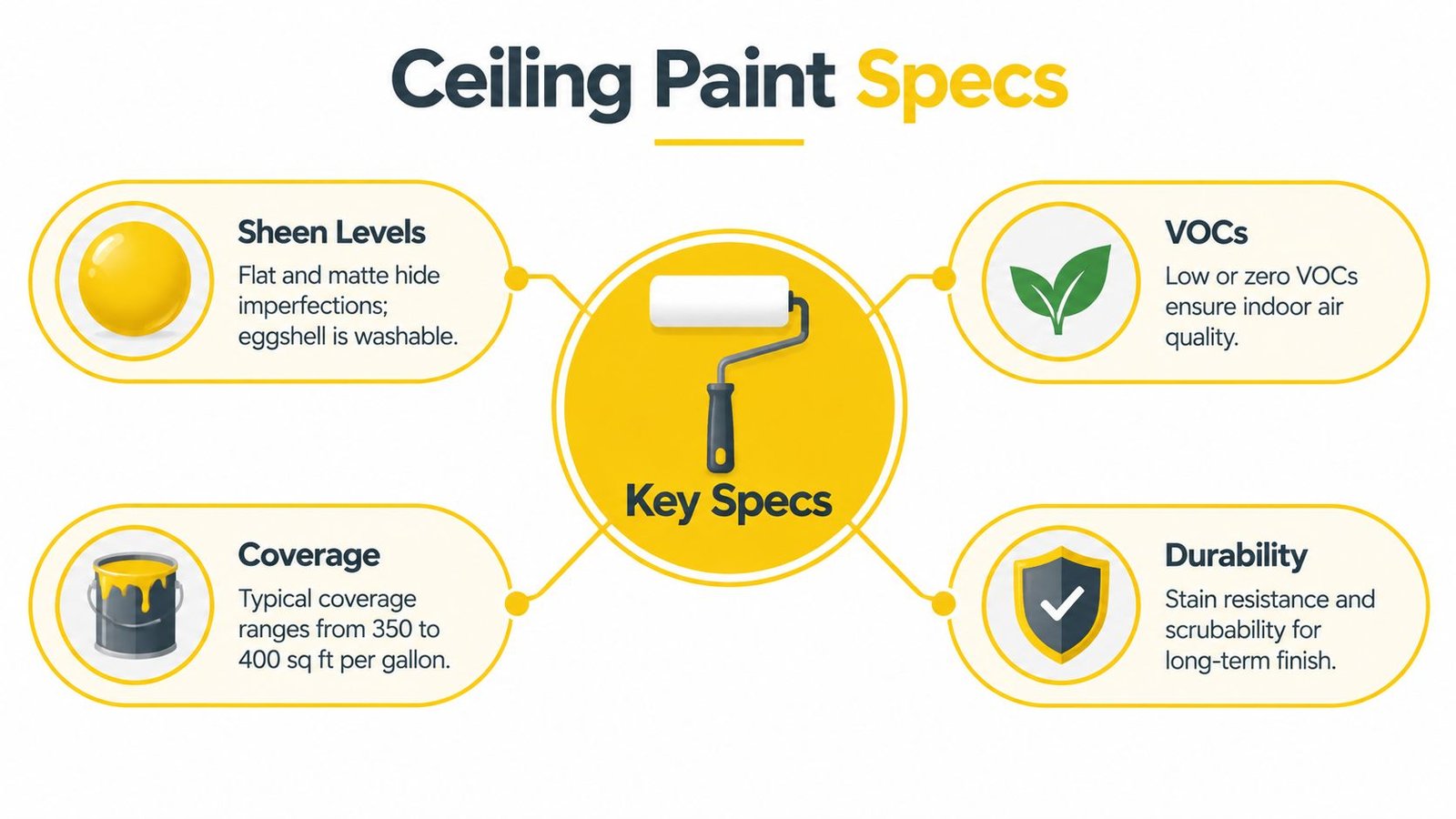
Read the label as a system. A product that spreads farther may leave a thinner film, while a heavier coating may hide more aggressively but require more material. New drywall, porous repairs, and colour changes can also alter real-world coverage.
For new drywall, preparation remains critical. Apply the right sealer or primer to prevent joint compound and paper from absorbing the finish unevenly. Soca Services' guide to the best primer for drywall explains why the first coat needs to suit the substrate.
Comparing Top Ceiling Paint Brands Available in Canada
The strongest Canadian choices differ less by marketing language than by how well they match the project. I'd shortlist Benjamin Moore Waterborne Ceiling Paint, BEHR Premium Plus Interior Ceiling Paint & Primer, Dulux Lifemaster, and suitable Sherwin-Williams ceiling formulations, then choose based on air-quality requirements, surface condition, and expected maintenance.
| Brand and Product | VOC Level | Coverage per 3.78 L | Sheen | Best For |
|---|---|---|---|---|
| Benjamin Moore Waterborne Ceiling Paint | Low VOC, product data should be checked before purchase | Product-specific | Flat or ultra-flat ceiling finish | Occupied homes and refined residential finishes |
| BEHR Premium Plus Interior Ceiling Paint & Primer | Product-specific | About 400 sq. ft. per container | Flat, non-reflective | General residential ceilings and practical repaints |
| Dulux Lifemaster | Low-emission positioning available in Canada | Product-specific | Ceiling-suitable flat finish | Homes and projects where odour is a concern |
| Sherwin-Williams ceiling formulations | Product-specific | Product-specific | Flat or matte options | Contractor-specified residential and commercial work |
Benjamin Moore Waterborne Ceiling Paint
This is my first choice when the homeowner wants a polished, uniform ceiling and the project calls for a premium product. Benjamin Moore also lists Waterborne Ceiling Paint among its low-VOC Canadian options. Verify the current label and technical data at the point of purchase, particularly when a same-day return to the room matters.
The advantage is finish control. A quality ultra-flat coating minimises light bounce and makes small surface variations less noticeable. It still won't hide major water staining or poor drywall work without proper preparation.
BEHR Premium Plus Interior Ceiling Paint and Primer
BEHR Premium Plus Interior Ceiling Paint & Primer provides a practical option for ordinary residential repainting. Home Depot Canada describes it as flat, non-reflective, and spatter-resistant, with a finish that maintains the ceiling's original acoustical properties. The listing gives coverage of about 400 sq. ft. per container in the stated package size, as shown on the Canadian BEHR Premium Plus product listing.
I'd consider it for clean, previously painted ceilings where the homeowner wants sensible application and dependable appearance without moving into a specialty commercial coating.
Dulux Lifemaster and Sherwin-Williams options
Dulux Lifemaster is relevant when low-odour priorities influence the purchase. Sherwin-Williams offers professional-grade interior products that can suit ceiling work, but the exact formulation, sheen, VOC declaration, and availability should be confirmed through the local Canadian store.
For a broader brand comparison before you choose a finish, Soca Services has a guide to interior paint brands in Canada. Don't choose solely by brand reputation. The best product is the one that fits the ceiling's condition and the occupants' needs.
Choosing the Right Ceiling Paint for Every Room
A single product won't be ideal for every ceiling in a Greater Toronto Area property. Room use, moisture exposure, existing stains, occupancy timing, and the condition of the substrate should determine the specification.

Bedrooms and living areas
For bedrooms, dining rooms, hallways, and living rooms, choose a flat or matte low-VOC ceiling paint. These spaces benefit from reduced light bounce, especially in condos where windows, pot lights, and bright wall colours can create strong reflections.
A North York bedroom may only need a straightforward repaint if the ceiling is sound and already painted. In that situation, a product such as Benjamin Moore Waterborne Ceiling Paint or BEHR Premium Plus can make sense. If the family plans to sleep in the room soon after painting, favour the product with the clearer low-emission profile and ventilate the space responsibly.
The ceiling colour usually stays white or a soft off-white, but the wall colour changes the perceived contrast. Homeowners choosing a new palette can use a practical resource to pick interior paint colours before finalising the ceiling tone.
Bathrooms and kitchens
Bathrooms need more than a moisture-resistant label. The ceiling must be clean, dry, and free from active moisture damage before painting. Address poor ventilation, recurring condensation, surface mould, or soft drywall first. For ordinary bathroom use, I still favour a flat or matte ceiling appearance unless the manufacturer specifically recommends another finish for the application.
A Vaughan kitchen may need better stain resistance than a quiet bedroom because cooking vapour can deposit grease and grime overhead. Choose a ceiling-suitable product with practical cleanability, but don't jump automatically to a glossy finish. Higher sheen can make roller texture and repairs more visible.
For detailed preparation and product planning, review Soca Services' service information on painting bathroom ceilings.
Rental turnovers
Property managers need low odour, reliable touch-up behaviour, and predictable application. A low-VOC product may be enough for a routine repaint when the ceiling is clean and sound. A zero-VOC option becomes more attractive when tenants need quick re-entry, the unit has limited ventilation, or occupants have heightened sensitivity to paint odour.
Avoid using a premium product to cover a preparation problem. Repair damaged drywall, seal stains, and choose a consistent application method. A well-prepared ceiling with a standard low-emission flat finish can be more practical than an expensive coating applied over a contaminated or uneven surface.
Commercial spaces
Offices, retail units, clinics, and King City commercial properties often prioritise uniform appearance, coverage, maintenance, and scheduling. Higher-solids dryfall-style coatings can suit certain large overhead applications because they're designed for heavier build and faster overhead work, but their spread rate differs from ordinary residential ceiling paint.
The right choice depends on access, furnishings, occupancy, and the required finish. Commercial clients should have the contractor confirm the product's technical data before work begins, especially where indoor air quality and reoccupation timing are contract requirements.
Why Professional Application Maximizes Paint Performance
Premium ceiling paint can still look poor when the surface and technique are wrong. The ceiling needs a clean substrate, repaired defects, suitable primer where required, and a consistent film thickness across the entire plane.
Start by identifying the cause of the problem. Water marks require stain treatment and possibly a moisture repair. New drywall needs sealing so joint compound and paper don't absorb paint at different rates. Loose texture or peeling layers need removal, not concealment.
Preparation controls the final appearance
Professional painters inspect the ceiling under strong, angled light before choosing the coating. They fill dents, sand repairs smoothly, remove dust, and protect fixtures, walls, flooring, and furniture. If the ceiling has popcorn texture, damaged stipple, or multiple failed coatings, the correct answer may involve removal or repair before repainting.
Roller selection also matters. A poor sleeve can shed lint, hold paint unevenly, or leave inconsistent texture. A professional uses tools appropriate to the ceiling texture and product, then keeps the working edge wet so adjoining passes blend instead of drying into visible bands.
Technique matters across large surfaces
Work in manageable sections and maintain a consistent direction. Don't return to an area that has started to tack up, because the roller can disturb the sheen and create flashing. Keep the roller loaded without allowing it to drip, and finish each pass lightly to even out the film.
Ventilation helps manage odour and supports drying, but excessive airflow can dry the surface too quickly. The painter needs to balance fresh air with stable working conditions, particularly during Toronto's humid summers or dry winter heating season.
A clean ceiling finish comes from preparation, film control, and timing. The can is only one part of the result.
Soca Services Painting handles residential and commercial ceiling preparation and application in Toronto, Vaughan, North York, and King City. Their broader benefits of hiring professional painters include the preparation discipline and equipment control that ceiling work demands.
The following video also demonstrates why overhead application depends on controlled technique and suitable tools:
Your Ceiling Paint Decision Framework
Use four questions before buying the paint. The answers will narrow the choice faster than comparing every white swatch in the store.
Start with the room
For a standard bedroom, living room, or hallway, choose a flat low-VOC ceiling paint. For a space where air quality and quick occupancy matter most, prioritise a clearly identified low-emission or zero-VOC product. For a commercial application, ask whether a dryfall-style coating suits the access and application plan.
Check the ceiling condition
A clean repaint is straightforward. New drywall needs the appropriate primer or sealer. Water stains, smoke marks, grease, or unknown discolouration need targeted preparation before the finish coat. If the substrate is soft, bubbling, or peeling, painting alone isn't an adequate repair.
Compare coverage realistically
Canadian ceiling paint coverage commonly falls around 23 to 37 m² per gallon, roughly 250 to 400 sq. ft., according to BEHR Canada's stain-blocking ceiling paint information. Treat that as a product-guide range, not a promise for every ceiling. Porous drywall repairs, heavy texture, stains, and colour changes can reduce practical coverage.
Choose value based on the project
Premium zero-VOC paint makes sense for occupied bedrooms, sensitive households, schools, and rental turnovers where odour and scheduling influence the decision. A standard low-VOC flat product is usually sufficient for a clean ceiling in an owner-occupied home, provided the surface is prepared correctly.
Property managers should compare more than the can price. A product that rolls predictably, touches up acceptably, and supports a fast turnover can be more useful than a cheaper coating that requires extra correction. Commercial owners should confirm ventilation, access, and reoccupation requirements before selecting the finish.
For complex ceilings, Soca Services can assess the surface, recommend a suitable coating, and coordinate preparation with the rest of the interior painting work. The service area includes Toronto, Vaughan, North York, and King City.
Frequently Asked Questions About Ceiling Paint
Can you use regular wall paint on a ceiling?
Yes, but I don't recommend it by default. Wall paint may have a sheen or working characteristic that makes ceiling defects more visible. Use a ceiling-specific flat product when you want low light reflection, controlled spatter, and a consistent overhead finish.
How many coats does a ceiling need?
The answer depends on the existing colour, porosity, stains, and product. A clean ceiling may reach the desired appearance with the manufacturer's recommended application, while new drywall or a stained surface may need primer and additional finish work. Don't use extra coats to cover active water damage or poor repairs.
Is paint and primer in one enough?
It can help on suitable previously painted surfaces, but it doesn't replace every primer. New drywall, water stains, smoke contamination, and unstable coatings need preparation matched to the problem. Check the technical data and inspect the substrate before relying on a combined product.
How do you touch up a ceiling?
Use the same product, sheen, colour, roller type, and application method whenever possible. Touch-ups can show a difference in texture or sheen if the original paint has aged, so test a small area first. If the patch remains visible, repaint the full continuous section rather than repeatedly adding small spots.
Soca Services Painting provides ceiling preparation, drywall repair, priming, and professional interior painting for homes, rentals, and commercial properties across Toronto, Vaughan, North York, and King City. Contact Soca Services Painting to discuss the right ceiling paint for your space and request a free estimate.