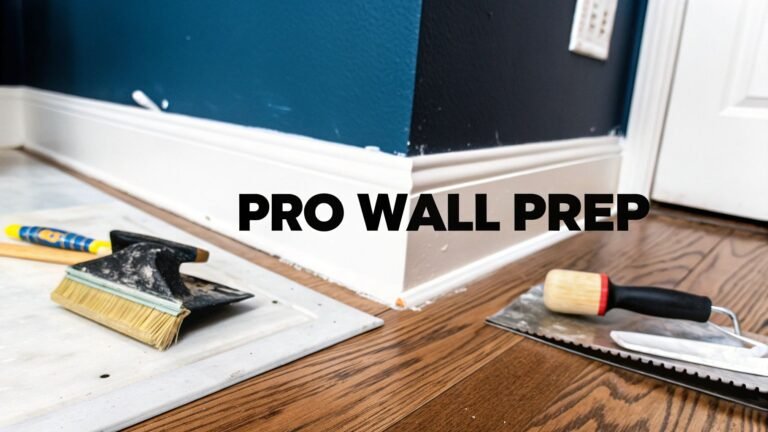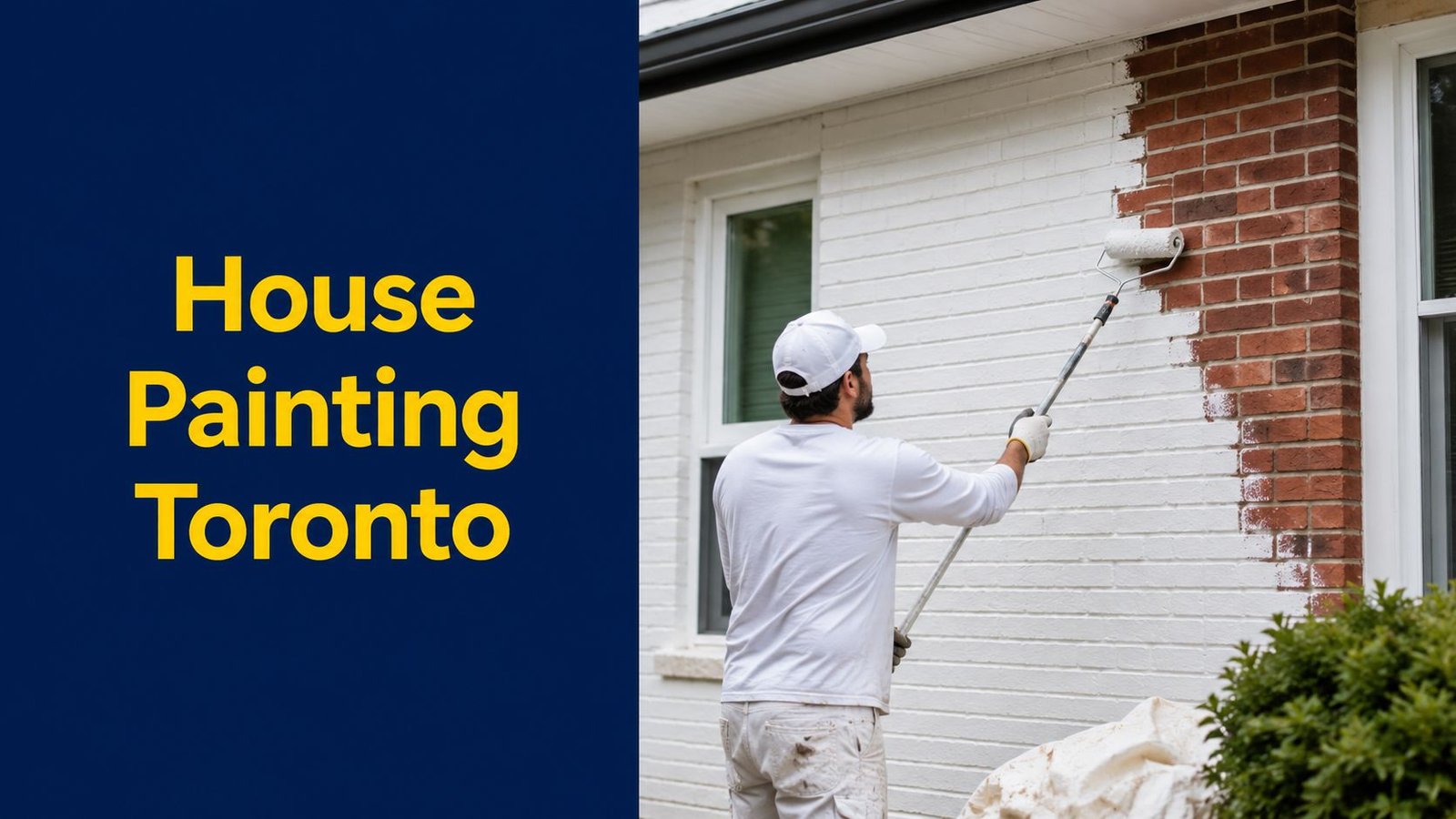
Most Toronto homeowners start with the wrong question: Which paint colour or brand should I choose? Colour matters, but it won't rescue a surface that's dirty, chalky, damp, poorly caulked, or never properly primed. In Toronto, the outcome of a paint job depends on preparation, weather timing, and contractor verification.
That matters even more in older neighbourhoods, where repainting often includes plaster repair, trim restoration, moisture staining, and access challenges. A large older housing base supports recurring maintenance demand. Close to 30% of the existing housing stock in the Greater Toronto Area was built in 1960 or earlier, according to a Toronto renovation and housing analysis. For homeowners, property managers, and renovation contractors, that means house painting Toronto projects are rarely just quick coverage jobs.
Why Toronto House Painting Decisions Are Really About Prep and Timing
A premium paint applied over a failing surface is still a failing paint job. Toronto's seasonal temperature swings, moisture, and freeze-thaw exposure punish shortcuts around scraping, sanding, caulking, priming, and adhesion testing. The colour may look excellent on completion day, but the coating can peel, blister, crack, or expose weak areas when the substrate moves or moisture gets behind the film.
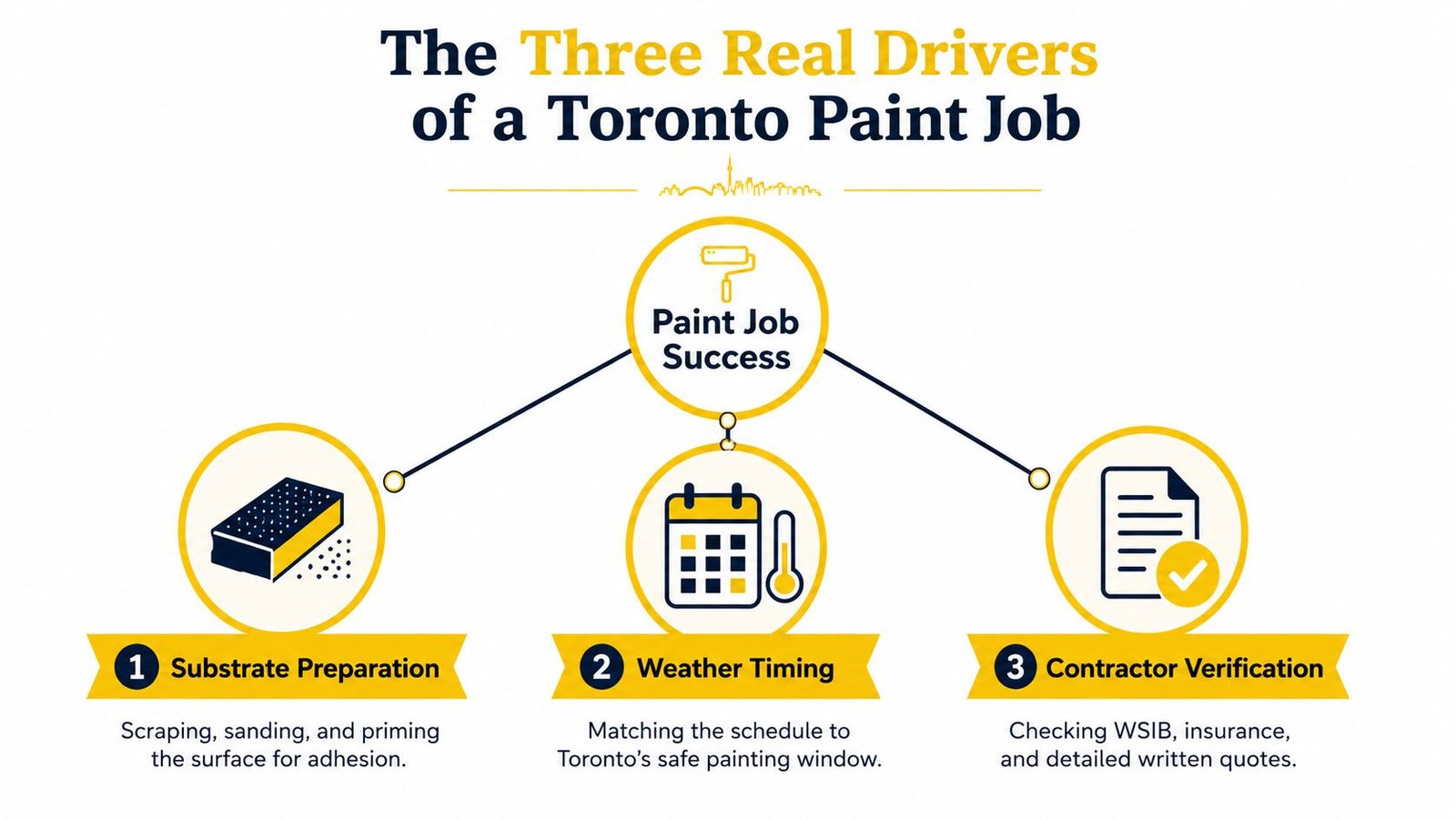
Three decisions deserve more attention than the paint chip:
- Substrate preparation: The crew must remove loose coating, clean the surface, sand glossy areas, repair damaged trim, and prime exposed or stained material.
- Weather timing: Exterior work needs a stable period for application, recoat time, and curing. Rain, dew, cold surfaces, and high humidity can disrupt all three.
- Contractor verification: A detailed quote, active coverage, insurance, product information, and warranty terms reveal whether the contractor has planned the work or priced the visible painting.
Why older Toronto homes need a different quote
Older homes commonly require more than rolling paint onto intact drywall or siding. Plaster may need stabilizing, wood trim may need filling and spot priming, and previous layers can leave ridges, chalk, or incompatible coatings. A house with high ceilings, elaborate casing, many doors, or difficult exterior access carries more labour even when its floor area resembles a simpler property.
The same principle applies to exterior siding. Sound wood, aluminum, or other paintable materials may benefit from restoration, while rot, warping, widespread water damage, or structural deterioration require repairs or replacement before painting makes sense. A responsible painter should identify that distinction before issuing a firm price.
Contractor's rule: If a quote says “prep as needed” but doesn't describe what prep includes, you haven't received a comparable quote.
Soca Services' exterior paint preparation guidance reflects the practical point homeowners often miss: preparation determines adhesion and finish quality. Ask every bidder to itemize washing, scraping, sanding, caulking, repairs, priming, and the number of finish coats. The cheapest price often comes from excluding those tasks, not from working more efficiently.
What House Painting in Toronto Really Costs in 2026
Painting quotes vary because Toronto homes vary. Surface condition is usually the largest cost driver, followed by access, trim, project size, and the coating system. Paint itself is only one part of the work. A wall with stains, patched holes, smoke residue, or failing previous paint can require cleaning, sanding, sealing, and multiple applications before the final colour looks uniform.
Neutral Ontario pricing guidance places interior repaints commonly around C$4,000 to C$12,000 or more, exterior work around C$2,500 to C$15,000 or more, and Toronto painting renovations roughly between C$2,604 and C$14,400, depending on scope and condition, as outlined in this Ontario house-painting pricing guide. The ranges below are practical 2026 budgeting benchmarks for typical Toronto semis, detached homes, and townhouses, not guaranteed quotes.
| Project Type | Low Range | Mid Range | High Range | Typical Timeline |
|---|---|---|---|---|
| Interior, one room | C$400 | C$650 | C$900 | Depends on prep and access |
| Whole-home interior | C$6,000 | C$12,000 | C$18,000 | Depends on rooms, trim, and repairs |
| Exterior house painting | C$4,500 | C$9,000 | C$15,000 | Depends on weather and access |
What pushes a quote upward
- Wall and trim condition: Heavy patching, peeling layers, stains, failed caulking, and bare wood need additional labour and primers.
- Height and access: Tall gables, three-storey elevations, tight side yards, balconies, and landscaping can require more setup and careful protection.
- Trim ratio: A home with extensive baseboards, window casings, doors, railings, shutters, and decorative details takes longer than a property with simple profiles.
- Colour changes: Strong changes, especially dark-to-light transitions, can require additional coverage and a more deliberate primer strategy.
- Exterior material: Stucco, brick, wood, aluminum, and mixed cladding each need different cleaning, masking, adhesion, and coating decisions.
A quote that looks 30% cheaper deserves a line-by-line comparison, not immediate acceptance. It may omit caulking, spot priming, sanding, ceiling work, trim preparation, protection, or a second finish coat. Compare scope, products, sheens, repairs, cleanup, and warranty terms before comparing totals.
Soca Services' Toronto and GTA house-painting cost guide is useful when you're building a project brief. Give contractors the same rooms, surfaces, photos, access details, and repair expectations. That produces more meaningful bids and reduces change orders.
Choosing the Right Paint System for Toronto Homes
A paint system is more than a topcoat. It includes the cleaner, repair materials, primer, finish paint, sheen, application method, and curing conditions. Toronto interiors and exteriors need different systems because they face different stresses.
For interiors, quality acrylic latex is the normal starting point for walls and ceilings. Use a durable enamel or urethane-modified product on doors, trim, cabinets, and high-contact areas. Alkyd products can still be useful where you need flow, hardness, or compatibility with an existing oil-based surface, but the contractor must manage odour, drying, and recoat conditions properly.
For exteriors, 100% acrylic is the sensible default for many Toronto applications. It offers flexibility and weather resistance across common painted surfaces, but the exact product still has to match the substrate. Sherwin-Williams Duration, Benjamin Moore Aura, and PPG Manor Hall each occupy a credible place in a professional specification. The right choice depends on whether the surface is stucco, wood siding, aluminum, masonry, or soffit material, not on brand loyalty alone.
Match the coating to the surface
| Surface | Recommended Primer | Recommended Topcoat | Sheen | Notes |
|---|---|---|---|---|
| Stucco | Masonry conditioner or compatible masonry primer | Exterior 100% acrylic | Low-lustre or flat | Repair cracks and address moisture before coating |
| Wood siding | Exterior wood primer on exposed areas | Flexible exterior acrylic | Satin or low-lustre | Scrape, sand, prime, and seal joints |
| Brick masonry | Breathable masonry primer where required | Masonry-compatible acrylic | Flat or low-lustre | Don't trap moisture behind an unsuitable film |
| Aluminum siding | Bonding or compatible exterior primer where needed | Exterior acrylic formulated for siding | Satin | Clean chalk and test adhesion first |
| Aluminum soffits | Bonding primer on difficult areas | Durable exterior acrylic | Satin | Protect vents and keep coatings from blocking airflow |
| Interior drywall | Drywall primer on new or porous areas | Quality acrylic latex | Eggshell or matte | Seal patches so they don't flash through |
| Interior trim and doors | Bonding or stain-blocking primer as required | Durable enamel | Satin or semi-gloss | Thin, even coats produce a smoother finish |
Primer is where the quote earns its value
Use stain-blocking primer for water marks, smoke staining, tannin bleed, and persistent discolouration. Use masonry primer or conditioner for porous mineral surfaces. Bare wood needs a primer that seals the substrate, while slick or previously oil-painted areas may require a bonding primer.
Two finish coats are the safer standard for most significant colour changes and demanding surfaces. A single-coat shortcut can leave uneven coverage, especially over repairs or contrasting colours. For a deeper technical discussion, Soca Services' exterior paint recommendations for Toronto weather provides useful context.
Colour still deserves planning. Before committing to wall colours, review this practical guide to choosing paint colours and test samples in the rooms where changing daylight, artificial light, and surrounding finishes will affect the result.
Toronto's Weather Window and How It Drives Your Schedule
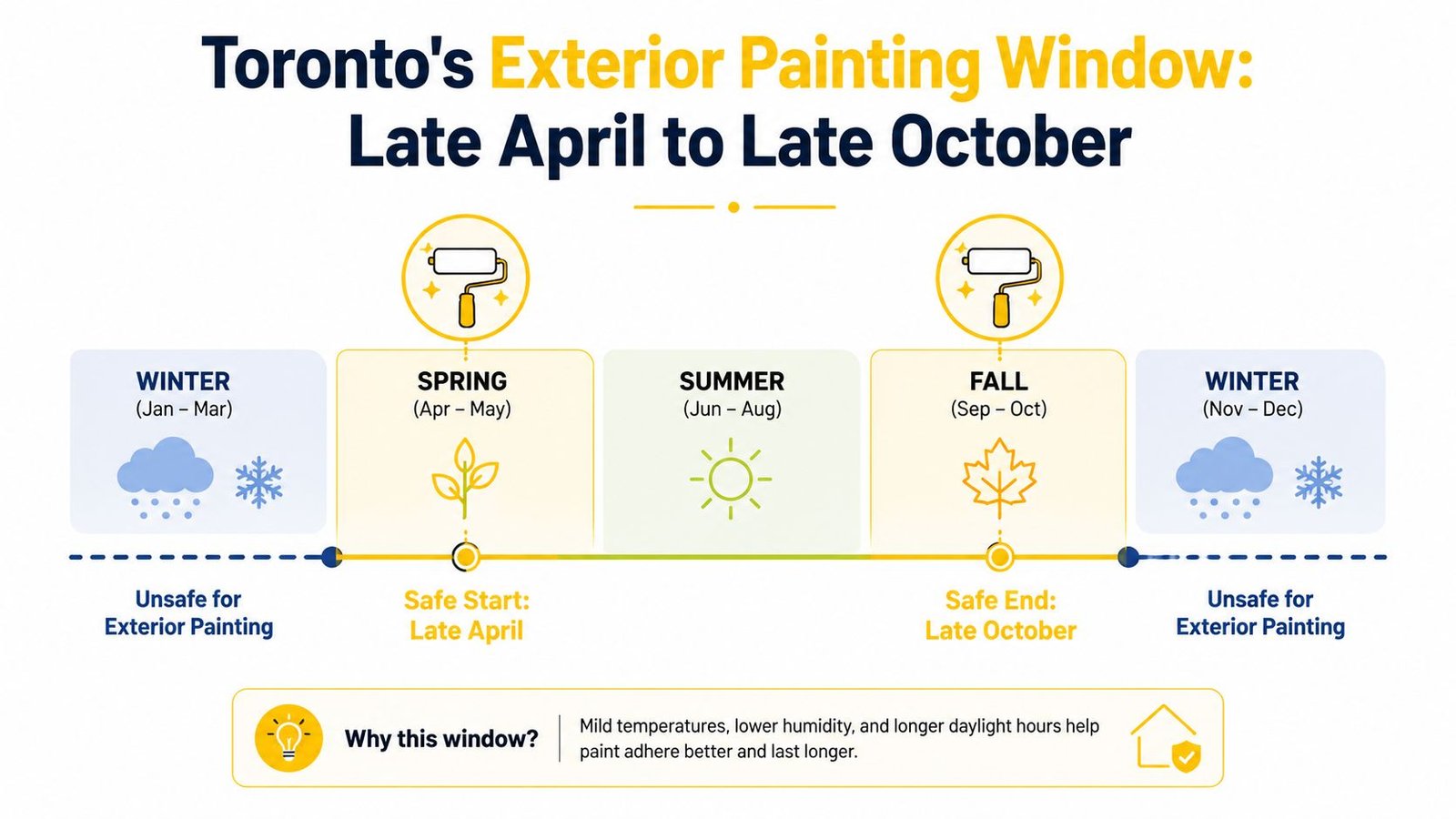
Exterior painting in Toronto is a scheduling problem before it's a colour problem. Most latex and acrylic coatings perform best within roughly 10°C to 30°C for exterior work and about 10°C to 25°C indoors, according to regional coating guidance from Randall's weather-painting advice. Humidity above about 70% slows water evaporation, extending dry times and increasing the risk of poor levelling, lap marks, or blistering.
Painters should check both air and surface temperature. The substrate should remain at least about 3°C above the dew point, and recoat planning commonly allows roughly 4 to 6 hours, while full curing can take days or weeks, depending on the product and conditions. A warm afternoon doesn't make a cold, damp wall ready for paint.
Book around the reliable season
Late spring and early fall are generally the dependable planning periods. A Toronto-specific seasonal guide identifies late May, June, and September as favourable periods, with typical temperatures around 15°C to 25°C, while July can bring humidity challenges and December isn't viable for ordinary exterior painting. See the Toronto exterior-painting timing guide for a local seasonal perspective.
| Period | Main concern | Practical recommendation |
|---|---|---|
| Early spring | Cold surfaces and unstable conditions | Book only after the substrate and overnight conditions are suitable |
| Late spring | Better temperatures, but rain can interrupt | Reserve the crew early and keep schedule flexibility |
| Summer | Direct sun, heat, humidity, and storms | Work in shade where possible and monitor humidity |
| Early fall | Good temperatures with shortening days | Protect the cure window and watch overnight dew |
| Late fall and winter | Cold, dampness, and unsuitable surfaces | Move exterior work to a suitable season |
South and west elevations can heat quickly in direct sun, causing a coating to flash-dry before it levels. Morning dew, fog near the Harbourfront, and sudden thunderstorms can force a pause even when the forecast looks acceptable at breakfast.
Scheduling advice: For a spring exterior project, start speaking with painters 6 to 10 weeks ahead. A compressed weather window leaves little room for rescheduling, especially for real-estate turnovers and custom homes.
Interior work is more flexible, but humid basements may need dehumidification. Winter door and window work may require heated enclosures so the substrate and coating stay within the product's requirements. Soca Services' GTA exterior painting scheduling guide covers the planning issues that cause avoidable delays.
Permits, VOC Rules, and Lead Paint in Older Toronto Properties
Routine repainting of interior walls, ceilings, doors, and existing trim usually doesn't involve the same approvals as structural renovation. The situation changes when a project includes removing cladding, altering exterior assemblies, touching shared condominium elements, or modifying a designated heritage property. Toronto states that most construction projects require permits and includes renovations, additions, and recladding among work that may trigger permit requirements, so confirm the scope with the City before work begins.
A single-family homeowner should ask whether the planned work changes the building envelope or only renews existing finishes. A condo owner needs written authorization before touching an exterior-facing surface or common element. Heritage properties may require City review under the Ontario Heritage Act, even when the proposed change appears cosmetic.
VOC selection is a compliance issue
Federal regulations under the Canadian Environmental Protection Act set limits across 53 architectural-coating categories. The allowable range runs from 100 g/L to 800 g/L, depending on category, with specific limits including 100 g/L for flat interior coatings, 150 g/L for non-flat interior coatings, and 250 g/L for high-gloss coatings, as set out in the federal architectural-coatings regulation.
That makes low-VOC selection more than a marketing preference. In occupied homes, rentals, offices, and commercial interiors, product choice affects odour, reoccupancy planning, and indoor air quality. Ask for the exact product line and technical data rather than accepting “eco-friendly” as a complete specification.
Older paint needs a cautious approach
Federal renovation guidance notes that interior paint was historically limited to 0.5% lead by weight under regulations passed in 1976, as explained in this Canadian lead-based paint guidance. Older Toronto, North York, Vaughan, and King City properties may contain legacy painted surfaces, so sanding or scraping can create hazardous dust.
Ontario's worker-protection benchmark for lead exposure is 0.05 mg/m3 as an 8-hour time-weighted average under Ontario Regulation 490/09 and Regulation 833, referenced in this Ontario lead guideline. Don't disturb suspect coatings casually. Ask about testing, containment, wet methods, HEPA cleanup, worker protection, and disposal procedures.
| Project Type | Permit Needed? | VOC Limit (g/L) | Lead-Paint RRP Required? |
|---|---|---|---|
| Interior repainting in a single-family home | Usually not for paint alone, confirm unusual scope | Depends on coating category | Assess older painted surfaces before disturbance |
| Exterior repainting of existing siding | Confirm if cladding is removed or altered | Depends on coating category | Assess legacy coatings before scraping or sanding |
| Condo exterior-facing work | Written condo authorization, permit depends on scope | Depends on coating category | Assess affected painted surfaces |
| Designated heritage property | City or heritage review may apply | Depends on coating category | Use controlled methods where legacy paint is disturbed |
| Commercial interior | Confirm building and project scope | Depends on coating category | Plan controls for older painted substrates |
How to Vet a Toronto Painting Contractor Before You Sign
A professional painter makes the work easy to evaluate before the first drop cloth reaches your floor. A lowball operator keeps the scope vague, relies on attractive photos, and explains missing details after the project starts.
Begin with coverage. Ask for an active WSIB clearance certificate and the contractor's WSIB account number, then confirm it directly. Request proof of at least C$2 million in general liability insurance and ask for a certificate naming you as an additional insured. Don't treat a verbal assurance as documentation.
Compare the written scope, not the sales pitch
Your quote should identify:
- Preparation: Washing, scraping, sanding, patching, caulking, repairs, and spot priming by surface.
- Products: Exact brand and product line, including primer, finish, colour, and sheen.
- Application: Number of coats, brush and roller work, spraying, back-rolling, and protection.
- Access: Ladders, scaffolding, lift equipment, furniture movement, and landscaping protection.
- Cleanup: Daily housekeeping, final cleanup, masking removal, and disposal.
- Warranty: Separate coverage for workmanship and materials, with exclusions and claim steps.
Ask who will paint your home. Some Toronto companies sell the contract and subcontract the labour, which can create inconsistent preparation standards. A direct answer about crew identity, supervision, and responsibility matters more than a polished website.

Check real work and reputation
Request three local references from the past 12 months, preferably for homes similar to yours. If possible, drive past one completed project. Photos can hide uneven cut lines, missed caulking, overspray, lap marks, and poor cleanup.
Review the Better Business Bureau profile, Google reviews, and unresolved complaints. Look for patterns, not one isolated comment. Homeowners comparing contractors can also apply the same verification mindset found in these trustworthy roofing contractor tips, especially around documentation, insurance, references, and written commitments.
Ask this directly: “Will the company named on my quote perform the work, and who is responsible if the finish fails?”
A two-year labour warranty is a reasonable benchmark for workmanship. Anything shorter deserves an explanation, particularly when the contractor claims premium preparation and materials. Soca Services' guide to finding reliable Toronto painters offers another useful checklist before you sign.
Maintenance, Warranties, and Common Mistakes to Avoid
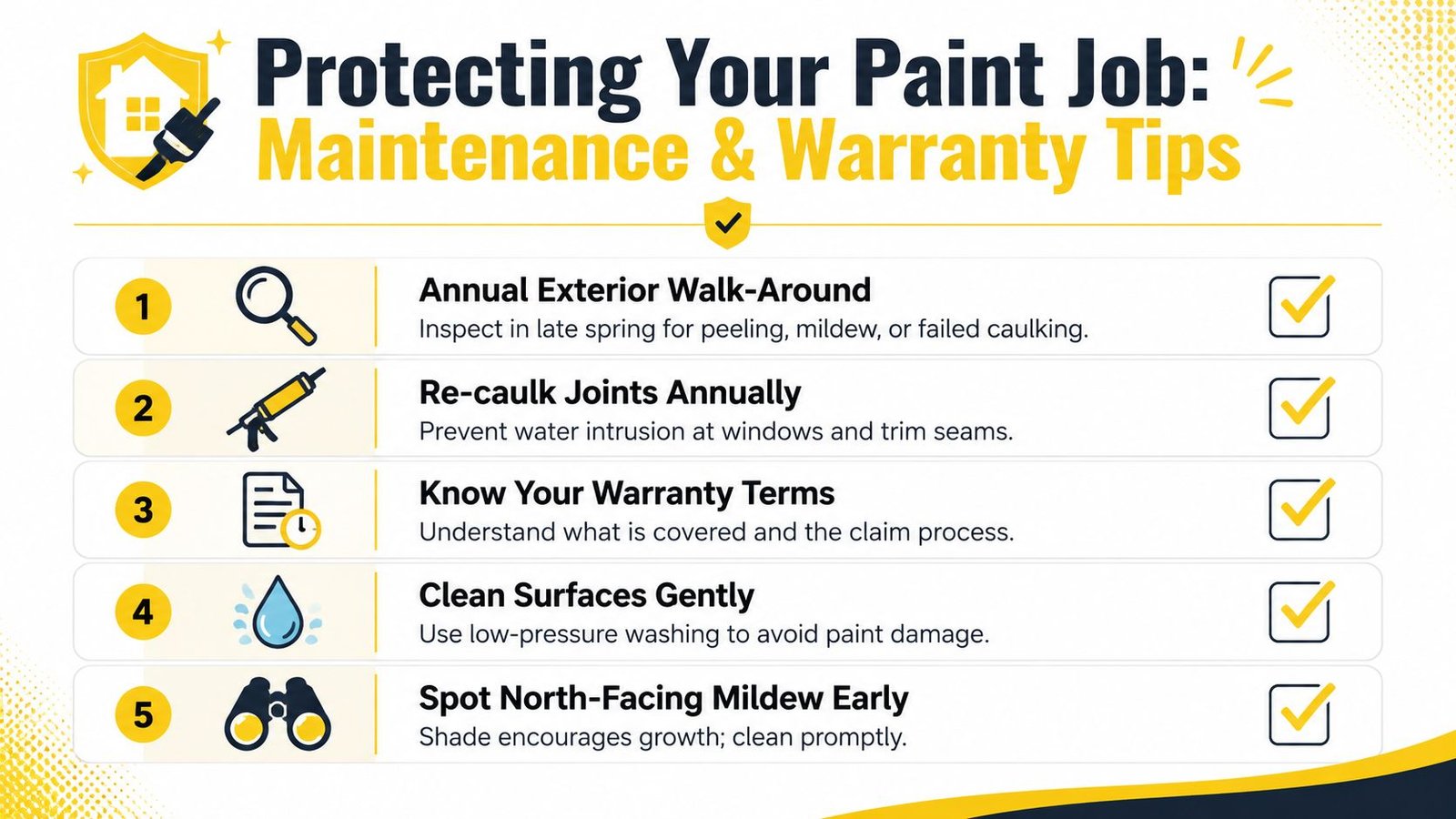
A paint job needs maintenance because Toronto weather keeps working on the building after the crew leaves. Schedule an exterior walk-around in late spring. Check failed caulking around windows and trim, mildew on north-facing walls, peeling near rooflines, exposed wood, and stains caused by gutter runoff.
Clean gently rather than attacking the finish with excessive pressure. Water, soft brushes, and appropriate cleaning solutions can remove dirt without cutting into the film. Pay particular attention to shaded elevations, soffits, window sills, and joints where moisture sits.
Put warranty language in writing
A manufacturer warranty and a contractor workmanship warranty cover different risks. The product warranty generally addresses coating or film performance under its stated conditions. The workmanship warranty should address application defects such as missed areas, premature peeling caused by inadequate preparation, or visible finish problems.
Neither warranty usually covers every cause of failure. Moisture intrusion, structural movement, neglected repairs, harsh cleaning, and substrate deterioration can fall outside the coverage. Ask for the claim process, exclusions, response expectations, and whether labour is included in any product-related repair.
Avoid the costly shortcuts
- Skipping primer on bare wood: The topcoat may absorb unevenly and fail to seal the surface.
- Painting over chalk: Loose residue prevents reliable adhesion.
- Ignoring gutter runoff: Repeated water staining can discolour brick, soffits, trim, and nearby painted surfaces.
- Choosing only by price: A low total can hide incomplete preparation, thin application, or unclear responsibility.
A practical maintenance schedule includes a gentle wash every 18 to 24 months, trim touch-ups around every five years, and a full exterior refresh around every eight to ten years, as a planning framework rather than a guarantee. Exposure, material, colour, moisture, and preparation determine the actual interval.
Request a written warranty and maintenance plan with your quote from Soca Services Painting. It's easier to protect a finished surface when the contractor records the products, preparation, exclusions, and recommended inspections from the start.
Frequently Asked Questions About House Painting in Toronto
How long should an exterior paint job last in Toronto?
A properly prepared exterior can perform for different periods depending on the material and exposure. A realistic planning range is eight to twelve years on stucco and five to eight years on wood trim. Those are not guarantees. South-facing exposure, moisture, movement, colour, drainage, and maintenance can shorten or extend performance.
Ask the painter to assess the substrate rather than promise a fixed lifespan. If the siding has rot, persistent dampness, or movement, a new coating won't correct the underlying problem.
Can I stay home during interior painting?
Often, yes, if the contractor sequences the work room by room and maintains practical ventilation. Low-odour, compliant products can make occupied work more manageable, but the household still needs to follow the product's reoccupancy guidance and keep children, pets, and vulnerable occupants away from active work areas.
Plan access before the crew arrives. Remove fragile items, identify rooms that must remain usable, and discuss doors, bedrooms, kitchens, and bathrooms in advance. VOC levels, drying time, dust from preparation, and airflow should guide the schedule.
What's the difference between a handyman and a professional painting contractor?
A professional painting contractor should provide a defined scope, WSIB information, liability insurance, product details, preparation standards, crew accountability, and written warranty terms. A handyman may be capable of small touch-ups, but a whole-home interior, exterior restoration, heritage-sensitive project, or occupied commercial space demands stronger documentation and process control.
The difference isn't the label. It's whether the contractor can show exactly who is working, what they'll do, what they'll apply, and what happens if the result fails.
How can I get an accurate quote without several site visits?
Start with a clear photo walkthrough. Provide room dimensions or floor plans, ceiling heights, surface photographs, close-ups of damage, access constraints, preferred colours, trim requirements, and whether furniture must be moved. For exteriors, include every elevation, the roofline, siding material, soffits, decks, fences, landscaping, and difficult access points.
A remote estimate can help establish a range, but a firm price should reflect the actual preparation and access conditions. Ask the contractor to identify what remains provisional and what would trigger a change order.
Request a formal written estimate from Soca Services that separates preparation, repairs, primers, finish coats, products, scheduling assumptions, and warranty coverage. That's the clearest way to compare house painting Toronto proposals without reducing the decision to a single number.
Soca Services Painting provides professional interior and exterior painting for homeowners, property managers, renovation partners, and commercial clients across Toronto, Vaughan, North York, and King City. For a written scope that addresses preparation, weather timing, products, and warranty terms, visit Soca Services Painting and request a free estimate.